

The Lean Six Sigma Pocket Toolbook
Vital tools for implementing Lean Six Sigma--what they are, how they work, and which to use The Lean Six Sigma Pocket Toolbook is today's most complete and results-based reference to the tools and concepts needed to understand, implement, and leverage Lean Six Sigma. The only guide that groups tools by purpose and use, this hands-on reference provides: Analyses of nearly 100 tools and methodologies--from DMAIC and Pull Systems to Control Charts and Pareto Charts Detailed explanations of each tool to help you know how, when, and why to use it for maximum efficacy Sections for each tool explaining how to create it, how to interpret what you find, and expert tips Lean Six Sigma is today's leading technique to maximize production efficiency and maintain control over each step in the managerial process. With The Lean Six Sigma Pocket Toolbook, you'll discover how to propel your organization to new levels of competitive success--one tool at a time.
| Date de parution | 16/08/2004 |
|---|---|
| Poids | 300g |
| EAN | 9780071441193 |
|---|---|
| Auteur | George L. Michael |
| Editeur | GARDNERS |
| Date de parution | 20040816 |
| Disponibilité | Sur commande en 6-10 jours |
Pourquoi choisir Molière ?
Du même auteur
-

Actes de la recherche en sciences sociales N° 171-172, Mars 200 : Politiques impérialistes. Genèses
Empire et domination mondiale George Steinmetz Impérialisme économique et impérialisme militaire américains Michael Mann L'impérialisme moral Yves Dezalay et Bryant Garth Genèse de l'État colonial Daniel P. S. Goth Les origines africaines de la guerre W. E. B. Du Bois Entre monopole, marché et religion Roland Lardinois Des gens inconvenants Romain Bertrand Le champ de l'État colonial George Steinmetz Les enjeux socio-économiques de la politique israélienne dans les territoires occupés Gisèle SapiroSur commande en 2-4 joursCOMMANDER19,30 € -
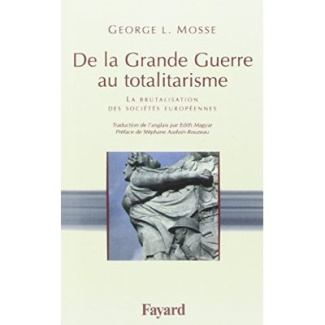
De la Grande Guerre au totalitarisme. La brutalisation des sociétés européennes
En 1914, une génération s'engagea dans la guerre pour ce qu'elle croyait être une cause juste. Quatre ans de conflit entraînèrent la mort de dix millions d'hommes et ébranlèrent, en profondeur, les sociétés et les régimes européens.Une fois la paix retrouvée, les formes de la commémoration occultèrent le souvenir de ce carnage ; en Allemagne, en Italie comme dans les pays vainqueurs, afin d'exorciser le traumatisme de la violence, on préféra exalter le martyre des soldats, en sacralisant leur combat. C'est une telle sanctification que George Mosse étudie dans ce livre, à travers ce qu'il nomme le "mythe de la guerre" : la mémoire déformée du combat, le culte quasi religieux du soldat qu'évoquèrent les monuments aux morts ou les cartes postales.L'auteur montre aussi comment, par un étrange processus destiné à apprivoiser la mort, la guerre devint un objet de commerce : jeux pour enfants, bibelots, souvenirs humoristiques ne traduisaient-ils pas ce besoin de banaliser l'horreur ...Mais exorcisée ou banalisée, l'expérience de la mort massive ne fut pas sans entamer la valeur de l'existence humaine, rendant alors concevable la violence totalitaire. Le mythe de la guerre fut exploité par les partis extrémistes ; il nourrit le nationalisme de revanche. De ce processus de "brutalisation", le nazisme est directement issu.George J. Mosse, récemment décédé, il était professeur à l'université de Madison et à celle de Jérusalem. Son oeuvre, essentiellement consacré à la Première Guerre Mondiale et aux fascismes, est encore méconnue en France.Sur commande en 2-4 joursCOMMANDER30,29 € -
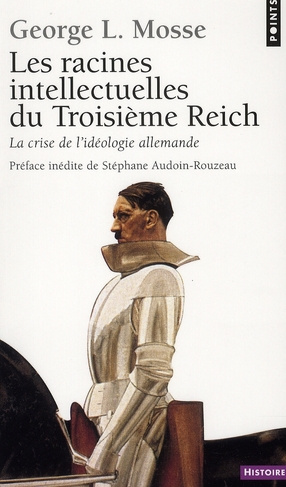
Les racines intellectuelles du Troisième Reich. La crise de l'idéologie allemande
Hitler, le nazisme et le Troisième Reich n'ont pas fait preuve d'une très grande originalité intellectuelle. En étudiant les fondements idéologiques de l'hitlérisme, George L. Mosse montre combien le romantisme allemand du XIXe siècle, dans son culte du Volk, de la terre et du sang, avait déjà constitué le terreau d'une pensée raciale et ethniciste (völkisch) qui servit plus tard d'armature intellectuelle au régime national-socialiste.La pensée völkisch avait ainsi pénétré les mouvements de jeunesse allemands et le milieu universitaire bien avant 1914, et s'était ensuite propagée parmi les anciens combattants et une part importante de la population allemande. C'est cette nébuleuse idéologique et ces frustrations que le mouvement nazi parviendra à canaliser en termes politiques, pour transformer la révolution antibourgeoise en révolution antijuive.Une étude capitale de l'enracinement intellectuel du Troisième Reich clans l'histoire de l'Allemagne comme dans celle du Vieux Continent. Biographie: George L. Mosse (1918-1999). Juif allemand, il s'exila aux États-Unis avec sa famille en 1933. Professeur émérite d'histoire à l'université du Wisconsin, il fut l'auteur d'ouvrages majeurs sur le nazisme, encore peu traduits en France.EpuiséVOIR PRODUIT13,95 € -
Les racines intellectuelles du Troisième Reich. La crise de l'idéologie allemande
Hitler, le nazisme et le Troisième Reich ne firent pas preuve d'une grande originalité intellectuelle. C'est en étudiant les fondements idéologiques de l'hitlérisme que l'historien américain George L. Mosse a mis en lumière combien le romantisme allemand, dans son culte du Volk, de la terre et du sang, avait constitué le terreau d'une pensée raciale et ethniciste (völkisch) qui fit plus tard l'armature intellectuelle du régime national-socialiste. La foi germanique en un peuple aryen et vierge de tout héritage biblique, l'exaltation des anciens Germains, le culte de la race enfin, avaient dès la seconde moitié du XIXee siècle ouvert la voie à une idéologie d'exclusion. Bien avant 1914, la pensée völkisch avait pénétré les mouvements de jeunesse allemands comme l'essentiel du milieu universitaire. Avec le traumatisme consécutif à la défaite de 1918, elle trouve un relais parmi une fraction importante des anciens combattants comme dans une large partie de la société allemande travaillée par le ressentiment et un antijudaisme fonctionnant ici comme un code culturel et social. Le mouvement hitlérien saura canaliser cette nébuleuse idéologique et traduire ces frustrations en termes politiques. En transformant in fine l'aspiration à une révolution antibourgeoise en révolution antijuive. Enfin traduit en français, ce livre, capital, met en lumière la profondeur de l'enracinement intellectuel du Troisième Reich dans l'histoire de l'Allemagne comme dans celle, plus largement, du Vieux Continent.EpuiséVOIR PRODUIT26,10 €


Du même éditeur
-

The Man in the High Castle
Revue de presse The most brilliant sci-fi mind on any planet (Rolling Stone)California's own William Blake. Visionary and prophet (Daily Telegraph)Sur commande en 6-10 joursCOMMANDER11,30 € -

The water knife
From the international bestselling author of the Hugo and Nebula award-winning The Windup Girl, comes an electrifying thriller set in a world on the edge of collapse.WATER IS POWERThe American Southwest has been decimated by drought, Nevada and Arizona skirmish over dwindling shares of the Colorado River, while California watches.When rumors of a game-changing water source surface in Phoenix, Las Vegas water knife Angel Velasquez is sent to investigate.With a wallet full of identities and a tricked-out Tesla, Angel arrows south, hunting for answers that seem to evaporate as the heat index soars and the landscape becomes more and more oppressive. There, Angel encounters Lucy Monroe, a hardened journalist who knows far more about Phoenix's water secrets than she admits, and Maria Villarosa, a young Texas migrant who dreams of escaping north to those places where water still falls from the sky.As bodies begin to pile up and bullets start flying, the three find themselves pawns in a game far bigger, more corrupt, and dirtier than any of them could have imagined. With Phoenix teetering on the verge of collapse and time running out, their only hope for survival rests in one another's hands.But when water is more valuable than gold, alliances shift like sand, and the only truth in the desert is that someone will have to bleed if anyone hopes to drink.Sur commande en 6-10 joursCOMMANDER11,25 € -

-

In Pale battalions
Extrait Chapter OneChildhood memories fit their own intricate pattern. They cannot be made to conform to the version of our past we try to impose upon them. Thus I could say that Lord and Lady Powerstock and the home they gave me at Meongate more than compensated for being an orphan, that a silver spoon easily took the place of my mother's smile. I could say it--but every recollection of my early years would deny it.Meongate must once have been the crowded, bustling house of a cheerful family, as the Hallowses must once have been that family. Every favour of nature in its setting where the Hampshire downs met the pastures of the Meon valley, every effort of man in its spacious rooms and landscaped park, had been bestowed on the home of one small child.Yet it was not enough. When I was growing up at Meongate in the early 1920s, most of its grandeur had long since departed. Many of the rooms were shut up and disused, much of the park turned over to farmland. And all the laughing, happy people I imagined filling its empty rooms and treading its neglected lawns had vanished into a past beyond my reach.I grew up with the knowledge that my parents were both dead, my father killed on the Somme, my mother carried off by pneumonia a few days after my birth. It was not kept from me. Indeed, I was constantly reminded of it, constantly confronted with the implication that I must in some way bear the blame for the shadow of grief, or of something worse, that hung over their memory. That shadow, cast by the unknown, lay at the heart of the cold, dark certainty that also grew within me: I was not wanted at Meongate, not welcomed there, not loved.It might have been different had my grandfather not been the grave, withdrawn, perpetually melancholic man that he was. I, who never knew him when he was young, cannot imagine him as anything other than the wheelchair-bound occupant of his ground-floor rooms, deprived by his own morbidity, as much as by the lingering effects of a stroke, of all warmth and fondness. When Nanny Hiles took me, as she regularly did, to kiss him goodnight, all I wanted to do was escape from the cold, fleeting touch of his flesh. When, playing on the lawn, I would look up and see him watching me from his window, all I wanted to do was run away from the mournful, questing sadness in his eyes. Later, I came to sense that he was waiting, waiting for me to be old enough to understand him, waiting in the hope that he would live to see that day.Lady Powerstock, twenty years his junior, was not my real grandmother. She was buried in the village churchyard, another ghost whom I did not know and who could do nothing to help me. I imagined her as everything her successor was not--kind, loving and generous--but it did me no good. Olivia, the woman I was required to address as Grandmama in her place, had once been beautiful and, at fifty, her looks were still with her, her figure still fine, her dress sense impeccable. That we were not related by blood explained, to my satisfaction, why she did not love me. What I could not explain was why she went so far as to hate me, but hate me she undoubtedly did. She did not trouble to disguise the fact. She let it hover, menacing and unspoken, at the edge of all our exchanges, let it grow as an awareness between us, a secret confirmation that she too was only waiting, waiting for death to remove her husband and with him any lingering restraint on her conduct towards me. There was an air of practised vice about her that was to draw men all her life, an air of voluptuous pleasure at her own depravity that made her hatred of me seem merely instinctive. Yet there was always more to it than that. She had drawn some venom from whatever part she had played in the past of that house and had reserved it for me.My only friend in those days, my only guide through Meongate's hidden perils, was Fergus, the taciturn and undemonstrative major-domo, "shifty" as Olivia described him and certainly not as deferential as he should have been, but none the less my sole confidant. Sally, the sullen maid, and humourless Nanny Hiles both went in awe of Olivia, but Fergus treated her with an assurance, bordering on disrespect, that made him my immediate ally. A cautious, solitary, pessimistic man who had expected little from life and consequently been spared many disappointments, perhaps he took pity on a lonely child whose plight he understood better than she did herself. He would take me on covert expeditions through the grounds, or down to the wooded reach of the Meon where he fished of a quiet afternoon, or into Droxford in the trap, when he would buy me a twist of sherbet and leave me sitting on the wall outside Wilsmer's saddlery whilst he went in to haggle over a new bridle for the pony. For such brief moments as those, kicking my heels on Mr. Wilsmer's wall and eating my sherbet in the sunshine, I was happy. But such moments did not last.It was Fergus who first showed me my father's name, recorded with the other war dead of the village, on a plaque at the church. Their Name Liveth for Evermore, the inscription said, and his name--Captain the Honourable John Hallows--is all that did live for me. I would stare at it for what seemed like hours trying to conjure up the real living and breathing father that he had never been to me, seeing only those stiff, expressionless, uniformed figures preserved by photographs in back copies of the Illustrated London News, glimpsing no part of his true self beyond the neatly carved letters of his name.As for my mother, of her there was no record at all, no grave, no memorial of any kind. Fergus, when I questioned him, prevaricated. My mother's grave, if she had one, was far away--and he did not know where. There were, I was to understand, limits to what even he could tell me. Whether he suggested it or not I cannot remember, but, for some reason, I decided to ask Olivia. I cannot recall how old I was when it happened, but I had followed her into the library, where she often went to look at a painting that hung there."Where is my mother's grave?" I said bluntly, partly intending the question to be a challenge. All hatred is, in time, reciprocated and I had come to hate Olivia as much as she hated me; I did not then appreciate how dangerous an enemy she could be.She did not answer in words. She turned aside from that great, high, dark painting and hit me so hard across the face that I nearly fell over. I stood there, clutching the reddening bruise, too shocked by the pain of it to cry, and she stooped over me, her eyes blazing. "If you ever ask that question again," she said, "if you ever mention your mother again, I'll make you suffer."The mystery of my mother thenceforth became the grand and secret obsession of my childhood. My father's death, after all, had a comforting simplicity about it. Every November there was an Armistice Parade in the village to commemorate the sacrifice of Captain the Honourable John Hallows and the many others like him. Though not permitted to join the Brownie troop that took part in the parade, I was allowed to go and watch and could imagine myself marching with all the little girls who, like me, had lost their father. But, at the end of the parade, they went home to their mothers; I could not even remember mine.Sometimes, though, I thought I could remember her. It was impossible, of course, if what I had been told of her was true, but Olivia had succeeded in making me doubt everything I had not personally experienced, and there was one dim, early memory, seemingly at the very dawn of my recollection, to sustain what I so wanted to believe.I was standing on the platform at Droxford railway station. It was a hot summer's day: I could feel the heat of the gravel seeping up through my shoes. A train was standing at the platform, great billows of smoke rising as the engine gathered steam. The man standing beside me, who had been holding my hand, stooped and lifted me up, cradling me in his arms to watch the train pull out. He was stout and white-haired. I remember the rumble of his voice and the brim of his straw hat touching my head as he raised his free hand to wave. And I was waving too, at a woman aboard the train who had wound down the window and was leaning out, waving also and smiling and crying as she did so. She was dressed in blue and held a white handkerchief in her right hand. And the train carried her away. And then I cried too and the stout old man hugged me, the brass buttons on his coat cold against my face.I recounted the memory to Fergus one day, when we were returning from a mushrooming expedition. When I had finished, I asked him who he thought the old man was."Sounds like old Mr. Gladwin," he replied. "The first Lady Powerstock's father. He lived here . . . till she sent him away." By she Fergus always meant Olivia."Why did she do that?""She'd have had her reasons, I don't doubt.""When did he go?""The summer of 1920, when you were three. Back to Yorkshire, so they say. A proper caution, was Mr. Gladwin.""Who was the pretty lady, Fergus?""That I don't know.""Was she . . . my mother?"He pulled up and looked down at me with a frown. "That she was not," he said with deliberate slowness. "Your mother passed away a few days after she had you. You know that. No amount of wanting is going to make you remember her.""Then . . . who was the pretty lady?"His frown became less kindly. "I told you: I don't know. That Mr. Gladwin, he was a close one. Now, look to that napkin or you'll pitch your breakfast into the lane--and mine with it."If the pretty lady wasn't my mother, who was she? What was old Mr. Gladwin, my great-grandfather, to her? There were no answers within my reach, just the secret hope I went on harbouring that maybe my mother wasn't really dead at all, just ....Sur commande en 6-10 joursCOMMANDER12,50 €




De la même catégorie
-
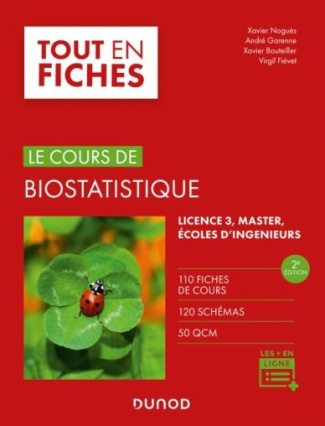
Le cours de biostatistique Licence 3/Master/Ecole d'ingénieurs. 110 fiches de cours, 120 schémas, 50
Cet ouvrage fait la synthèse en 110 fiches des principaux concepts, outils et méthodes de biostatistique enseignés de la Licence au Master. A travers des problèmes concrets, chaque fiche guide l'étudiant vers la compréhension d'un concept par une approche intuitive ou vers une solution dont elle détaille les étapes jusqu'à la rédaction du résultat final. La présentation est adaptée aux besoins des étudiants préparant un examen ou un concours : fiches synthétiques associant un concept fondamental à des exemples, exercices et QCM avec corrections argumentées. Les tableaux de données des exemples et des exercices sont téléchargeables sur le site dunod. com.EpuiséVOIR PRODUIT39,20 € -
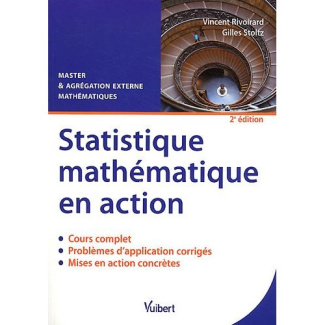
Statistique mathématique en action Master & Agrégation externe mathématiques. Cours, problèmes d'app
Rédigé principalement à l'attention de tous les étudiants en Master de mathématiques et des candidats préparant l'Agrégation externe, ce cours complet de statistique est illustré par de nombreux problèmes d'application corrigés et des annexes techniques disponibles en ligne. D'une lecture aisée, ce manuel propose une approche originale de la matière qui repose sur la mise en action de la démarche statistique à travers des thèmes concrets.Sur commande en 4-6 joursCOMMANDER42,90 € -
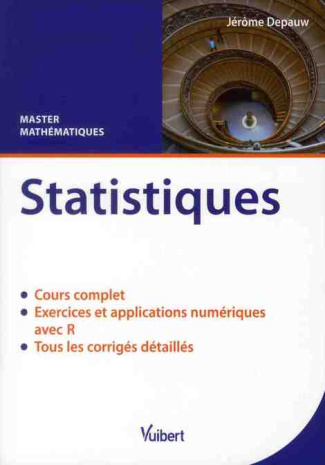
Statistiques. Cours & exercices corrigés. Master mathématiques
L'ouvrage permet aux étudiants en Master de mathématiques de maîtriser l'essentiel du programme de statistiques. Composé d'un cours précis et de nombreux exercices, intégralement corrigés, il met l'accent sur les méthodes statistiques incontournables dont il donne à étudier les principales variantes. En fin de volume, une annexe explique comment utiliser le logiciel libre de statistiques R pour appliquer ces méthodes à des données concrètes.Sur commande en 4-6 joursCOMMANDER21,90 € -
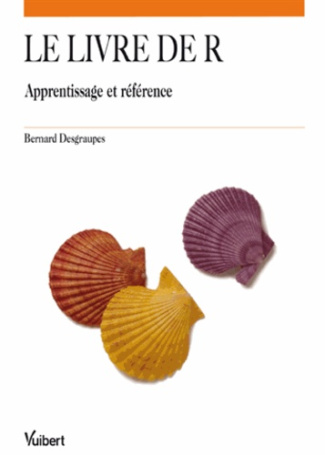
Le livre de R. Apprentissage et référence
R est un logiciel libre consacré aux statistiques. Il s'agit d'une part d'un outil interactif proposant un environnement de travail pour la manipulation de données statistiques et, d'autre part, d'un langage de programmation permettant de définir et d'automatiser de nouvelles opérations. Ses principales fonctionnalités recouvrent : l'exploration et la manipulation de données statistiques ; l'exécution de tests statistiques ; la recherche de modèles ; l'échantillonnage et la simulation ; la création de graphiques ; l'exécution de calculs numériques et probabilistes ; l'analyse de séries temporelles. R fonctionne comme un langage de programmation qui permet de créer et d'automatiser des séries de tâches statistiques, de recueillir et d'analyser des données, de les traiter, de définir de nouvelles opérations, de produire des comptes rendus, de créer de nouveaux types de graphiques, etc. R est un outil extensible et un nombre considérable de packages complémentaires et spécialisés sont produits régulièrement par la communauté scientifique. Cet ouvrage s'adresse aussi bien aux étudiants qu'aux professionnels dans tous les domaines utilisant les statistiques : médecine, biologie, chimie, physique, économie, économétrie, finances, calcul scientifique, linguistique. Le développement de R au cours des dernières années a été fulgurant. Etant un logiciel à la fois libre et gratuit, il s'est répandu dans le monde professionnel et à l'université dans les domaines les plus divers et remplace progressivement les logiciels propriétaires. L'ouvrage présente les deux aspects de l'utilisation de R : d'une part, un guide pour la prise en main et la maîtrise des multiples fonctionnalités et, d'autre part, un manuel pour l'apprentissage du langage de programmation.EpuiséVOIR PRODUIT39,90 €


