

TWO FRENCH TRAGEDIES OF SAINT GENEST: - PIECES DE DEVOTION (HAGIOGRAPHIC PLAYS) THE FAMOUS ACTOR OR
As the Introduction demonstrates, these two dramatisatioins of the legend of Saint Genest (Lat. Genesius) are richly complementary as dramatic texts, precisely by virtue of their contrasting approaches. They are also revealing with regard to a significant, but often neglected, strain of mid-seventeenth century French tragedy. That the plays were virtually contemporary—both created in or around the same year (1644)—bears witness to the attraction of their common subject. The legend of the actor-saint and martyr, which Lope de Vega had previously dramatised in Lo fingido verdadera (pub. 1620), was taking on increased importance in the context of a defence on the Parisian dramatic scene of théâtre dévot and theatre generally. The relation between the two French plays, which were produced by rival troupes (at the Hôtel de Bourgogne and L'Illustre Théâtre), raises provocative—and productive—questions, beginning with their uncertain chronological order. That Rotrou was responding to the work of Desfontaines may (or may not) be reflected in the claim in his title to be presenting the “veritable” (“véritable”) Saint Genest. In any case, his play more thoroughly exploits the metadramatic potential inherent in the legend, according to which Genest was converted by divine intervention during a performance. The episode is developed by Rotrou so as to comment profoundly, from a Christian point of view, on the relation between true and false identities. The venerable notion of theatrum mundi is deployed with subtle yet forceful irony. Yet while Desfontaines's treatment is more straightforward, it is by no means without powerful dramatic moments, linked especially with the romantic relation between Genest and the actress Pamphilie. For their terrestrial love evolves, by a further act of conversion, into a shared spiritual commitment and double martyrdom that shake the confidence, even the pagan faith, of their Roman persecutor.
| Date de parution | 08/12/2023 |
|---|---|
| Poids | 501g |
| Largeur | 145mm |
| EAN | 9782869069237 |
|---|---|
| Titre | TWO FRENCH TRAGEDIES OF SAINT GENEST: - PIECES DE DEVOTION (HAGIOGRAPHIC PLAYS) THE FAMOUS ACTOR OR |
| Auteur | HILLMAN RICHARD |
| Editeur | RABELAIS |
| Largeur | 145 |
| Poids | 501 |
| Date de parution | 20231208 |
| Nombre de pages | 0,00 € |
| Disponibilité | Impression à la demande |
Pourquoi choisir Molière ?
Du même auteur
-

SIDNEY'S ARCADIA ON THE FRENCH STAGE - TWO RENAISSANCE ADAPTATIONS : PHALANTE, BY JEAN GALAUT. THE S
Sur commande en 2-4 joursCOMMANDER20,00 € -
MANKIND - JUSTIFIED BY FAITH: TRAGICOMEDY, HENRI DE BARRAN (1554)
Sur commande en 2-4 joursCOMMANDER20,00 € -
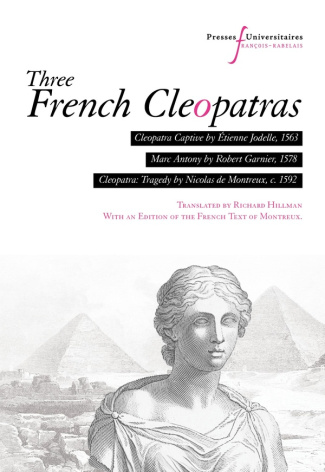
THREE FRENCH CLEOPATRAS - CLEOPATRA CAPTIVE (ETIENNE JODELLE, 1553), MARC ANTONY (ROBERT GARNIER, 15
The three dramatisations of the sensational story of Antony and Cleopatra translated here (two for the first time) amount to a significant sub-genre within the current of sixteenth-century French tragedy generally termed “humanist”. Étienne Jodelle's Cleopatra Captive (Cleopatre captive) was first performed before Henri II in 1553 and widely recognised as the first neo-classical tragedy in French. It also served as a reference point for the subsequent treatments of Robert Garnier (1578) and Nicolas de Montreux (c. 1592), which likewise extract from the classical narratives (principally Plutarch) a triangular dynamic of love and power among the three protagonists (Antony, Cleopatra, Octavius Caesar). That dynamic proves susceptible to varying emphases and ambiguous interpretations in a way that documents the developing potential of humanist tragedy itself. The volume presents these features more clearly thanks to two innovative features. The first is the translation of the work of Garnier, which, apart from the greater accessibility of its modern English, is more respectful of the original, both in form and key details, than the Elizabethan version produced by Mary Sidney Herbert, Countess of Pembroke (Antonius, 1592). Secondly, the volume includes not only the first English translation of the little-known but remarkable tragedy of Montreux, but also, to facilitate access and comparison, the first edition of the French text since its own era, when it was widely diffused.Impression à la demandeCOMMANDER32,00 € -
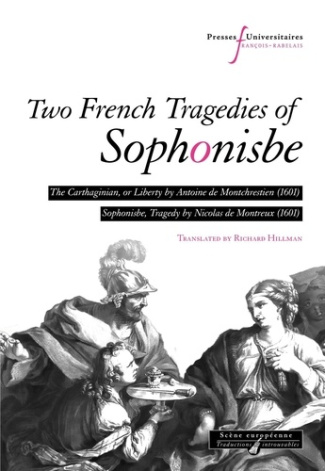
Two French Tragedies of Sophonisbe. The Carthaginian, or Liberty, by Antoine de Montchrestien (1601)
The fascinating story of the Numidian queen Sophonisbe (235-203 BCE) naturally commanded the attention of Roman historians, most notably Livy and Appian, given the strategic importance of her role towards the end of the second Punic war (218-202 BCE). That role, conferred by her position as daughter of the Carthaginian general Hasdrubal, was played out through successive marriages to two rival kings of Numidian factions, Syphax and Massinissa, who were both implicated in shifting intrigues and alliances with the invading Roman forces under the famed general Scipio (later surnamed Africanus). The historians could hardly neglect, moreover, the intensely fraught human dimension of her relations with her husbands, especially Massinissa, who finally fulfilled her wish to facilitate her death rather than face humiliating captivity under Roman rule. The potential for her portrayal as a tragic heroine, whose life and death had much in common with Cleopatra, was further enhanced by the literary elaboration of the subject by Petrarch in his Latin epic Africa (c. 1337-43, pub. 1501). That potential was realised in theatrical form throughout the early modern period, beginning in Italy with the Sofonisba of Giangiorgio Trissino (1515 ; pub. 1524), which was translated and performed in France under the auspices of Catherine de' Medici in 1556. It was, however, the two turn-of-the century versions composed by Antoine de Montchrestien and Nicolas de Montreux that founded a distinctively French tradition of tragedies on the subject, to be continued by Jean Mairet (1634), Pierre Corneille (1663) and Voltaire (pub. 1770). The key works of Montchrestien and Montreux presented here are notable for adding complexity of characterisation and depth of feeling to the story, and for structuring it dramatically in contrasting ways. Montchrestien emphasises the destructive power of love - to the point of introducing a Fury to emblematise its influence. Montreux's stress is rather on conflicting responses to political circumstances, with Sophonisbe emerging - much on the model of Cleopatra in his own tragedy on that subject - as a heroine whose courageous defiance of forms of masculine power puts to shame not only her royal husbands but the victorious Scipio.Sur commande en 2-4 joursCOMMANDER24,99 €



Du même éditeur
-
Etudier les migrations internationales
Les migrations internationales sont une clef de compréhension essentielle du fonctionnement du monde actuel. Elles constituent un enjeu fondamental dans chacune des sociétés qu'elles concernent, qu'il s'agisse des régions d'origine, des pays d'installation ou des zones de transit. Le "paradigme migratoire" offre un puissant outil d'analyse des transformations sociales et spatiales à l'oeuvre dans le monde. Aurait-on pu par exemple imaginer, il y a trente ou quarante ans, que la question migratoire marquerait à ce point les élections nord-américaines, britanniques, allemandes, hongroises, autrichiennes, néerlandaises, italiennes... et bien entendu françaises ? Les auteurs - géographes, sociologues, historiens, anthropologues, juristes, démographes - font le point sur la façon dont ont été conçues, élaborées et traitées les problématiques relatives aux migrations depuis une trentaine d'années. Chaque chapitre montre comment un domaine de recherche a émergé, tiraillé entre demande publique (possédant us propres objectifs généralement de court terme) et autonomie de la recherche attachée à la construction des savoirs. Il en résulte un ouvrage qu'on peut utiliser comme un manuel, utile à tous ceux qui veulent comprendre la complexité des migrations internationales.Sur commande en 2-4 joursCOMMANDER26,00 € -
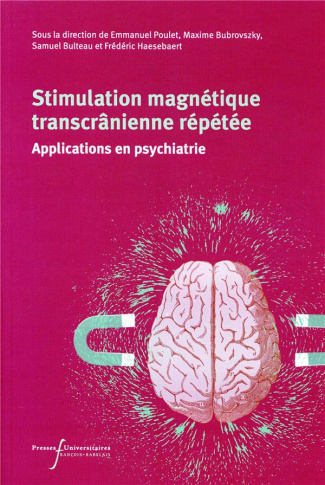
Stimulation magnétique transcrânienne répétée. Applications en psychiatrie
Depuis l'invention, en 1985 par Antony Barker, du premier appareil permettant de stimuler de manière non invasive le cortex cérébral au moyen d'un champ magnétique focalisé, la rTMS connaît un essor considérable comme outil thérapeutique en psychiatrie. C'est aujourd'hui une option de traitement à l' efficacité clairement établie, qui doit encore prendre sa place dans les propositions thérapeutiques en santé mentale.Cet ouvrage didactique dresse l'état de l'art de l'usage et des applications de la rTMS, en particulier dans le domaine de la psychiatrie, des aspects historiques, pratiques et techniques jusqu'aux questions de modulation du fonctionnement cortical dans le cadre des applications en recherche. Il détaille également l'ensemble des données disponibles dans les principales applications thérapeutiques, de la dépression (dorénavant reconnue comme une indication au niveau international) à d'autres applications thérapeutiques pour lesquelles la rTMS représente une voie de traitement prometteuse.4e de couverture : Depuis l'invention, en 1985 par Antony Barker, du premier appareil permettant de stimuler de manière non invasive le cortex cérébral au moyen d'un champ magnétique focalisé, la rTMS connaît un essor considérable comme outil thérapeutique en psychiatrie. C'est aujourd'hui une option de traitement à l' efficacité clairement établie, qui doit encore prendre sa place dans les propositions thérapeutiques en santé mentale.Cet ouvrage didactique dresse l'état de l'art de l'usage et des applications de la rTMS, en particulier dans le domaine de la psychiatrie, des aspects historiques, pratiques et techniques jusqu'aux questions de modulation du fonctionnement cortical dans le cadre des applications en recherche. Il détaille également l'ensemble des données disponibles dans les principales applications thérapeutiques, de la dépression (dorénavant reconnue comme une indication au niveau international) à d'autres applications thérapeutiques pour lesquelles la rTMS représente une voie de traitement prometteuse.Sur commande en 2-4 joursCOMMANDER28,01 € -

Traduire, collaborer, résister. Traducteurs et traductrices sous l'Occupation
A travers une galerie de portraits de traducteurs et traductrices ayant exercé entre 1940 et 1944, cet ouvrage offre un éclairage nouveau sur la vie littéraire durant la seconde guerre mondiale. Traduire, comme écrire, sous la botte de l'occupant nazi, c'est résister ou collaborer. Ce livre explore les trajectoires individuelles et le travail de ces médiateurs, "acteurs invisibles de la littérature". Quelle est leur place ? Dans quel contexte évoluent-t-ils ? Quel est leur rôle ? Hélène Bokanowski, Maurice Betz, Pierre Darmangeat, Paul de Man ou encore Jean Wahl : ces portraits saisissent la traduction sous plusieurs aspects : biographique, historique, sociologique, historique, éditorial et théorique. En s'appuyant sur des archives privées inédites, cet ouvrage constitue un apport précieux aux études sur la vie littéraire francophone en temps de guerre. Avec les contributions de Lucile Arnoux-Famoux, Albrecht Betz, Stéphanie Braendli, Pauline Giocanti, Yanno Guo, Sylvie Humbert-Mougin, Alexis Tautou, Hubert Roland, Thomas Vuong.Sur commande en 2-4 joursCOMMANDER22,00 € -
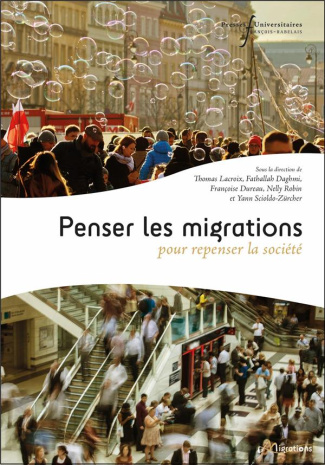
Penser les migrations pour repenser la société
Les migrations internationales contribuent à définir l'Etat et ses formes de citoyenneté. Elles modifient les relations professionnelles, transforment les espaces géographiques et jouent un rôle fondamental dans les expressions artistiques. Par effet miroir, les pratiques des migrants sont, elles aussi, tributaires des contraintes et opportunités qu'ils rencontrent dans les espaces qu'ils traversent, sinon investissent. De l'Europe au continent américain en passant par l'Afrique, ce livre illustre la façon dont les études migratoires permettent d'éclairer les sociétés contemporaines, depuis leur construction politique jusqu'aux multiples échelles servant à l'analyse des pratiques sociales quotidiennes. Prises ensemble, elles initient un dialogue nécessaire entre spécialistes des migrations et des sciences sociales. En d'autres termes, penser les migrations est "un moyen de penser la société", au-delà de la question du contrôle des frontières par les Etats, à laquelle elles sont trop souvent réduites.Sur commande en 2-4 joursCOMMANDER24,99 €


