Cahiers de fare N° 16 : Frontières, géopolitique et relations internationales. Mélanges pour Jean-Ch
Ce numéro spécial des Cahiers Fare est dédié à Jean-Christophe Romer, professeur d'histoire contemporaine à l'Université de Strasbourg parti en retraite à la rentrée 2017. Ses anciens collègues ont voulu lui rendre hommage dans cette publication, en se penchant, chacun à leur manière, sur deux enjeux qui ont été au cour de ses recherches et de sa réflexion : la place de la géopolitique et l'enjeu des frontières dans les relations internationales contemporaines. Les douze contributions qui composent ce cahier constituent ainsi à la fois un témoignage de la reconnaissance et de l'affection de leurs auteurs envers Jean-Christophe Romer, et la confirmation, si besoin en était, de la richesse épistémologique de voies souvent croisées qu'il a, tout au long de sa carrière, contribué à paver.
| Nombre de pages | 254 |
|---|---|
| Date de parution | 27/02/2019 |
| Poids | 400g |
| Largeur | 155mm |
| EAN | 9782343167992 |
|---|---|
| Titre | Cahiers de fare N° 16 : Frontières, géopolitique et relations internationales. Mélanges pour Jean-Ch |
| Auteur | Wassenberg Birte ; Aballéa Marion |
| Editeur | L'HARMATTAN |
| Largeur | 155 |
| Poids | 400 |
| Date de parution | 20190227 |
| Nombre de pages | 254,00 € |
| Disponibilité | Sur commande en 6-8 jours |
Pourquoi choisir Molière ?
Du même auteur
-
Séminaires sur la coopération transfrontalière 2018-2022. Études sur les cas de la frontière franco-
Les textes issus de ce volume portent sur la coopération transfrontalière à partir des exemples pris le long de la frontière franco-allemande et sur les frontières de la Roumanie. Les contributions rassemblées soulignent comment dans les espaces frontaliers les sociétés civiles construisent un peu d'Europe. Cela ne va pas sans difficulté ni arrière-pensée, et ces laboratoires n'échappent pas non plus aux problèmes que traversent les relations bilatérales entre ces États frontaliers. Dès lors, si la coopération frontalière peut être une opportunité pour approfondir l'intégration européenne, elle n'en reste pas moins traversée par les vicissitudes que soulève ce processus. Les différents exemples présentés dans ce volume mettent en valeur les possibilités ouvertes ou non par ces processus transfrontaliers. Ils permettent également une comparaison entre coopération transfrontalière en Europe de l'Ouest et en Europe centrale et orientale.Sur commande en 6-8 joursCOMMANDER15,00 € -
BORDERS AND BORDER SPACES IN THE EU VOLUME 1 - VOL24 - EUROPEAN BORDER MANAGEMENT FROM A COMPARATIVE
Sur commande en 6-8 joursCOMMANDER24,00 € -
Cahiers de fare N° 25 : Borders and Border Spaces in the EU. Volume 2, European Border Perception fr
Which are the perceptions of the border in European border regions before and after the COVID-19 pandemic ? This Cahier Fare n°25 presents the results of the Jean Monnet Network "Frontières en mouvement : quels modèles pour l'UE (FRONTEM)? ", which was supported by the EU's Erasmus+ program for the period between 2019-2023. The network exchanged knowledge and practices on five different types of EU border perception : at the border between France and Germany, at the border between France and Belgium, at the border between Ireland and Northern Ireland, at the border between Rumania and Hungary and at the border between Denmark and Germany. By analysing the results of focus groups organised in and mental maps drawn for each of the 5 border regions concerned, it critically examines the perception of the border as a place of cross-border reconciliation, of minority co-existence and of peace facilitation. The key question addressed by the network was to assess the mental perception of the border when faced with processes of re-bordering and the re-questioning of the model of a "Europe without borders".Sur commande en 6-8 joursCOMMANDER22,00 € -
Cahiers de fare N° 18 : Cross-border Circulation and Networks in the European Space. Textes en franç
This publication on "Cross-border Circulation and Networks in the European Space" is an attempt to enlarge the perspectives of Contemporary European Border Studies both temporally and epistemologically. Border studies in Europe are indeed still largely focused on the analysis of cross-border cooperation and its relationship with the process of European Integration after the Second World War. What is generally missing is a long-term historical perspective and the consideration that circulation and networks can also be built across borders because there is a community of ideas or a shared good to defend : a common scientific culture, health, environment, etc. The publication regroups communications to a doctoral seminar which was organized on 10-11 January 2019 in Strasbourg on "Cross-border circulation and networks in the European space (18th -21rst century) : a trans-periodical approach" and supported by the Erasmus+ Jean Monnet project on "Crises in European Border Regions". It has been put an emphasis on several types of circulation and networks in cross-border spaces. On the one hand, on the completed several case-studies on the Franco-Spanish cross-border region.The authors circulation of ideas (anti-fascism in the inter-war period), the circulation of people (visa regulations between Poland and Belarus), the circulation of scientific culture (among the universities of the Upper Rhine Region), of languages (in the Catalan Region) and of law (legal cross-border tools). On the other hand, on networks of environmental cooperation in the Upper Rhine Region, of health care with the example of the cross-border hospital in Cerdayna and of para-diplomacy in Andorra and in Catalonia. Ont contribué à cet ouvrage : Martine Camiade, Jordi Cicres, Xavier Faure, Elen Guy, Anna Kuleszewicz, Silvia Llach, Rapahaël Mariotti, Jean Peyrony, Rose-Marie Quintana, Franzeska Tortorella, Birte Wassenberg.Sur commande en 6-8 joursCOMMANDER24,50 €


Du même éditeur
-

L'AVENIR DE L'AFRIQUE - LA DIASPORA INTELLECTUELLE INTERPELLEE
L'année 2010 marquera, pour de nombreux pays africains surtout francophones, 50 ans d'indépendance, donc de gestion du pouvoir entre les mains des élites dirigeantes africaines. Seulement, un demi-siècle plus tard, un constat se dégage de l'ensemble des Etats africains : le développement semble s'éloigner de l'Afrique au fur et à mesure que les années passent. Pourquoi l'Afrique demeure-t-elle à la traîne malgré toutes les richesses qu'elle possède ? Le continent noir peut-il se sortir du piège de l'aide pour son développement si la bonne gouvernance s'installe effectivement et si les mentalités changent radicalement ? Compte tenu de l'apport remarquable des diasporas intellectuelles notamment chinoise et indienne pour l'émergence de la Chine et de l'Inde, la diaspora intellectuelle africaine, avec l'élection du fils d'Afrique Barack Obama à la Maison Blanche, ne constitue-t-elle pas le meilleur pilier de l'Afrique pour sortir du labyrinthe de la néguentropie ? Dans le cadre de mes recherches de plus d'une décennie, je présente également ce que l'on pourrait assimiler à une nouvelle théorie des relations Nord-Sud. Ce sont ces réflexions et interrogations auxquelles nous essayons de trouver des solutions pour l'avenir de l'Afrique avec quelques brillants intellectuels de la diaspora africaine d'Europe et d'Amérique du Nord.EpuiséVOIR PRODUIT32,00 € -
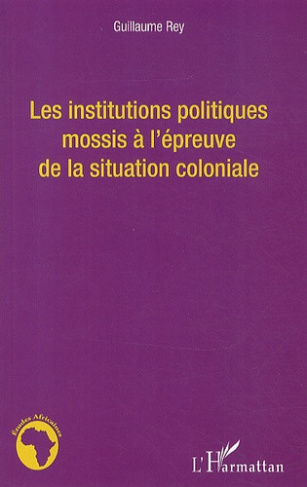
Les institutions politiques mossis à l'épreuve de la situation coloniale
Avant la conquête française, la plus grande partie de la moitié orientale du Burkina Faso actuel était occupée par les Mossis. On appelle également "mossis" les représentants de l'ordre aristocratique qui dirige ce territoire, souvent qualifié à tort d'empire, un ordre dont les institutions se sont maintenues durant les six décennies de domination coloniale. Pourquoi et comment ce système a-t-il été préservé alors même que la société toute entière vit de grands bouleversements ? Au moment de la conquête, les chefs précoloniaux n'auraient-ils pas dû être renversés et leur système aboli ? Et lorsqu'on s'approche de la décolonisation, c'est-à-dire d'une indépendance accordée à une élite "moderne" formée à l'école coloniale, la question de l'abolition des organisations traditionnelles n'aurait-elle pas dû être de nouveau soulevée ? Comment les structures politiques mossis ont-elles su se maintenir durant la période coloniale ? Selon quelles modalités ...Sur commande en 6-8 joursCOMMANDER29,00 € -