

The design of everiday things
20,95 €
Sur commande en 6-10 jours
EAN :
9780262525671
Even the smartest among us can feel inept as we try to figure out the shower control in a hotel or attempt to navigate an unfamiliar television set or stove. When The Design of Everyday Things was published in 1988, cognitive scientist Don Norman provocatively proposed that the fault lies not in ourselves, but in design that ignores the needs and psychology of people. Fully revised to keep the timeless principles of psychology up to date with ever-changing new technologies, The Design of Everyday Things is a powerful appeal for good design, and a reminder of how-and why-some products satisfy while others only disappoint.
Plus d'informations
| EAN | 9780262525671 |
|---|---|
| Auteur | Norman |
| Editeur | GARDNERS |
| Date de parution | 20131223 |
| Disponibilité | Sur commande en 6-10 jours |
Pourquoi choisir Molière ?
Efficacité et rapidité Commandé avant 16h livré demain
Économique et pratique Livraison dès 3,90 €
Facile et sans frais Retrait gratuit en magasin
Du même auteur
-
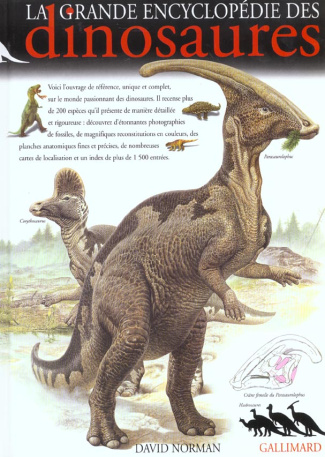
La grande encyclopédie des dinosaures
Parasaurolophus, Mégalosaurus, Iguanodon, Diplodocus, Hadrosaurus... Apparus il y a 220 millions d'années, mystérieusement disparus 150 millions d'années plus tard, les dinosaures se répartissent, d'après l'état actuel des recherches en une trentaine de familles. Les dinosaures ont développé une incroyable diversité de morphologies depuis les lestes coureurs bipèdes de moins de cent kilos jusqu'aux lourds quadrupèdes marcheurs de plusieurs tonnes. Éminent spécialiste, David Norman retrace ici l'histoire de la paléontologie. Il décrit toutes les familles connues de dinosaures, exposant les connaissances les plus récentes sur leur apparence, leur mode de vie et leur lien de parenté. Il présente également les principaux animaux contemporains de ces reptiles et se fait l'écho des grandes polémiques qu'ils ont suscitées. Cet ouvrage propose de remarquables reconstitution; en couleurs de l'illustrateur John Sibbick, spécialiste des dinosaures. « Les artistes sont les yeux des paléontologues et leurs peintures sont les fenêtres par lesquelles le public peut contempler les dinosaures ».EpuiséVOIR PRODUIT23,40 € -

Paul McCartney
1965. Paul McCartney conquiert les sommets ? et le coeur des fans des Beatles. Cinquante ans plus tard, il n'est pas redescendu : il a formé puis quitté Wings, oeuvré en solo, connu la prison avant d'être anobli. Un destin extraordinaire, qui n'avait jamais été si bien conté que par Philip Norman. Son récit, précis et passionné, s'impose comme le portrait définitif du légendaire musicien.Sur commande en 2-4 joursCOMMANDER12,50 € -
Les maîtres du jeu
Sujet: Edward a découvert un jeu bizarre, caché derrière de vieux livres, dans la bibliothèque de son oncle. A la lecture des instructions, il comprend qu'un pouvoir mystérieux semble lier le jeu avec le monde réel. Il entraîne donc un de ses cousins et camarade de pension à jouer avec lui. Cet exercice dangereux va mener les deux jeunes garçons sur un terrain non balisé, qu'ils pensaient pourtant contrôler. Commentaire: Les jeux de rôles ne sont pas des jeux anodins. Sans pour autant modifier réellement notre environnement, ils influencent sûrement le mental des joueurs, ce qui peut parfois revenir au même... Ce livre nous montre les dangers de "jouer avec le feu", tout en laissant entrevoir les séductions très fortes qui peuvent entrer en action. Bien que l'on puisse se lasser d'entendre le narrateur nous raconter certaines parties, l'ensemble du récit est bien construit. Il peut mettre en garde, à moins qu'il ne séduise..EpuiséVOIR PRODUIT7,00 € -

Londres
Votre voyage commence dès la première page ! Les guides Voir changent totalement ! Dès les premières pages, laissez-vous inspirer par Londres : Westminster, Kensington, King's Cross ou Regent's Park... Le guide Voir vous fait explorer l'intégralité de cette capitale cosmopolite, des sites incontournables aux coins les plus secrets. Le guide Voir Londres, c'est : - Une présentation moderne, des pages qui se lisent comme un magazine, illustrées de splendides photos. - Un nouveau chapitre d'introduction tout en images pour vous inspirer et découvrir tout ce qui compte à Londres. - Tout ce qu'il faut savoir pour vous organiser : conseils d'experts, cartes claires, grands itinéraires. - Une organisation claire par quartier : du quartier de Mayfair et St James à celui de Soho et Trafalgar Square, en passant par South Bank, Holborn... - Des dessins réalisés à la main des sites et des promenades exceptionnels : Bloomsbury, la cathédrale de Saint-Paul, la City, Southwark... - Des cartes colorées et détaillées pour vous orienter facilement. - Les bons conseils pour un voyage inoubliable : où prendre la photo parfaite, où en prendre plein les yeux avec des panoramas sublimes et où échapper à la foule. - Les adresses les plus authentiques pour dormir, manger, boire un verre et faire les boutiques. - L'histoire, les monuments et les expériences à vivre à Londres.En stock (dernières pièces)COMMANDER19,40 €


Du même éditeur
-

The Man in the High Castle
Revue de presse The most brilliant sci-fi mind on any planet (Rolling Stone)California's own William Blake. Visionary and prophet (Daily Telegraph)Sur commande en 6-10 joursCOMMANDER11,30 € -

The water knife
From the international bestselling author of the Hugo and Nebula award-winning The Windup Girl, comes an electrifying thriller set in a world on the edge of collapse.WATER IS POWERThe American Southwest has been decimated by drought, Nevada and Arizona skirmish over dwindling shares of the Colorado River, while California watches.When rumors of a game-changing water source surface in Phoenix, Las Vegas water knife Angel Velasquez is sent to investigate.With a wallet full of identities and a tricked-out Tesla, Angel arrows south, hunting for answers that seem to evaporate as the heat index soars and the landscape becomes more and more oppressive. There, Angel encounters Lucy Monroe, a hardened journalist who knows far more about Phoenix's water secrets than she admits, and Maria Villarosa, a young Texas migrant who dreams of escaping north to those places where water still falls from the sky.As bodies begin to pile up and bullets start flying, the three find themselves pawns in a game far bigger, more corrupt, and dirtier than any of them could have imagined. With Phoenix teetering on the verge of collapse and time running out, their only hope for survival rests in one another's hands.But when water is more valuable than gold, alliances shift like sand, and the only truth in the desert is that someone will have to bleed if anyone hopes to drink.Sur commande en 6-10 joursCOMMANDER11,25 € -

-

In Pale battalions
Extrait Chapter OneChildhood memories fit their own intricate pattern. They cannot be made to conform to the version of our past we try to impose upon them. Thus I could say that Lord and Lady Powerstock and the home they gave me at Meongate more than compensated for being an orphan, that a silver spoon easily took the place of my mother's smile. I could say it--but every recollection of my early years would deny it.Meongate must once have been the crowded, bustling house of a cheerful family, as the Hallowses must once have been that family. Every favour of nature in its setting where the Hampshire downs met the pastures of the Meon valley, every effort of man in its spacious rooms and landscaped park, had been bestowed on the home of one small child.Yet it was not enough. When I was growing up at Meongate in the early 1920s, most of its grandeur had long since departed. Many of the rooms were shut up and disused, much of the park turned over to farmland. And all the laughing, happy people I imagined filling its empty rooms and treading its neglected lawns had vanished into a past beyond my reach.I grew up with the knowledge that my parents were both dead, my father killed on the Somme, my mother carried off by pneumonia a few days after my birth. It was not kept from me. Indeed, I was constantly reminded of it, constantly confronted with the implication that I must in some way bear the blame for the shadow of grief, or of something worse, that hung over their memory. That shadow, cast by the unknown, lay at the heart of the cold, dark certainty that also grew within me: I was not wanted at Meongate, not welcomed there, not loved.It might have been different had my grandfather not been the grave, withdrawn, perpetually melancholic man that he was. I, who never knew him when he was young, cannot imagine him as anything other than the wheelchair-bound occupant of his ground-floor rooms, deprived by his own morbidity, as much as by the lingering effects of a stroke, of all warmth and fondness. When Nanny Hiles took me, as she regularly did, to kiss him goodnight, all I wanted to do was escape from the cold, fleeting touch of his flesh. When, playing on the lawn, I would look up and see him watching me from his window, all I wanted to do was run away from the mournful, questing sadness in his eyes. Later, I came to sense that he was waiting, waiting for me to be old enough to understand him, waiting in the hope that he would live to see that day.Lady Powerstock, twenty years his junior, was not my real grandmother. She was buried in the village churchyard, another ghost whom I did not know and who could do nothing to help me. I imagined her as everything her successor was not--kind, loving and generous--but it did me no good. Olivia, the woman I was required to address as Grandmama in her place, had once been beautiful and, at fifty, her looks were still with her, her figure still fine, her dress sense impeccable. That we were not related by blood explained, to my satisfaction, why she did not love me. What I could not explain was why she went so far as to hate me, but hate me she undoubtedly did. She did not trouble to disguise the fact. She let it hover, menacing and unspoken, at the edge of all our exchanges, let it grow as an awareness between us, a secret confirmation that she too was only waiting, waiting for death to remove her husband and with him any lingering restraint on her conduct towards me. There was an air of practised vice about her that was to draw men all her life, an air of voluptuous pleasure at her own depravity that made her hatred of me seem merely instinctive. Yet there was always more to it than that. She had drawn some venom from whatever part she had played in the past of that house and had reserved it for me.My only friend in those days, my only guide through Meongate's hidden perils, was Fergus, the taciturn and undemonstrative major-domo, "shifty" as Olivia described him and certainly not as deferential as he should have been, but none the less my sole confidant. Sally, the sullen maid, and humourless Nanny Hiles both went in awe of Olivia, but Fergus treated her with an assurance, bordering on disrespect, that made him my immediate ally. A cautious, solitary, pessimistic man who had expected little from life and consequently been spared many disappointments, perhaps he took pity on a lonely child whose plight he understood better than she did herself. He would take me on covert expeditions through the grounds, or down to the wooded reach of the Meon where he fished of a quiet afternoon, or into Droxford in the trap, when he would buy me a twist of sherbet and leave me sitting on the wall outside Wilsmer's saddlery whilst he went in to haggle over a new bridle for the pony. For such brief moments as those, kicking my heels on Mr. Wilsmer's wall and eating my sherbet in the sunshine, I was happy. But such moments did not last.It was Fergus who first showed me my father's name, recorded with the other war dead of the village, on a plaque at the church. Their Name Liveth for Evermore, the inscription said, and his name--Captain the Honourable John Hallows--is all that did live for me. I would stare at it for what seemed like hours trying to conjure up the real living and breathing father that he had never been to me, seeing only those stiff, expressionless, uniformed figures preserved by photographs in back copies of the Illustrated London News, glimpsing no part of his true self beyond the neatly carved letters of his name.As for my mother, of her there was no record at all, no grave, no memorial of any kind. Fergus, when I questioned him, prevaricated. My mother's grave, if she had one, was far away--and he did not know where. There were, I was to understand, limits to what even he could tell me. Whether he suggested it or not I cannot remember, but, for some reason, I decided to ask Olivia. I cannot recall how old I was when it happened, but I had followed her into the library, where she often went to look at a painting that hung there."Where is my mother's grave?" I said bluntly, partly intending the question to be a challenge. All hatred is, in time, reciprocated and I had come to hate Olivia as much as she hated me; I did not then appreciate how dangerous an enemy she could be.She did not answer in words. She turned aside from that great, high, dark painting and hit me so hard across the face that I nearly fell over. I stood there, clutching the reddening bruise, too shocked by the pain of it to cry, and she stooped over me, her eyes blazing. "If you ever ask that question again," she said, "if you ever mention your mother again, I'll make you suffer."The mystery of my mother thenceforth became the grand and secret obsession of my childhood. My father's death, after all, had a comforting simplicity about it. Every November there was an Armistice Parade in the village to commemorate the sacrifice of Captain the Honourable John Hallows and the many others like him. Though not permitted to join the Brownie troop that took part in the parade, I was allowed to go and watch and could imagine myself marching with all the little girls who, like me, had lost their father. But, at the end of the parade, they went home to their mothers; I could not even remember mine.Sometimes, though, I thought I could remember her. It was impossible, of course, if what I had been told of her was true, but Olivia had succeeded in making me doubt everything I had not personally experienced, and there was one dim, early memory, seemingly at the very dawn of my recollection, to sustain what I so wanted to believe.I was standing on the platform at Droxford railway station. It was a hot summer's day: I could feel the heat of the gravel seeping up through my shoes. A train was standing at the platform, great billows of smoke rising as the engine gathered steam. The man standing beside me, who had been holding my hand, stooped and lifted me up, cradling me in his arms to watch the train pull out. He was stout and white-haired. I remember the rumble of his voice and the brim of his straw hat touching my head as he raised his free hand to wave. And I was waving too, at a woman aboard the train who had wound down the window and was leaning out, waving also and smiling and crying as she did so. She was dressed in blue and held a white handkerchief in her right hand. And the train carried her away. And then I cried too and the stout old man hugged me, the brass buttons on his coat cold against my face.I recounted the memory to Fergus one day, when we were returning from a mushrooming expedition. When I had finished, I asked him who he thought the old man was."Sounds like old Mr. Gladwin," he replied. "The first Lady Powerstock's father. He lived here . . . till she sent him away." By she Fergus always meant Olivia."Why did she do that?""She'd have had her reasons, I don't doubt.""When did he go?""The summer of 1920, when you were three. Back to Yorkshire, so they say. A proper caution, was Mr. Gladwin.""Who was the pretty lady, Fergus?""That I don't know.""Was she . . . my mother?"He pulled up and looked down at me with a frown. "That she was not," he said with deliberate slowness. "Your mother passed away a few days after she had you. You know that. No amount of wanting is going to make you remember her.""Then . . . who was the pretty lady?"His frown became less kindly. "I told you: I don't know. That Mr. Gladwin, he was a close one. Now, look to that napkin or you'll pitch your breakfast into the lane--and mine with it."If the pretty lady wasn't my mother, who was she? What was old Mr. Gladwin, my great-grandfather, to her? There were no answers within my reach, just the secret hope I went on harbouring that maybe my mother wasn't really dead at all, just ....Sur commande en 6-10 joursCOMMANDER12,50 €




De la même catégorie
-

Le design. Histoire, principaux courants, grandes figures
Né au XIXe siècle, en Europe, au sein des mouvements avant-gardistes qui souhaitaient mettre les valeurs de l'art à la portée de tous, le design se situe au croisement de l'art et de l'industrie, du beau et de l'utile, de la forme et de la fonction. Profondément enraciné dans la tradition intellectuelle, industrielle et historique propre à chaque pays, le design est aussi un témoin privilégié et un révélateur de son temps à travers : ses différents champs d'application, de l'équipement domestique (mobilier, arts ménagers) à l'équipement industriel, en passant par l'urbanisme et l'environnement ; ses grands représentants, Peter Behrens, Raymond Loewy, Alvar Aalto, Jean Prouvé, Verner Panton, Ettore Sottsass, Philippe Starck... les entreprises internationales les plus performantes et les plus créatives (Olivetti, Ikea, Sony, Braun...) ; les écoles et les formations, les théories et les mouvements, de la Sécession viennoise au biodesign, en passant par le Streamline ou la contestation de l'antidesign ; les innovations techniques et technologiques (ère du bois, du verre, du plastique, du virtuel...). Destiné au grand public comme aux amateurs d'art moderne et contemporain, cet ouvrage dresse, de 1851 au début du XXIe siècle, un panorama international et historique du design.EpuiséVOIR PRODUIT28,05 € -
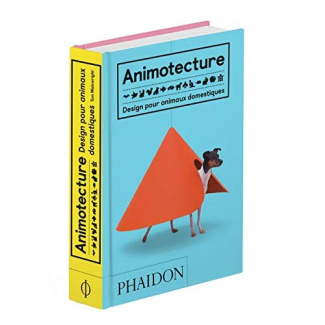
Animotecture. Design pour animaux domestiques
De la niche en béton au griffoir pour chat en forme de chien, du poulailler de luxe à l'aquarium imprimé en 3D, une collection surprenante d'objets imaginés pour les animaux, à poils, à plumes et même à écailles ! Aussi amusant qu'irrésistible, Animotecture comblera les amoureux des animaux ainsi que les amateurs de design.Sur commande en 2-4 joursCOMMANDER19,95 € -

Bruno Moinard. Du trait à la lumière
Au 41 avenue Montaigne, les murs noirs sont illuminés par les photographies de ses réalisations et ses croquis aux traits sophistiqués. Dans son bureau ovale donnant sur la pretigieuse avenue parisienne, l'homme est chaleureux, toujours très élégant... Bruno Moinard fait partie de l'univers stellaire des grands architectes d'intérieur d'aujourd'hui. Médiatisé, reconnu pour un style qui se passe désormais de signature, son nom est définitivement associé à des lieux d'exception : les boutiques Cartier à New York, Paris et Milan, l'intérieur de Château Latour à Pauillac, l'hôtel du Marc de Veuve Clicquot à Reims, les boutiques hôtels de Chengdu en Chine, le Plaza Athénée à Paris ou encore The Grill at the Dorchester à Londres. Bruno Moinard imprime également son style dans de somptueux appartements, hôtels particuliers et maisons du monde entier. Minimaliste et chaleureuse, sobre sans être austère, élégante et intemporelle, chacune des réalisations de Bruno Moinard parle d'elle-même, proposant une autre définition d'un luxe sans ostentation, une manière de gommer les effets et de privilégier l'art du détail. C'est cet univers sensible et très personnel que propose d'explorer cet ouvrage. Richement illustré de photographies inédites et enrichi de magnifiques croquis, il comporte cinq chapitres : la lumière, la matière, le luxe, l'épure et le mobilier.EpuiséVOIR PRODUIT60,00 € -

Charles & Ray Eames
Designers incontournables du XXe siècle reconnus comme pionniers par les plus grands noms du design contemporain, Charles et Ray Eames ont laissé, au-delà de leurs pièces iconiques, l'image d'un style de vie et d'une philosophie du plaisir sérieux devenue leur marque de fabrique. Soucieux de "produire le meilleur pour le plus grand nombre au coût le plus bas", ce couple visionnaire et touche-à-tout a révolutionné et démocratisé le design. Préfacé par Eames Demetrios, petit-fils des Eames, ce livre s'appuie sur le témoignage de designers du monde entier qui nous livrent leur point de vue face à cet héritage. Aux archives du Eames Office se superpose au fil des chapitres une iconographie contemporaine qui met en avant l'incroyable modernité des Eames et le caractère intemporel de leur production. C'est une trajectoire ancrée dans une époque et défiant le temps et les modes que ce livre invite à découvrir, chapitre fondamental de l'histoire du design.EpuiséVOIR PRODUIT45,00 €


