

Mille jours de la vie d'un déporté qui a eu de la chance
17,85 €
Impression à la demande
EAN :
9782748169966
Les survivants de la déportation attribuent souvent à la chance les circonstances dans lesquelles ils échappèrent à une mort certaine. Ils évoquent également l'aléatoire et l'arbitraire qui régnaient dans le système concentrationnaire nazi. Théodore Woda met la chance au coeur de son témoignage car il démontre que, malgré que la destruction de tous les juifs soit programmée par le IIIe Reich allemand, la chambre à gaz ou la mort lente par la faim et/ou les mauvais traitements n'a pas toujours été la fin du parcours du déporté juif. On ne peut pas dire que la chance ait été avec lui lorsque la Gestapo, lors d'un contrôle, l'arrête au seul motif d'être juif, puis le déporte du camp de Drancy par le convoi n° 33.
| Nombre de pages | 160 |
|---|---|
| Date de parution | 13/04/2006 |
| Poids | 205g |
| Largeur | 140mm |
Plus d'informations
| EAN | 9782748169966 |
|---|---|
| Titre | Mille jours de la vie d'un déporté qui a eu de la chance |
| Auteur | Woda Théodore |
| Editeur | MANUSCRIT |
| Largeur | 140 |
| Poids | 205 |
| Date de parution | 20060413 |
| Nombre de pages | 160,00 € |
| Disponibilité | Impression à la demande |
Pourquoi choisir Molière ?
Efficacité et rapidité Commandé avant 16h livré demain
Économique et pratique Livraison dès 3,90 €
Facile et sans frais Retrait gratuit en magasin
Du même auteur
-

A THOUSAND DAYS IN THE LIFE OF A DEPORTEE WHO WAS LUCKY
Holocaust survivors often say that the circumstances in which they defied death were a matter of sheer luck. They also mention the random, arbitrary nature of the Nazi concentration camp system. The odore Woda puts luck at the heart of his story, showing that, although the Third Reich was intent on destroying all the Jews of Europe, gas chambers or a slow death by starvation and/or mistreatment did not always lie at the end of the road. It cannot really be said that luck was on The odore's side when the Gestapo arrested him during a spot check for the sole crime of being Jewish and deported him from the Drancy camp on transport 33. His "luck", then, was relative. It came into play when the train taking him to the Auschwitz extermination camp stopped at the railway station in Opole, where he and some fellow deportees were selected for slave labor. But during the 32 months he spent in three slave labor and two concentration camps in Silesia, The odore's "luck" did not keep him safe from hunger, beatings, unhygienic conditions and abuse. As he relates in plain, matter-of-fact words, he was "lucky" to work in workshops, know German and possess the resourcefulness to live by his wits. Under those circumstances, he managed not only to find food to supplement his insufficient diet, but to correspond with his family and even receive parcels sent to him under the names of men in the STO (the French acronym for Service de travail obligatoire, or Compulsory Labor Service). In sum, he was "lucky" to return alive from the maelstrom that claimed the lives of his mother, two of his brothers, one of his sisters, his uncle and his aunt. His testimonial has been unpublished until now.EpuiséVOIR PRODUIT17,85 €

Du même éditeur
-
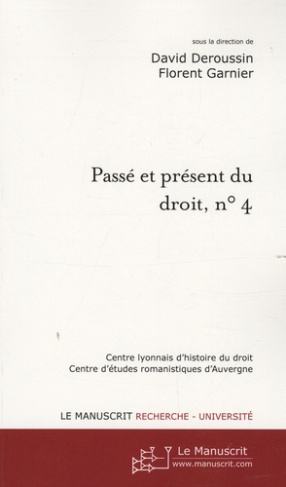
Passé et présent du droit, n° 4. Compilations et codifications juridiques, Tome 1, De l'Antiquité à
Depuis 2004, les célébrations des codes napoléoniens se succèdent. Trois volumes réunissant les actes d'un colloque international, tenu à Clermont-Ferrand les 16-18 juin 2004, par le Centre d'Etudes Romanistiques d'Auvergne (E. A. 2147) s'attachent de manière diachronique à saisir les phénomènes de la compilation et de la codification juridique. Les 26 communications présentées intéressent des espaces géographiques divers (Europe, Amérique, Afrique et Asie). "Le regard rétrospectif sur l'histoire des codifications nationales suscite aujourd'hui un autre regard, prospectif, à l'échelle d'un continent, sur la nécessité ou non de l'unification juridique de l'Union européenne" (J. -P. Coriat).EpuiséVOIR PRODUIT38,05 € -
-
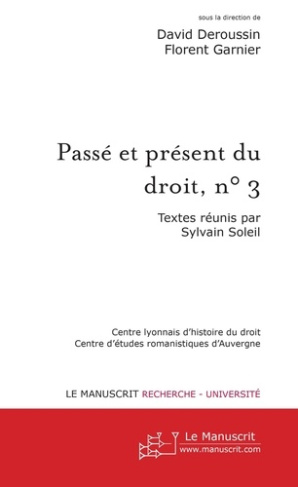
Passé et présent du droit, n° 3. L'ordalie : modalités et rationalités d'une épreuve judiciaire
Pour son troisième numéro Passé et présent du droit abandonne (pour un temps) le monde des codifications pour accueillir les actes de la journée d'étude organisée à l'initiative de S. Soleil par le Centre rennais d'histoire du droit : "l'ordalie : modalités et rationalités d'une épreuve judiciaire". A travers des exemples variés (de l'Orient ancien aux Temps modernes), les contributions ainsi réunies s'efforcent de saisir dans sa complexité les traits saillants d'une pratique aussi récurrente que, souvent, mal comprise.EpuiséVOIR PRODUIT24,55 € -
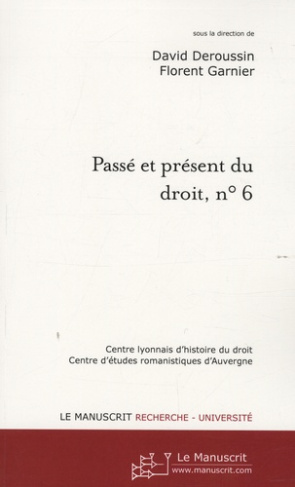
Passé et présent du droit, n° 6. Compilations et codifications juridiques, Tome 3, Les codifications
Depuis 2004, les célébrations des codes napoléoniens se succèdent. Trois volumes réunissant les actes d'un colloque international, tenu à Clermont-Ferrand les 16-18 juin 2004, par le Centre d'Etudes Romanistiques d'Auvergne (E. A. 2147) s'attachent de manière diachronique à saisir les phénomènes de la compilation et de la codification juridique. Les 26 communications présentées intéressent des espaces géographiques divers (Europe, Amérique, Afrique et Asie). "Le regard rétrospectif sur l'histoire des codifications nationales suscite aujourd'hui un autre regard, prospectif, à l'échelle d'un continent, sur la nécessité ou non de l'unification juridique de l'Union européenne" (J. -P. Coriat).EpuiséVOIR PRODUIT31,30 €


