George Stubbs. "All done from Nature"
George Stubbs: ?all done from Nature? presents the first significant overview of Stubbs?s work in Britain for more than 10 years and brings together 100 paintings, drawings and publications, from the National Gallery?s Whistlejacket to pieces that have never been seen in public. George Stubbs: ?all done from Nature? accompanies an exhibition organised by MK Gallery in Milton Keynes, which will be shown at MK Gallery and the Mauritshuis in The Hague. The publication includes new writing on Stubbs with major essays by Jenny Uglow, Martin Myrone, Martin Postle and Nicholas Clee as well as new and existing poetry by Roger Robinson. Born in Liverpool in 1724, Stubbs was a quintessential product of the Enlightenment and embodied all of its core principles, questioning traditional authority and embracing the notion that humanity could be improved through the application of reason. Rather than trust to history and the untested example of his artistic and scientific precursors, Stubbs championed doing as a way of thinking and deployed pictorial representation as a form of knowledge and understanding. Today, Stubbs is recognised as one of the most original artists of the eighteenth century. His wide-ranging subjects included portraits, conversation pieces and pictures of exotic and domestic animals?horses included?and his obsession with scientific exactitude has drawn comparison with the work of Leonardo da Vinci. A major theme of the exhibition is anatomy. The show includes Stubbs?s contributions to a pioneering treatise on midwifery and his preliminary work on A Comparative Anatomical Exposition of the Structure of the Human Body with that of a Tiger and a Common Fowl. It also includes the detailed studies and drawings that led to The Anatomy of the Horse?the greatest coming together of art and science in British art?alongside the actual skeleton of the legendary racehorse Eclipse who Stubbs depicted on several occasions.
| Nombre de pages | 232 |
|---|---|
| Date de parution | 22/11/2019 |
| Poids | 1 015g |
| Largeur | 217mm |
| EAN | 9781911300687 |
|---|---|
| Titre | George Stubbs. "All done from Nature" |
| Auteur | Spira Anthony ; Postle Martin ; Bonaventura Paul |
| Editeur | HOLBERTON |
| Largeur | 217 |
| Poids | 1015 |
| Date de parution | 20191122 |
| Nombre de pages | 232,00 € |
| Disponibilité | Sur commande en 4-6 jours |
Pourquoi choisir Molière ?
Du même auteur
-
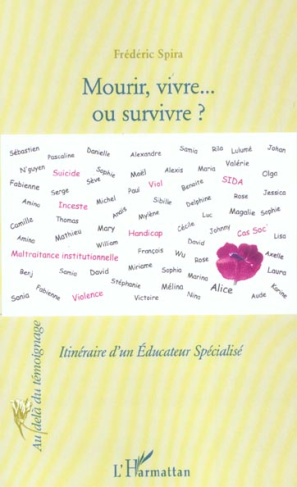
Mourir, vivre... ou survivre ? Itinéraire d'un Educateur spécialisé
De toutes façons, c'est moi qui vais savoir en premier s'il a mangé la Rose, puisque je vais mourir avant toi." Comment réagir quand une petite fille de quatre ans, crinière dorée, grands yeux gris et née avec le Virus du SIDA, vous chuchote ces quelques mots? Comment raisonner cet homme, ou plus exactement cette voix anonyme, qui murmure au téléphone: "je vais me pendre..." Existe-t-il seulement une réponse? Tout au moins puis-je livrer ici mon expérience. Mais que faire face à la violence? Celle de cet enfant autiste qui se mutile sans discontinuer, celle de ces adolescentes, à la fois indomptables et inconsolables, menaçantes et provocantes, maltraitées et abandonnées. Que reste-t-il quand on a tout tenté, qu'on est seul et qu'on a 14 ou 15 ans? En comprimant les poignets tailladés de Simane, ou en tentant d'empêcher les automutilations de Miriam, ou de Wu, je cherchais encore des réponses... C'est mon métier d'accompagner ces adolescents et adolescentes, "Cas Soc" "et sauvageons. Un accompagnement au quotidien, dans les rires, les larmes, les cris, les confessions, et dans la lutte pour la survie au sein des Institutions. Car je vous dois ici la vérité: je suis Educateur Spécialisé... Biographie de l'auteur Après avoir été bénévole dans deux Associations, l'une axée dans l'accompagnement d'enfants touchés par le virus du SIDA, l'autre dans l'écoute de personnes à tendance suicidaire, j'entamais une longue formation pour devenir Educateur.Enfants handicapés, adolescents" sauvageons ", maltraitance institutionnelle...: j'apprenais le métier. A 27 ans, après dix années d'expérience du secteur Social et après deux années d'exercice de la profession au sein d'un internat atypique, le besoin de faire le point se faisait pressant. Période de réflexions que j'ai mise à profit pour rendre compte d'une réalité quotidienne du terrain, impressionnante, autant que poignante."Sur commande en 6-8 joursCOMMANDER42,00 € -
La transparence des choses. Contemplation de la nature de l'expérience
Ce livre est une suite d'observations sur la nature de l'expérience. Son unique finalité est d'observer clairement l'expérience elle-même, sans jamais essayer de la changer. Rupert Spira ne s'intéresse pas aux qualités particulières de l'expérience, mais il en explore la nature fondamentale. Qu'est-ce que ce "je" ? Quels sont cet "autre" et ce "monde" ? La découverte essentielle de toutes les grandes traditions spirituelles est le fait que la nature fondamentale de chacun d'entre nous, c'est-à-dire la Conscience elle-même, est identique à la nature fondamentale de l'univers. Qu'en est-il de la Conscience elle-même? N'est-elle pas toujours présente derrière et au coeur de chaque expérience. La Conscience est tellement proche qu'elle ne peut-être connue comme objet, et pourtant elle est toujours connue. Elle est si intime que toute expérience est entièrement imprégnée et saturée par sa présence. Elle est si ouverte qu'elle accueille et reçoit tout en elle. Elle est si spacieuse et vaste qu'elle contient tout. Rupert Spira nous permet, par son écriture même, de réaliser que notre nature essentielle n'est ni le corps, ni le mental. C'est la Conscience qui est consciente de l'expérience en cours.EpuiséVOIR PRODUIT22,00 € -
La nature de la conscience. Essais sur l'unité de l'esprit et de la matière
Une exploration de la conscience passionnante et palpitanteSur commande en 4-6 joursCOMMANDER24,00 € -


Du même éditeur
-

'A Perfect Eye and Steady Hand'. Goldsmithing in Tudor & Stuart London
This handsomely illustrated book is published to mark the opening of the Goldsmiths' Gallery at the new London Museum in Smithfield. Showcasing the Cheapside Hoard alongside historic treasures from the Goldsmiths' Company's collection, it takes readers on a global journey in the wake of plate, jewels and gemstones - and the people who made, traded and treasured them. Gold and silver are precious - prized as a form of portable capital, essential for the mints and coinage, used to express power and status. Yet great skill was needed in the buying, the fashioning and the selling of either metal. As fashions changed, much early modern plate and jewellery was melted down when sentiment gave way to market value. This makes the survival of the Goldsmiths' Company's holdings exceptional - and the Cheapside Hoard, unearthed by workmen in 1912 after lying undisturbed for nearly 300 years - nothing short of extraordinary. Comprising over 500 pieces - made of emeralds, diamonds and sapphires sourced from across the world, worked into mesmerising brooches, buttons, necklaces and rings - the Cheapside Hoard is the greatest single collection of Elizabethan and Stuart jewellery in the world. The book places the Hoard in its historical and global context, celebrating it alongside highlights from the Goldsmiths' Company's collection. It offers four main chapters on Elizabethan and early Stuart London, the goldsmiths' trade, the Hoard itself, and the city's global networks. Interwoven thematic sections explore craftsmanship, personal stories, trade practices, taste and fashion - bringingtogether jewels and plate to reveal a rich tapestry of skill, style and exchange.PréventePRÉCOMMANDER35,00 € -

-
-