

DIAMONDS : THE COLLECTION OF BENJAMIN ZUCKER
Accompanying an exhibition at Les Enluminures, New York, this lavish catalogue presents an extraordinary collection of diamonds from the king of gems, Benjamin Zucker, one of New York?s leading dealers in diamonds and precious stones. Benjamin Zucker?s remarkable story unfolds over three generations of diamond dealers. Arriving in New York in 1941, he had the benefit of the training of his grandfather, a leading expert in uncut diamonds in Antwerp, and his uncle, one of the foremost dealers of diamonds in the Far East. Some of the world?s most famous diamonds, such as the Wittelsbach Diamond, passed through the hands of the Zucker family. Armed with the family ?know-how?, Benjamin Zucker formed a collection that ?has taken a lifetime of patience, money, and unquenchable enthusiasm?, according to Diana Scarisbrick. As Mr. Zucker himself says ?diamonds will always be a magical window facing the invisible world?. Put together over more than forty-five years, this truly rare and immensely valuable collection includes thirty-five precious jewels mostly made for European patrons ? rings, brooches, hairpins, earrings. It tells the story of the Indian diamond over a period of nearly 600 years, ending before the discovery of mines in Brazil, a source that displaced India and inaugurated a new age of diamonds. Starting with the octahedral diamond, the collection includes outstanding examples of world-class importance showing how jewellers gradually captured more and more of the allure of these indomitable gems, evolving from point to table to rose to brilliant cuts. The success of the brilliant cut (close to our cuts today) eclipsed the earlier shapes, many of which were recut to ?modernize? them, with the result that the earlier cuts of ?old mine? diamonds included here are exceedingly rare. Most of these jewels are published. Many of them have been exhibited in prestigious museums such as the Walters Art Museum, the Yale Peabody Museum of Natural History, the Museum of Fine Arts, Houston, and most recently the Metropolitan Museum of Art. As assembled in the present collection they have never been displayed together and have never been offered for sale. This lavish publication by the leading scholar in the field accompanies the exhibition. It is written by Diana Scarisbrick, celebrated jewellery historian and author of Diamond Jewelry: Seven Hundred Years of Glory and Glamour (September 2019).
| Date de parution | 08/11/2019 |
|---|---|
| Poids | 1 156g |
| Largeur | 170mm |
| EAN | 9780578420189 |
|---|---|
| Titre | DIAMONDS : THE COLLECTION OF BENJAMIN ZUCKER |
| Auteur | SCARISBRICK DIANA |
| Editeur | HOLBERTON |
| Largeur | 170 |
| Poids | 1156 |
| Date de parution | 20191108 |
| Nombre de pages | 0,00 € |
| Disponibilité | Epuisé |
Pourquoi choisir Molière ?
Du même auteur
-

I LIKE MY CHOYCE: POSY RINGS FROM THE GRIFFIN COLLECTION
The distinguished private collection, known as the Griffin Collection, comprises in its entirety examples of every category of ring ? signet, devotional, memorial, decorative ? dating from antiquity to modern times. This catalogue, focusing on about 150 rings in the collection, is concerned with perhaps the most personal rings of all, those associated with love and marriage. Some can be recognised by the figure of Cupid armed with his quiver of golden arrows, others by the symbols of heart and clasped hands. However, the majority are gold bands, sometimes plain and occasionally decorated, that are inscribed with mottoes in English expressing the admiration, affection, and pledges of fidelity which bind humankind together. Known as posies or little poems because they often rhyme, these mottoes were current on rings from the late Middle Ages until the middle of the 19 th century. Through these rings, Ms. Scarisbrick engagingly tells the long story of the relations between the sexes from the fifteenth century, when the cult of courtly love was superseded by an idealization of monogamous marriage, to an end in the twentieth century as a result of a different moral outlook. Scholars would agree that the Griffin Collection of posy rings makes an important contribution to English social history and connects with the national literature from Chaucer to Byron. Small though they are in scale, their significance was appreciated by Victorian collectors, and they are well represented in the leading museums, notably the Victoria and Albert Museum, the British Museum, and the Museum of London, as well as the Ashmolean and Fitzwilliam museums in Oxford and Cambridge. Yet none of these institutions have ever published fully illustrated catalogues of their posy rings, nor has there been an up-to-date study since the seminal monograph by Joan Evans entitled English Posies and Posy rings (1931). In this respect, the catalogue of the Griffin Collection, which illustrates the rings and sets them in context, using wide-ranging literary and historical sources, breaks new ground. It also contains posy rings with inscriptions hitherto unrecorded and others with identified maker?s marks.Sur commande en 4-6 joursCOMMANDER50,00 € -

-
-
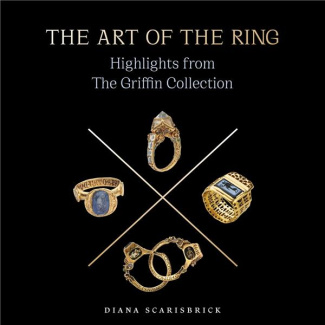
The Art of the Ring. Highlights from the Griffin Collection
The distinguished private collection, known as the Griffin Collection, comprises in its entirety examples of every category of ring - signet, devotional, memorial, decorative - dating from antiquity to modern times. This catalogue focuses on about one hundred special rings, chosen as highlights of this extensive collection with the aim to offer the reader a real history of the art of the ring across the ages. Covering as they do so many facets of civilization, rings tell us more about the hopes, aspirations, taste and sentiments of our ancestors than any other jewels surviving from the past. Moreover, the examples from the Griffin Collection, which have been assembled with taste and discernment over several decades, are not only rare but also of unusually high quality and intrinsic value. As well as being aesthetically attractive, these rings offer us a glimpse into the lives of their owners, as becomes evident in the vivid account offered by Diana Scarisbrick, one of the world's leading jewellery historians. The collection illustrates the many uses of rings-as seals needed for business, in expressing religious belief, political loyalties and personal interests such as theatre going, hunting, classical art and astrology. Some demonstrate high rank and commemorate great historical occasions ; others dating from the Middle Ages to Victorian England mark the major events of human existence - love, marriage and death - with rings bearing symbols and inscriptions. Often connected with historical figures, monarchs, notably Charles II and William IV or Isabella Zápolya, Queen of Hungary, but also with popes or artists, such as the Romantic poet Lord Byron. Each ring reveals personal information about the people who wore them and the societies in which they lived. An unusually high proportion of the rings have distinguished later provenance, coming from celebrated collectors : George Spencer 4th Duke of Marlborough, Constantine Ionides, Ernest Guilhou, Ralph Harari and Maurice de Rothschild.EpuiséVOIR PRODUIT40,00 €



Du même éditeur
-

'A Perfect Eye and Steady Hand' - Goldsmithing in Tudor & Stuart London
This handsomely illustrated book is published to mark the opening of the Goldsmiths' Gallery at the new London Museum in Smithfield. Showcasing the Cheapside Hoard alongside historic treasures from the Goldsmiths' Company's collection, it takes readers on a global journey in the wake of plate, jewels and gemstones - and the people who made, traded and treasured them. Gold and silver are precious - prized as a form of portable capital, essential for the mints and coinage, used to express power and status. Yet great skill was needed in the buying, the fashioning and the selling of either metal. As fashions changed, much early modern plate and jewellery was melted down when sentiment gave way to market value. This makes the survival of the Goldsmiths' Company's holdings exceptional - and the Cheapside Hoard, unearthed by workmen in 1912 after lying undisturbed for nearly 300 years - nothing short of extraordinary. Comprising over 500 pieces - made of emeralds, diamonds and sapphires sourced from across the world, worked into mesmerising brooches, buttons, necklaces and rings - the Cheapside Hoard is the greatest single collection of Elizabethan and Stuart jewellery in the world. The book places the Hoard in its historical and global context, celebrating it alongside highlights from the Goldsmiths' Company's collection. It offers four main chapters on Elizabethan and early Stuart London, the goldsmiths' trade, the Hoard itself, and the city's global networks. Interwoven thematic sections explore craftsmanship, personal stories, trade practices, taste and fashion - bringing together jewels and plate to reveal a rich tapestry of skill, style and exchange.Sur commande en 4-6 joursCOMMANDER35,00 € -
-
-
