

MANUEL DE RADIOTELEPHONIE POUR NAVIGANTS PROFESSIONNELS QRI 2E ED T 2 ( CD AUDIO MP3) 1997
58,00 €
Indisponible
EAN :
9782854284409
| Date de parution | 28/05/1997 |
|---|---|
| Poids | 420g |
| Largeur | 170mm |
Plus d'informations
| EAN | 9782854284409 |
|---|---|
| Titre | MANUEL DE RADIOTELEPHONIE POUR NAVIGANTS PROFESSIONNELS QRI 2E ED T 2 (+ CD AUDIO MP3) 1997 |
| Auteur | RENGADE Y/ ROVES G |
| Editeur | CEPADUES |
| Largeur | 170 |
| Poids | 420 |
| Date de parution | 19970528 |
| Disponibilité | Indisponible |
Pourquoi choisir Molière ?
Efficacité et rapidité Commandé avant 16h livré demain
Économique et pratique Livraison dès 3,90 €
Facile et sans frais Retrait gratuit en magasin
Du même auteur
-

AIRCOM - ENGLISH COURSE IN RADIO COMMUNICATIONS FOR AIRLINES PILOTS - ACCESS TO ICAO LEVELS 4 & 5
MP3 sound files inside This course in radio communications, designed by the reference expert in Aviation English, Yves Rengade, is the only one to be based on authentic in-flight recordings used as language training material which will help you to acquire or consolidate the competences required by ICAO by adopting a personalized method of working. Texte de présentation The aim of this manual is to help you to acquire or consolidate the competences required by ICAO and, to this end, to adopt a personalized method of working. The advantage of the approach followed by ICAO is that it clearly identifies the competences whose acquisition guarantees the required linguistic level ; the objectives being clearly defined, it is important that from the outset you prioritize your needs so that you can organize your work accordingly. Two categories may be listed as follows : - either you may judge that you are lacking in each of the competences in the ICAO grid ; in this case you would have to revise thoroughly all the domains in order to reach the five objectives set out in the manual. - or you may judge that you have mastered one competence well but feel less confident in another ; the layout of the manual allows you to concentrate on the domains which, in your opinion, necessitate more attention. Whatever the category, it would be advisable not to go through the manual in a rectilinear fashion. Its structure allows you, if you so wish, to go to and from one competence and another ; thus progressively, you will master all of them and will be able to use them with confidence. Since the manual is divided into two main parts - Access to level 4 & Access to level 5 - you can modify your objectives as you progress : it could be that at first you aim for level 4, however nothing prevents you from being more ambitious and going on to level 5. If this manual helps you to progress in this way, then the author's satisfaction will be all the greater. Table of contents First part Access level 4 Objective 1 : Comprehension - Flights1 to 8 Objective 2 : Vocabulary Objective 3 : Pronunciation Objective 4 : Structures Objective 5 : Interaction Read-back exercises In-flight exercises Second part Access level 5 Objective 1 : Comprehension - Non-routine situations Objective 2 : Vocabulary Objective 3 : Pronunciation Objective 4 : Structures Objective 5 : Interaction - Units 1 to 5IndisponibleVOIR PRODUIT68,00 € -
-
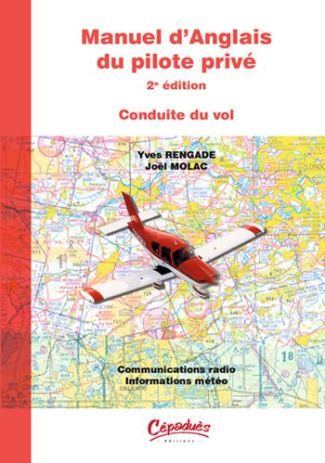
MANUEL D'ANGLAIS DU PILOTE PRIVE - CONDUITE DU VOL - 2E ED.
Le double objectif de ce premier tome du Manuel d'Anglais du pilote privé est de vous permettre d'acquérir une solide maîtrise des communications radio et un niveau de compréhension satisfaisant de l'information météo, en particulier lorsque celle-ci vous est diffusée oralement. Il est complété par un second tome dont le but est de vous donner la capacité d'exploiter pleinement l'information aéronautique nécessaire à la préparation et à la conduite du vol (fiches de terrain, NOTAMS). Ce volume est divisé en deux parties : La première, consacrée aux communications radio, comprend six unités ; quatre d'entre elles sont fondées sur l'exploitation d'enregistrements authentiques de radiotéléphonie, dont deux ont été recueillis en Grande-Bretagne et les deux autres aux Etats-Unis. Pour le volet britannique, il vous est proposé successivement des échantillons de communications enregistrées dans la tour de l'aérodrome de Wycombe (près de Londres) et un vol complet, effectué à partir de ce terrain dans le sud de l'Angleterre. De même, pour le volet américain, vous exploiterez tour à tour des séquences recueillies dans la tour de l'aérodrome de Vero Beach (Floride) et l'enregistrement d'un vol complet sur le parcours aller-retour Vero Beach-Orlando. Chacune des quatre séquences est accompagnée d'exercices qui vous permettront d'assimiler le vocabulaire utilisé en situation réelle, de vous entraîner à collationner les instructions du contrôle et à gérer les communications radio tout au long d'un vol. Les unités 5 et 6 sont consacrées respectivement aux situations non-routinières, aux anomalies de fonctionnement et aux urgences, ceci afin que vous soyez en mesure de réagir de manière appropriée à des instructions ou informations qui impliquent l'utilisation d'un vocabulaire élargi et de rendre compte au contrôle de problèmes éventuels. La seconde partie du manuel traite de l'information météo ; elle comprend quatre unités qui vous permettront de vous familiariser successivement avec des METARs/TAFs et AREA FORECASTS britanniques, suivis de TIBS (Telephone Information Briefing Service) américains.IndisponibleVOIR PRODUIT80,00 € -

La psychothérapie : approches comparées par la pratique
Cet ouvrage apporte un éclairage nouveau et différent sur la pratique de la psychothérapie et propose une aide efficace au praticien en lui offrant de travailler sur des cas cliniques tirés de l'exercice au quotidien. Les auteurs, tous deux psychiatres, l'un d'orientation psychanalytique, éclectique et intégrative, et l'autre cognitvo-comportementaliste, confrontent leur approche du patient. Ainsi, de l'entretien clinique à la mise en place de solutions thérapeutiques, ils soulèvent les questions fondamentales auxquelles sont confrontés les psychothérapeutes. En effet chaque cas part d'une rencontre avec un patient et détaille un point de difficulté précis selon différents angles théoriques, en particulier psychanalytique ou cognitif et comportemental, de manière claire et didactique, pour proposer des solutions directement applicables dans la pratique quotidienne. Cette démarche incite le lecteur à réfléchir à sa pratique personnelle ou aux efforts de mise en pratique en répondant à ces questions, puis à confronter ses propres tentatives de réponse à la conceptualisation et à l'argumentation proposée par les auteurs. Destiné aux psychothérapeutes, cet ouvrage constitue un outil clair et pédagogique, qui apporte des réponses concrètes au quotidien du thérapeute.EpuiséVOIR PRODUIT35,90 €



Du même éditeur
-
-
-
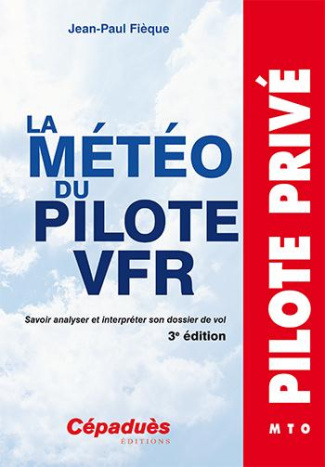
LA METEO DU PILOTE VFR - 3E EDITION - SAVOIR ANALYSER ET INTERPRETER SON DOSSIER DE VOL
L'idée d'écrire un tel ouvrage a été suggérée à l'auteur par des pilotes inspecteurs qui font trop souvent le constat que les candidats pilote VFR ont quelques lacunes dans la lecture et la compréhension des documents météo de vol, en association avec la représentation graphique de l'état de l'atmosphère. Ce livre n'a pas la prétention de répondre à toutes les questions afférentes au mécanisme complexe qu'est l'atmosphère. Il apporte seulement une sorte de synthèse d'analyse afin que le pilote puisse exploiter au mieux ses documents météorologiques. Le but est de savoir faire la liaison entre les caractéristiques du courant général de l'atmosphère, les nuages associés et les messages d'observation et de prévision, pour finir sur une image satellitale animée si possible. Même si l'apprentissage des codes météorologiques reste fastidieux, ce manuel va permettre de décrypter les messages plus aisément, grâce à des exemples de situations météorologiques délicates. Avec un peu d'expérience, le pilote pourra se faire une idée rapide des conditions météo qui se présentent à lui lors d'un vol de navigation VFR. Fort de ces connaissances, il aura un esprit critique plus pertinent et sera à même de comparer la situation prévue à la situation réelle, afin que le déroulement de son vol soit exempt de toute surprise.Table des matières CHAPITRE IAnalyse de cartes ANALYSE D'UNE CARTE EN SURFACEANALYSE D'UNE CARTE EN ALTITUDEINFLUENCE SAISONNIÈRE DE LA POSITION DES CENTRES D'ACTIONCARTES MÉTÉOROLOGIQUES DES VENTS ET DES TEMPÉRATURES EN ALTITUDE DESTINEES A L'AÉRONAUTIQUECHAPITRE II Description des nuages NUAGES DE L'ETAGE SUPERIEURNUAGES DE L'ETAGE MOYENNUAGES DE L'ETAGE INFERIEURCHAPITRE III Constitution du dossier de volLES UNITES EMPLOYEESLES CARTES DE VENT ET DE TEMPÉRATURES EN ALTITUDE. WINTEM (WINDS TEMPERATURES)LES CARTES TEMSI (EUROC : EUROPE OCCIDENTALE)LES MESSAGES METAR ET SPECIMESSAGES TAFMESSAGES SIGMET CHAPITRE IV Interprétation des images satellitaires, radar et impact de foudreLES SATELLITES MÉTÉOLES IMAGES RADARLES IMPACTS DE FOUDRECHAPITRE VAnalyse pratique du dossier météoCOMMENT IDENTIFIER SUR UNE SERIE DE METAR LE PASSAGE D'UN FRONT CHAUD ...COMMENT IDENTIFIER SUR UNE SERIE DE METAR LE PASSAGE D'UN FRONT FROID ...CONCORDANCE DES DONNEES METEO ENTRE CARTES DES VENTS,CARTE TEMSI, METAR ET TAFCOMMENT ANALYSER LA SITUATIONCHAPITRE VI Quelques phénomènes météorologiques locauxLES VENTS REGIONAUXLES VENTS LOCAUX LES PHENOMENES DANGEREUX POUR LE VOL VFRIndisponibleVOIR PRODUIT23,00 € -
AIRCOM - ENGLISH COURSE IN RADIO COMMUNICATIONS FOR AIRLINES PILOTS - ACCESS TO ICAO LEVELS 4 & 5
MP3 sound files inside This course in radio communications, designed by the reference expert in Aviation English, Yves Rengade, is the only one to be based on authentic in-flight recordings used as language training material which will help you to acquire or consolidate the competences required by ICAO by adopting a personalized method of working. Texte de présentation The aim of this manual is to help you to acquire or consolidate the competences required by ICAO and, to this end, to adopt a personalized method of working. The advantage of the approach followed by ICAO is that it clearly identifies the competences whose acquisition guarantees the required linguistic level ; the objectives being clearly defined, it is important that from the outset you prioritize your needs so that you can organize your work accordingly. Two categories may be listed as follows : - either you may judge that you are lacking in each of the competences in the ICAO grid ; in this case you would have to revise thoroughly all the domains in order to reach the five objectives set out in the manual. - or you may judge that you have mastered one competence well but feel less confident in another ; the layout of the manual allows you to concentrate on the domains which, in your opinion, necessitate more attention. Whatever the category, it would be advisable not to go through the manual in a rectilinear fashion. Its structure allows you, if you so wish, to go to and from one competence and another ; thus progressively, you will master all of them and will be able to use them with confidence. Since the manual is divided into two main parts - Access to level 4 & Access to level 5 - you can modify your objectives as you progress : it could be that at first you aim for level 4, however nothing prevents you from being more ambitious and going on to level 5. If this manual helps you to progress in this way, then the author's satisfaction will be all the greater. Table of contents First part Access level 4 Objective 1 : Comprehension - Flights1 to 8 Objective 2 : Vocabulary Objective 3 : Pronunciation Objective 4 : Structures Objective 5 : Interaction Read-back exercises In-flight exercises Second part Access level 5 Objective 1 : Comprehension - Non-routine situations Objective 2 : Vocabulary Objective 3 : Pronunciation Objective 4 : Structures Objective 5 : Interaction - Units 1 to 5IndisponibleVOIR PRODUIT68,00 €
