A CHRONICLE OF ETHNIC STRIFE AND PEACE BUILDING IN THE NORTH WEST REGION OF CAMEROON - THE OKU-MBESA
32,50 €
Sur commande en 6-8 jours
EAN :
9782343223230
| Nombre de pages | 298 |
|---|---|
| Date de parution | 25/01/2021 |
| Poids | 364g |
| Largeur | 135mm |
Plus d'informations
| EAN | 9782343223230 |
|---|---|
| Titre | A CHRONICLE OF ETHNIC STRIFE AND PEACE BUILDING IN THE NORTH WEST REGION OF CAMEROON - THE OKU-MBESA |
| Auteur | NGEK MONTEH RENE |
| Editeur | L'HARMATTAN |
| Largeur | 135 |
| Poids | 364 |
| Date de parution | 20210125 |
| Nombre de pages | 298,00 € |
| Disponibilité | Sur commande en 6-8 jours |
Pourquoi choisir Molière ?
Efficacité et rapidité Commandé avant 16h livré demain
Économique et pratique Livraison dès 3,90 €
Facile et sans frais Retrait gratuit en magasin
Du même auteur
-

CHALLENGES OF NON-GOVERNMENTAL ORGANISATIONS (NGOS) IN CONFLICT RESOLUTION - IN THE NORTH WEST REGIO
Sur commande en 6-8 joursCOMMANDER15,00 € -
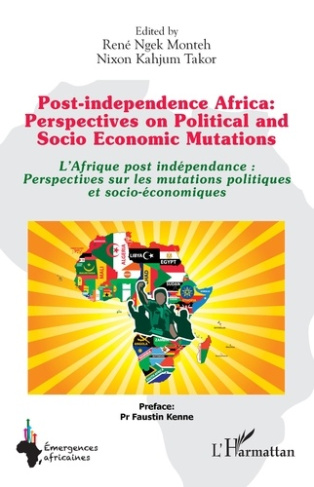
Post-independence Africa: Perspectives on Political and Socio Economic Mutations. L'Afrique post ind
The colonial period and post-independence era are two exciting historical pegs with shared and diametrically opposed narratives on the people and continent of Africa. They are two periods with leverages of continuities and discontinuities. While the colonial period for the most part left the African people as passive recipients of European socioeconomic and political values, colonialism at the same time created strands of resistance that manifested variously as nationalism. The outcome of the nationalist effervescence was the 'termination' of the colonial enterprise and the appropriation of political independence. The independence of most African states was accompanied by a craving to indigenize the political institutions and to orient development along African paradigms. This scholarly compendium of 15 chapters integrates different narratives on the state, stakes, and prospects of the African continent in responding to dynamic socio-economic and political exigencies.Sur commande en 6-8 joursCOMMANDER33,00 € -
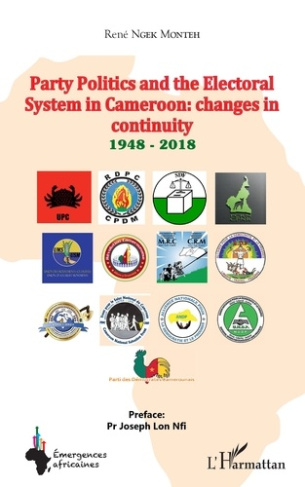
PARTY POLITICS AND THE ELECTORAL SYSTEM IN CAMEROON: CHANGES IN CONTINUITY 1948 - 2018
Few concepts are more central to the modern state and, at the same time, more difficult to define than the concepts of political parties, democracy, and elections. Based on primary, secondary, and alternative sources, the author nonetheless try to defy the odds and explain these concepts as clearly as possible in the context of Cameroon from 1948, the year in which the first political party (UPC) was created and went operational, to 2018, the year in which the last presidential elections took place. In this book, political parties are presented as central institutions of a modern democracy at different epochs. The characteristics and functions of parties, the basic elements of their organisation, their political and social context, as well as the problems of party democracy and the specific challenges faced by parties, besides proposed solutions from within the time frame, are the main issues.Sur commande en 6-8 joursCOMMANDER22,00 € -
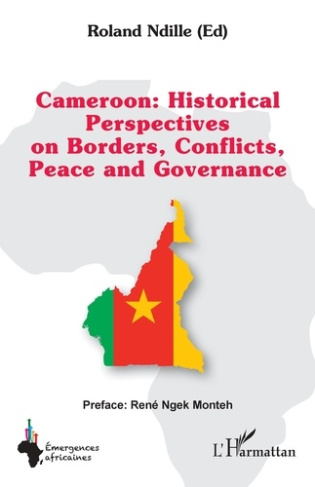
CAMEROON : HISTORICAL PERSPECTIVES ON BORDERS, CONFLICTS, PEACE AND GOVERNANCE
The study of history in Cameroon has most of the time been national and political. In our school textbooks and university courses, there is hardly an emphasis on local contents mastery. This has had implications for the articulation of grassroots research and local contents. Cameroon : Historical Perspectives on Borders, Conflicts, Peace and Governance is an authoritative volume which draws its place in Cameroons historiography from the originality of the historical evidence presented and from the subaltern perspectives adopted. The book, in the majority speaks to local history. It not only draws on local contents but captures the role of local agents and phenomena in historical causation. Topics include land and boundary/border conflicts, indigenous conflict resolution, local players in historical construction, peace building, national questions and identity issues. University lecturers, teachers, researchers and Postgraduate students would find the contents most illuminating while those preparing to undertake research would find it very inspirational.Sur commande en 6-8 joursCOMMANDER35,00 €



Du même éditeur
-
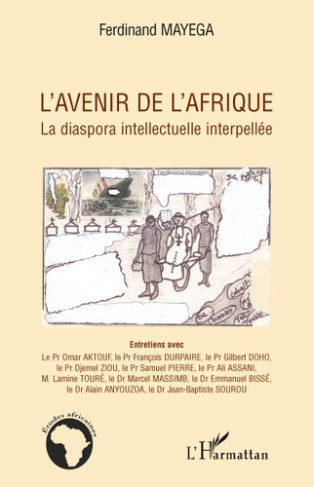
L'AVENIR DE L'AFRIQUE - LA DIASPORA INTELLECTUELLE INTERPELLEE
L'année 2010 marquera, pour de nombreux pays africains surtout francophones, 50 ans d'indépendance, donc de gestion du pouvoir entre les mains des élites dirigeantes africaines. Seulement, un demi-siècle plus tard, un constat se dégage de l'ensemble des Etats africains : le développement semble s'éloigner de l'Afrique au fur et à mesure que les années passent. Pourquoi l'Afrique demeure-t-elle à la traîne malgré toutes les richesses qu'elle possède ? Le continent noir peut-il se sortir du piège de l'aide pour son développement si la bonne gouvernance s'installe effectivement et si les mentalités changent radicalement ? Compte tenu de l'apport remarquable des diasporas intellectuelles notamment chinoise et indienne pour l'émergence de la Chine et de l'Inde, la diaspora intellectuelle africaine, avec l'élection du fils d'Afrique Barack Obama à la Maison Blanche, ne constitue-t-elle pas le meilleur pilier de l'Afrique pour sortir du labyrinthe de la néguentropie ? Dans le cadre de mes recherches de plus d'une décennie, je présente également ce que l'on pourrait assimiler à une nouvelle théorie des relations Nord-Sud. Ce sont ces réflexions et interrogations auxquelles nous essayons de trouver des solutions pour l'avenir de l'Afrique avec quelques brillants intellectuels de la diaspora africaine d'Europe et d'Amérique du Nord.EpuiséVOIR PRODUIT32,00 € -
Les institutions politiques mossis à l'épreuve de la situation coloniale
Avant la conquête française, la plus grande partie de la moitié orientale du Burkina Faso actuel était occupée par les Mossis. On appelle également "mossis" les représentants de l'ordre aristocratique qui dirige ce territoire, souvent qualifié à tort d'empire, un ordre dont les institutions se sont maintenues durant les six décennies de domination coloniale. Pourquoi et comment ce système a-t-il été préservé alors même que la société toute entière vit de grands bouleversements ? Au moment de la conquête, les chefs précoloniaux n'auraient-ils pas dû être renversés et leur système aboli ? Et lorsqu'on s'approche de la décolonisation, c'est-à-dire d'une indépendance accordée à une élite "moderne" formée à l'école coloniale, la question de l'abolition des organisations traditionnelles n'aurait-elle pas dû être de nouveau soulevée ? Comment les structures politiques mossis ont-elles su se maintenir durant la période coloniale ? Selon quelles modalités ...Sur commande en 6-8 joursCOMMANDER29,00 € -