

THE MONK - BY M. G. LEWIS
Lewis claimed to have written The Monk in just ten weeks, when he was twenty-one years of age. He published the first edition anonymously, sensing that the controversial and then-pornographic nature of the novel would stun society. And so it did?the book was so sensational, so salacious, and so scandalous, that after he put his full name (and title, as a member of Parliament) on the second edition, his reputation hardly recovered for the rest of his life.The Monk is a Gothic horror novel marked by an intricate plot, melodramatic characters, and scenes of shocking terror. It follows two plots: in the first, the celebrated monk Ambrosio meets a mysterious novice at the abbey?a woman, Matilda, posing as a man, who seems to have a powerful, irresistible charisma. Matilda seduces Ambrosio not just in body but in mind, and leads him down a path of darkness and brutal violence. In the other plot, Raymond, the son of a marquis, falls in love with a nun, and the two scheme to live together; but their plans lead to encounters with evil spirits, exorcisms, riots, dungeons, and more.The novel was shocking for its time in its frank depiction of sexuality and sexual violence, demons, spirits, and scenes of raw horror; but just as shocking was its anti-religious sentiment and thesis that evil often triumphs over good. It sold so well and offended so many that just two years after its publication Lewis was forced to issue a bowdlerized fourth edition, in which any offensive passages were either muted or expunged. Despite this attempt at satisfying society, and despite at least one written apology, Lewis spent the rest of his days in a constant struggle to escape the shadow of The Monk's reputation, which he never quite did?even posthumous assessments of him as a person sometimes concluded that the debauched excess depicted The Monk reflected a failing of his own personal morals.
| Nombre de pages | 488 |
|---|---|
| Date de parution | 31/03/2026 |
| Poids | 630g |
| Largeur | 148mm |
| EAN | 9791043144844 |
|---|---|
| Auteur | LEWIS C. S. |
| Editeur | CULTUREA |
| Largeur | 148 |
| Date de parution | 20260331 |
| Nombre de pages | 488,00 € |
| Disponibilité | Sur commande en 2-4 jours |
Pourquoi choisir Molière ?
Du même auteur
-

Le Monde de Narnia Tome 1 : Le neveu du magicien
Polly trouve parfois que la vie à Londres n'est guère passionnante... jusqu'au jour où elle rencontre son nouveau voisin, Digory. Il vit avec sa mère, gravement malade, et un vieil oncle au comportement étrange. Celui-ci force les deux enfants à essayer des bagues magiques qui les transportent dans un monde inconnu. Commence alors la plus extraordinaire des aventures...En stockCOMMANDER12,90 € -

Arrowsmith. By sinclair lewis
Martin Arrowsmith, the titular protagonist, grows up in a small Midwestern town where he wants to become a doctor. At medical school he meets an abrasive but brilliant professor, Gottlieb, who becomes his mentor. As Arrowsmith completes his training he begins a career practicing medicine. But, echoing Lewis's Main Street, small-town life becomes too insular and restricting; his interest in research and not people makes him unpopular, and he decides to work in a research laboratory instead.From there Arrowsmith begins a career that hits all of the ethical quandaries that scientists and those in the medical profession encounter: everything from the ethical problem of research protocol strictness versus saving lives, to doing research for the betterment of mankind versus for turning a profit, to the politics of institutions, to the social problems of wealth and poverty. Arrowsmith struggles with these dilemmas because, like all of us, he isn't perfect. Despite his interest in helping humanity, he has little interest in people?aside from his serial womanizing?and this makes the path of his career an even harder one to walk. He's surrounded on all sides by icons of nobility, icons of pride, and icons of rapaciousness, each one distracting him from his calling.Though the book isn't strictly a satire, few escape Lewis's biting pen. He skewers everyone indiscriminately: small-town rubes, big-city blowhards, aspiring politicians, doctors of both the noble and greedy variety, hapless ivory-towered researchers, holier-than-thou neighbors, tedious gilded-age socialites, and even lazy and backwards islanders. In some ways, Arrowsmith rivals Main Street in its often-bleak view of human nature?though unlike Main Street, the good to humanity that science offers is an ultimate light at the end of the tunnel.The novel's publication in 1925 made it one of the first serious "science" novels, exploring all aspects of the life and career of a modern scientist. Lewis was aided in the novel's preparation by Paul de Kruif, a microbiologist and writer, whose medically-accurate contributions greatly enhance the text's realist flavor.In 1926 Arrowsmith was awarded the Pulitzer Prize, but Lewis famously declined it. In his refusal letter, he claimed a disinterest in prizes of any kind; but the New York Times reported that those close to him say he was still angered over the Pulitzer's last-minute snatching of the 1921 prize from Main Street in favor of giving it to The Age of Innocence.Sur commande en 2-4 joursCOMMANDER29,95 € -

-



Du même éditeur
-

Essai sur la nature du commerce en général
Essai sur la nature du commerce en général" est un ouvrage fondamental de Richard Cantillon, écrit aux alentours de 1730 et publié posthumement en 1755. Ce livre est souvent considéré comme l'un des premiers traités d'économie moderne, où Cantillon jette les bases de l'analyse économique systématique. Dans cet essai, Cantillon explore plusieurs aspects de l'économie, notamment la production, la distribution et la circulation des richesses. Il introduit le concept d'entrepreneur, défini comme un individu qui prend des risques pour organiser la production et la distribution. Cantillon met en lumière l'importance de l'anticipation des prix futurs et de l'incertitude dans l'économie de marché. Cantillon analyse également la formation des prix, soulignant le rôle des coûts de production et de la demande dans leur détermination. Il explique comment les terres et les travaux, en tant que sources de toutes les richesses, influencent les prix des produits. L'ouvrage décrit les différentes classes sociales et leur rôle économique : les propriétaires fonciers, les entrepreneurs et les travailleurs, montrant comment chacun contribue à l'économie. Cantillon aborde la circulation monétaire, en expliquant comment la quantité de monnaie en circulation influence les niveaux de prix et comment les échanges internationaux affectent les économies nationales. Il décrit le mécanisme d'équilibre automatique de la balance commerciale, anticipant des théories économiques développées plus tard. En résumé, "Essai sur la nature du commerce en général" de Richard Cantillon est une oeuvre pionnière en économie. Il introduit des concepts fondamentaux tels que l'entrepreneur, la formation des prix, et l'importance des terres et du travail. Cantillon propose une analyse détaillée de la structure sociale et économique, offrant des idées qui ont profondément influencé la pensée économique ultérieure.En stockCOMMANDER14,00 € -

Maria chapdelaine - by louis hemon (version en anglais)
It takes a hardy people to survive farming the harsh lands of the French Canadian wilderness, and Maria Chapdelaine must choose either to remain Québécois in this unforgiving land that has broken her heart, or to pursue a softer urban life in foreign New England.French writer Louis Hémon wrote Maria Chapdelaine during the two years he lived in Quebec, and it's based on his experiences working on a farm in the Lac Saint-Jean region where the novel is set. It was his only work published in his lifetime, as he died in a tragic train accident before learning of its success.The novel is described as a masterwork that was Canada's entry into world literature and Quebec's introduction to the rest of the Francophone world. An enduring work, it has served as the basis of four movies, and has been adapted into plays, an illustrated novel, a radio novel, a television series, and an opera.En stockCOMMANDER19,95 € -

Du sang, de la volupté et de la mort. Les récits poignants de Maurice Barrès, explorant la mort, la
Dans 'Du sang, de la volupté et de la mort', Maurice Barrès explore des thèmes profonds tels que la mort, la sensualité et le deuil. A travers une prose sombre et éclatante, il évoque la mémoire de Jules Tellier, un ami disparu, et médite sur la condition humaine. Le livre aborde également des réflexions sur l'art, la passion et la solitude, à travers des récits poignants et des portraits saisissants.Sur commande en 2-4 joursCOMMANDER19,90 € -
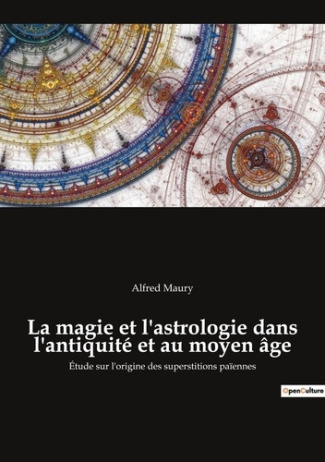
La magie et l'astrologie dans l'antiquité et au moyen âge - Magie astrologie et croyances savantes
Présenter en aperçu l'histoire de ce grand mouvement de l'esprit humain qui nous éleva graduellement de la magie et de l'astrologie à la science moderne, tel est le but de ce petit ouvrage. On a écrit déjà plusieurs fois l'histoire de la magie. Les uns ont cherché dans l'ensemble de ces croyances chimériques des preuves à l'appui de leur solidité ; les autres n'ont voulu que nous inspirer un profond dédain pour tant de folies et d'absurdités ; nul n'a songé à tirer de la comparaison des faits un enseignement réellement philosophique, et à marquer les différentes phases par lesquelles a passé une science qui, toute chimérique qu'elle est, a été cependant le début nécessaire des grandes découvertes qui devaient en ruiner les fondements. Je tenterai de le faire. J'aurais pu accumuler bien des témoignages et grossir ce volume d'une foule de détails intéressants ; mais j'ai voulu me borner à indiquer la voie qu'a suivi l'esprit humain, et je n'ai demandé à mes lectures que les citations indispensables à la démonstration de la vérité. (A. Maury)Impression à la demandeCOMMANDER22,00 €


