DELIRIOUS NEW YORK - A RETROACTIVE MANIFESTO FOR MANHATTAN
Since its publication - Delirious New York (1978) has attained mythic status. Rem Koolhaas's celebration and analysis of New York depicts the city as a metaphor for the variety of human behavior At the end of the nineteenth century, population, information, and technology explosions made Manhattan a laboratory for the invention and testing of a metropolitan lifestyle - "the culture of congestion" - and its architecture. "Manhattan," he writes, "is the 20th century's Rosetta Stone . . . occupied by architectural mutations (Central Park, the Skyscraper), utopian fragments (Rockefeller Center, the U.N. Building), and irrational phenomena (Radio City Music Hall)." Koolhaas interprets and reinterprets the dynamic relationship between architecture and culture in a number of telling episodes of New York's history, including the imposition of the Manhattan grid, the creation of Coney Island, and the development of the skyscraper. Delirious New York is also packed with intriguing and fun facts and illustrated with witty watercolors and quirky archival drawings, photographs, postcards, and maps. The spirit of this visionary investigation of Manhattan equals the energy of the city itself.
| Date de parution | 01/12/1997 |
|---|---|
| Poids | 950g |
| Largeur | 183mm |
| EAN | 9781885254009 |
|---|---|
| Titre | DELIRIOUS NEW YORK - A RETROACTIVE MANIFESTO FOR MANHATTAN |
| Auteur | KOOLHAAS REM |
| Editeur | MONACELLI PRESS |
| Largeur | 183 |
| Poids | 950 |
| Date de parution | 19971201 |
| Nombre de pages | 0,00 € |
| Disponibilité | Sur commande en 2-4 jours |
Pourquoi choisir Molière ?
Du même auteur
-
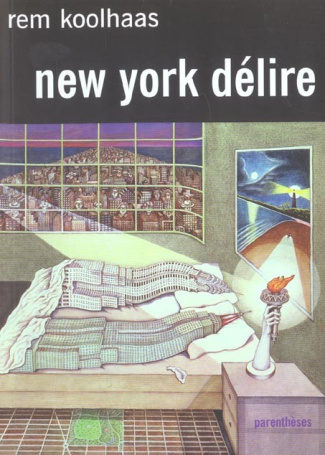
New York délire
Manhattan est l'arène où se joue le dernier acte du monde occidental. Avec l'explosion démographique et l'invasion des nouvelles technologies, Manhattan, depuis le milieu du XIXe siècle est devenu le laboratoire d'une nouvelle culture - celle de la congestion - ; une île mythique où se réalise l'inconscient collectif d'un nouveau mode de vie métropolitain, une usine de l'artificiel où naturel et réel ont cessé d'exister. New York Délire est un " manifeste rétroactif ", une interprétation de la théorie informulée, sous-jacente au développement de Manhattan ; c'est le récit des intrigues d'un urbanisme qui, des origines à Coney Island jusqu'aux théoriciens du gratte-ciel, a fait exploser la grille d'origine. Ce livre, polémique et prémonitoire (publié en 1978), illustre les relations entre un univers métropolitain mutant et la seule architecture qu'il puisse produire. Il dit aussi que, souvent, l'architecture génère la culture.EpuiséVOIR PRODUIT29,00 € -
Vers une architecture extrême / Entretiens
Convertir l'optimisme en danger et laisser celui-ci s'exprimer procède d'une forme de créativité dont on peut dire qu'elle a toujours figuré au coeur du programme architectural de Rem Koolhaas. Toutefois, ce principe n'a jamais été aussi clairement explicité que dans ce livre-manifeste. Les spectaculaires affirmations et les implacables défis y sont développés tout au long de ces "conversations" avec les étudiants de l'école d'architecture de la Rice University à Houston. Datés de janvier 1991, ces échanges n'ont rien perdu de leur fulgurance et de leur actualité. L'optimisme de Koolhaas est dual : il affirme non seulement que l'architecture doit se détourner de la vanité et du narcissisme confortables qui continuent à l'isoler des réalités historiques, mais également que la réflexion architecturale doit se recentrer sur la découverte de nouveaux potentiels et dans la ligne des forces de modernisation et des inévitables transformations en cours.Sur commande en 4-6 joursCOMMANDER11,00 € -
S, M, L, XL
This extraordinary, massive, and mind-boggling 1,300-page book combines essays, manifestos, diaries, fairy tales, travelogues, a cycle of meditations on the contemporary city--and complex illustration--with work produced by Koolhaas"Office for Metropolitan Architecture over the past twenty years. This almost overwhelming accumulation of words and images illuminates the condition of architecture today--its splendors and miseries--exploring and revealing the corrosive effects of politics, context, the economy, and globalization. In some ways, this is the"Medium is the Message"of 1990s architectural discourse: guaranteed to be hugely influential in the coming decades, but grossly misunderstood by those who have not read it. The core arguments it makes about metropolitan architecture--accepting complexity and lack of centralized control--are similar to those of Kevin Kelly's Out of Control: The New Biology of Machines, Social Systems and the Economic World. Very highly recommended."EpuiséVOIR PRODUIT79,95 € -
Etudes sur (ce qui s'appelait autrefois) la ville
A la manière des "Images de pensée" de Walter Benjamin, Rem Koolhaas s'interroge sur les profonds bouleversements qui touchent la nature même des villes contemporaines. Que ce soit Atlanta, Singapour, Paris, Lille, Berlin, Tokyo, Moscou, New York, Londres, une question revient : qu'est-ce que la ville aujourd'hui ? Pourquoi des architectes, des systèmes politiques, des cultures (américaine, européenne, asiatique) complètement différents en arrivent à des configurations relativement similaires ...Sur commande en 2-4 joursCOMMANDER18,50 €