

Acid for the Children - VO
20,99 €
Sur commande en 6-10 jours
EAN :
9781472230829
Plus d'informations
| EAN | 9781472230829 |
|---|---|
| Auteur | Flea |
| Editeur | GARDNERS |
| Date de parution | 20180925 |
| Disponibilité | Sur commande en 6-10 jours |
Pourquoi choisir Molière ?
Efficacité et rapidité Commandé avant 16h livré demain
Économique et pratique Livraison dès 3,90 €
Facile et sans frais Retrait gratuit en magasin
Du même auteur
-

Ados sous acide
Les mémoires brutes et fascinantes du bassiste et cofondateur des RED HOT CHILI PEPPERS Aujourd'hui icône du rock, Flea a autrefois été un gamin turbulent occupé à courir les rues, faire la fête et prendre tous les risques. De sa prose rêveuse, teintée de jazz, il redonne vie au Los Angeles des années 1970 et 1980, avec tout le plaisir, le danger, le chaos ou l'inspiration que peuvent cacher les rues. C'est à la marge de cette ville que le jeune Flea, cherchant à fuir un foyer à l'ambiance orageuse, a trouvé une famille dans une communauté de musiciens, d'artistes et de junkies. Là qu'il a rencontré un autre paria, Anthony Kiedis, rapidement devenu son âme soeur, le yin de son yang, son partenaire dans l'espièglerie. Avec une prose aussi spirituelle, divertissante et follement imprévisible que l'auteur lui-même, Ados sous acide nous révèle les sommets vertigineux comme les bas-fonds qu'il a atteints. Au travers d'anecdotes hilarantes, de réflexions sensibles et de quelques envolées sauvages, Flea fait la chronique habile des expériences qui l'ont forgé en tant qu'artiste et en tant qu'homme. Traduit de l'anglais (Etats-Unis) par Valérie Le Plouhinec. A propos de l'auteur Né en Australie, Flea est un musicien et acteur américain, principalement connu en tant que bassiste et cofondateur du groupe de rock Red Hot Chili Peppers. Il a également cofondé en 2001 le Silverlake Conservatory of Music, un centre d'éducation musicale à but non lucratif à destination des enfants défavorisés.EpuiséVOIR PRODUIT20,10 € -
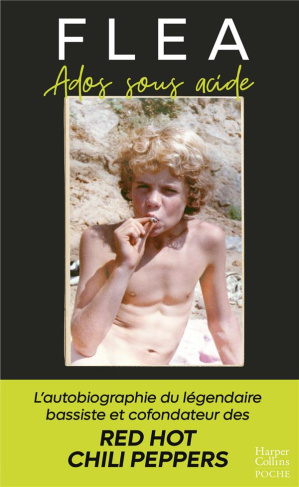
Ados sous acide
Les mémoires brutes et fascinantes du bassiste et cofondateur des Red Hot Chili Peppers Aujourd'hui véritable icône du rock, Flea fut un temps "Michael" , un gamin turbulent occupé à courir les rues de Los Angeles dans les années 1970-1980. C'est à la marge de cette ville que, fuyant un foyer où les orages s'enchaînent, il trouve une famille dans une communauté de musiciens et de junkies. Là qu'il rencontre un autre paria, Anthony Kiedis, celui qui deviendra son partenaire de tous les coups. Au travers d'anecdotes, de réflexions et de quelques envolées aussi follement imprévisibles que l'auteur lui-même, Ados sous acide nous révèle l'ascension d'un jeune rêveur comme ses chutes et ses errances. D'une plume teintée de jazz, Flea fait la chronique habile des expériences qui l'ont forgé en tant qu'artiste et en tant qu'homme. Traduit de l'anglais (Etats-Unis) par Valérie Le Plouhinec. EDITEUR GF : HARPER A propos de l'auteur Né en Australie, Flea est un musicien et acteur américain, bassiste et cofondateur du groupe de rock Red Hot Chili Peppers. Il a également cofondé en 2001 le Silverlake Conservatory of Music, un centre d'éducation musicale à but non lucratif à destination des enfants défavorisés. " Le miracle, c'est cette plume groovy, sensible, drôle et acide à la fois. " Sophie Rosemont, Rolling Stone "Un recueil de souvenir, écrit avec l'habituelle énergie de la "puce" californienne, mais aussi une profondeur émotionnelle qu'on ne soupçonnait pas". Stéphanie Binet, Le MondeEn stockCOMMANDER8,75 € -
Rêver le monde. Promenade initiatique
Rêver le Monde présente l'oeuvre inclassable de Jean Fléaca, poète et artiste. Il nous invite à voir la beauté du monde, à lâcher notre univers quotidien pour nous laisser entraîner dans la joie d'une redécouverte joyeuse et poétique.Sur commande en 4-6 joursCOMMANDER24,00 € -
En finale. Volume 1
La plupart des livres de finales traitent des positions à matériel très réduit, souvent inventées par d'habiles compositeurs. Certes, il est utile de connaître la théorie de ces finales élémentaires, mais nombre de joueurs peinent à s'y intéresser vraiment car ils ne rencontrent que rarement ce type de positions dans leurs parties. En effet, la transition entre milieu de partie et finale théorique est loin d'être toujours brutale, et, avant de rentrer dans une finale Fou contre Cavalier ou Tour contre Tour, par exemple, on peut avoir à jouer longtemps avec Tour et Fou contre Tour et Cavalier... un rapport de force sur lequel il n'est pas si facile de trouver du matériel! Glenn Flear comble ici une lacune de la littérature échiquéenne en s'intéressant aux positions qui, outre les Rois et les pions, opposent deux pièces à zéro, une ou deux pièces. En plus de 350 exemples, ce premier volume couvre les situations avec un net avantage matériel, les diverses configurations de lutte entre paires de pièces mineures et les combats asymétriques comme Tour contre deux pièces mineures ou Dame contre deux Tours. La qualité des exemples n'a rien à envier à leur quantité: la plupart sont extraits de rencontres entre des joueurs du gratin mondial, et Kasparov, Karpov, Kramnik, Anand et Topalov sont parmi les joueurs les plus souvent cités. L'auteur donne également de nombreux exemples qu'il connaît bien pour les avoir rencontrés dans ses propres parties. Les commentaires vont à l'essentiel et aident le lecteur à tirer les leçons de la pratique des grands joueurs. Parce que vous retrouverez nombre de situations similaires à celles que vous avez déjà rencontrées - et rencontrerez encore - devant l'échiquier, c'est probablement le livre de finales que vous consulterez souvent!EpuiséVOIR PRODUIT24,80 €


Du même éditeur
-

The Man in the High Castle
Revue de presse The most brilliant sci-fi mind on any planet (Rolling Stone)California's own William Blake. Visionary and prophet (Daily Telegraph)Sur commande en 6-10 joursCOMMANDER11,30 € -

The water knife
From the international bestselling author of the Hugo and Nebula award-winning The Windup Girl, comes an electrifying thriller set in a world on the edge of collapse.WATER IS POWERThe American Southwest has been decimated by drought, Nevada and Arizona skirmish over dwindling shares of the Colorado River, while California watches.When rumors of a game-changing water source surface in Phoenix, Las Vegas water knife Angel Velasquez is sent to investigate.With a wallet full of identities and a tricked-out Tesla, Angel arrows south, hunting for answers that seem to evaporate as the heat index soars and the landscape becomes more and more oppressive. There, Angel encounters Lucy Monroe, a hardened journalist who knows far more about Phoenix's water secrets than she admits, and Maria Villarosa, a young Texas migrant who dreams of escaping north to those places where water still falls from the sky.As bodies begin to pile up and bullets start flying, the three find themselves pawns in a game far bigger, more corrupt, and dirtier than any of them could have imagined. With Phoenix teetering on the verge of collapse and time running out, their only hope for survival rests in one another's hands.But when water is more valuable than gold, alliances shift like sand, and the only truth in the desert is that someone will have to bleed if anyone hopes to drink.Sur commande en 6-10 joursCOMMANDER11,25 € -

-

In Pale battalions
Extrait Chapter OneChildhood memories fit their own intricate pattern. They cannot be made to conform to the version of our past we try to impose upon them. Thus I could say that Lord and Lady Powerstock and the home they gave me at Meongate more than compensated for being an orphan, that a silver spoon easily took the place of my mother's smile. I could say it--but every recollection of my early years would deny it.Meongate must once have been the crowded, bustling house of a cheerful family, as the Hallowses must once have been that family. Every favour of nature in its setting where the Hampshire downs met the pastures of the Meon valley, every effort of man in its spacious rooms and landscaped park, had been bestowed on the home of one small child.Yet it was not enough. When I was growing up at Meongate in the early 1920s, most of its grandeur had long since departed. Many of the rooms were shut up and disused, much of the park turned over to farmland. And all the laughing, happy people I imagined filling its empty rooms and treading its neglected lawns had vanished into a past beyond my reach.I grew up with the knowledge that my parents were both dead, my father killed on the Somme, my mother carried off by pneumonia a few days after my birth. It was not kept from me. Indeed, I was constantly reminded of it, constantly confronted with the implication that I must in some way bear the blame for the shadow of grief, or of something worse, that hung over their memory. That shadow, cast by the unknown, lay at the heart of the cold, dark certainty that also grew within me: I was not wanted at Meongate, not welcomed there, not loved.It might have been different had my grandfather not been the grave, withdrawn, perpetually melancholic man that he was. I, who never knew him when he was young, cannot imagine him as anything other than the wheelchair-bound occupant of his ground-floor rooms, deprived by his own morbidity, as much as by the lingering effects of a stroke, of all warmth and fondness. When Nanny Hiles took me, as she regularly did, to kiss him goodnight, all I wanted to do was escape from the cold, fleeting touch of his flesh. When, playing on the lawn, I would look up and see him watching me from his window, all I wanted to do was run away from the mournful, questing sadness in his eyes. Later, I came to sense that he was waiting, waiting for me to be old enough to understand him, waiting in the hope that he would live to see that day.Lady Powerstock, twenty years his junior, was not my real grandmother. She was buried in the village churchyard, another ghost whom I did not know and who could do nothing to help me. I imagined her as everything her successor was not--kind, loving and generous--but it did me no good. Olivia, the woman I was required to address as Grandmama in her place, had once been beautiful and, at fifty, her looks were still with her, her figure still fine, her dress sense impeccable. That we were not related by blood explained, to my satisfaction, why she did not love me. What I could not explain was why she went so far as to hate me, but hate me she undoubtedly did. She did not trouble to disguise the fact. She let it hover, menacing and unspoken, at the edge of all our exchanges, let it grow as an awareness between us, a secret confirmation that she too was only waiting, waiting for death to remove her husband and with him any lingering restraint on her conduct towards me. There was an air of practised vice about her that was to draw men all her life, an air of voluptuous pleasure at her own depravity that made her hatred of me seem merely instinctive. Yet there was always more to it than that. She had drawn some venom from whatever part she had played in the past of that house and had reserved it for me.My only friend in those days, my only guide through Meongate's hidden perils, was Fergus, the taciturn and undemonstrative major-domo, "shifty" as Olivia described him and certainly not as deferential as he should have been, but none the less my sole confidant. Sally, the sullen maid, and humourless Nanny Hiles both went in awe of Olivia, but Fergus treated her with an assurance, bordering on disrespect, that made him my immediate ally. A cautious, solitary, pessimistic man who had expected little from life and consequently been spared many disappointments, perhaps he took pity on a lonely child whose plight he understood better than she did herself. He would take me on covert expeditions through the grounds, or down to the wooded reach of the Meon where he fished of a quiet afternoon, or into Droxford in the trap, when he would buy me a twist of sherbet and leave me sitting on the wall outside Wilsmer's saddlery whilst he went in to haggle over a new bridle for the pony. For such brief moments as those, kicking my heels on Mr. Wilsmer's wall and eating my sherbet in the sunshine, I was happy. But such moments did not last.It was Fergus who first showed me my father's name, recorded with the other war dead of the village, on a plaque at the church. Their Name Liveth for Evermore, the inscription said, and his name--Captain the Honourable John Hallows--is all that did live for me. I would stare at it for what seemed like hours trying to conjure up the real living and breathing father that he had never been to me, seeing only those stiff, expressionless, uniformed figures preserved by photographs in back copies of the Illustrated London News, glimpsing no part of his true self beyond the neatly carved letters of his name.As for my mother, of her there was no record at all, no grave, no memorial of any kind. Fergus, when I questioned him, prevaricated. My mother's grave, if she had one, was far away--and he did not know where. There were, I was to understand, limits to what even he could tell me. Whether he suggested it or not I cannot remember, but, for some reason, I decided to ask Olivia. I cannot recall how old I was when it happened, but I had followed her into the library, where she often went to look at a painting that hung there."Where is my mother's grave?" I said bluntly, partly intending the question to be a challenge. All hatred is, in time, reciprocated and I had come to hate Olivia as much as she hated me; I did not then appreciate how dangerous an enemy she could be.She did not answer in words. She turned aside from that great, high, dark painting and hit me so hard across the face that I nearly fell over. I stood there, clutching the reddening bruise, too shocked by the pain of it to cry, and she stooped over me, her eyes blazing. "If you ever ask that question again," she said, "if you ever mention your mother again, I'll make you suffer."The mystery of my mother thenceforth became the grand and secret obsession of my childhood. My father's death, after all, had a comforting simplicity about it. Every November there was an Armistice Parade in the village to commemorate the sacrifice of Captain the Honourable John Hallows and the many others like him. Though not permitted to join the Brownie troop that took part in the parade, I was allowed to go and watch and could imagine myself marching with all the little girls who, like me, had lost their father. But, at the end of the parade, they went home to their mothers; I could not even remember mine.Sometimes, though, I thought I could remember her. It was impossible, of course, if what I had been told of her was true, but Olivia had succeeded in making me doubt everything I had not personally experienced, and there was one dim, early memory, seemingly at the very dawn of my recollection, to sustain what I so wanted to believe.I was standing on the platform at Droxford railway station. It was a hot summer's day: I could feel the heat of the gravel seeping up through my shoes. A train was standing at the platform, great billows of smoke rising as the engine gathered steam. The man standing beside me, who had been holding my hand, stooped and lifted me up, cradling me in his arms to watch the train pull out. He was stout and white-haired. I remember the rumble of his voice and the brim of his straw hat touching my head as he raised his free hand to wave. And I was waving too, at a woman aboard the train who had wound down the window and was leaning out, waving also and smiling and crying as she did so. She was dressed in blue and held a white handkerchief in her right hand. And the train carried her away. And then I cried too and the stout old man hugged me, the brass buttons on his coat cold against my face.I recounted the memory to Fergus one day, when we were returning from a mushrooming expedition. When I had finished, I asked him who he thought the old man was."Sounds like old Mr. Gladwin," he replied. "The first Lady Powerstock's father. He lived here . . . till she sent him away." By she Fergus always meant Olivia."Why did she do that?""She'd have had her reasons, I don't doubt.""When did he go?""The summer of 1920, when you were three. Back to Yorkshire, so they say. A proper caution, was Mr. Gladwin.""Who was the pretty lady, Fergus?""That I don't know.""Was she . . . my mother?"He pulled up and looked down at me with a frown. "That she was not," he said with deliberate slowness. "Your mother passed away a few days after she had you. You know that. No amount of wanting is going to make you remember her.""Then . . . who was the pretty lady?"His frown became less kindly. "I told you: I don't know. That Mr. Gladwin, he was a close one. Now, look to that napkin or you'll pitch your breakfast into the lane--and mine with it."If the pretty lady wasn't my mother, who was she? What was old Mr. Gladwin, my great-grandfather, to her? There were no answers within my reach, just the secret hope I went on harbouring that maybe my mother wasn't really dead at all, just ....Sur commande en 6-10 joursCOMMANDER12,50 €




De la même catégorie
-

Bowie. Les années studio
En près de cinquante ans de carrière, le génie créatif de David Bowie s'est illustré dans tous les domaines : la pop, l'art, la scène, le rock, la mode, le cinéma, le son et le style. Artiste aux mille visages, se jouant des formes et des genres, il aura composé vingt-neuf albums. Bowie. Les Années studio célèbre le génie créatif de l'artiste, en retraçant l'ensemble de sa production studio, depuis son premier album éponyme en 1967, en passant par les classiques des années 1970 que furent The Rise And Fall Of Ziggy Stardust, Aladdin Sane, Station To Station, Low et "Heroes", jusqu'aux petits bijoux que sont The Buddha Of Suburbia ou son ultime opus, Blackstar, lancé deux jours avant son décès. Cet ouvrage, riche d'illustrations rares ou emblématiques signées des plus grands photographes, évoque la genèse de chacun de ces albums, les replaçant dans leur contexte social et musical. Extraits d'interviews, témoignages de ses proches, albums live, singles, compilations, rien n'est oublié dans cet hommage à l'un des artistes majeurs, parmi les plus originaux et imprévisibles, de ces dernières décennies .EpuiséVOIR PRODUIT10,00 € -

Vinyles. L'art du disque
A l'intersection des arts graphiques et de la production musicale, les 33-tours constituent depuis plus d'un demi-siècle un médium visuel et sonore jamais égalé. Depuis l'explosion du phénomène rock dans les années 1950, le disque vinyle a capturé l'imagination de millions d'auditeurs par le biais de pochettes composées à partir de photographies, d'illustrations ou de typographies étudiées. Il se décline au fil des ans sous différents formats (gatefold, picture-discs, vinyles colorés...) et traverse les décennies suivantes en épousant les tendances visuelles de chaque époque. Sévèrement concurrencés par l'avènement du CD dans les années 1990 et 2000, les 33-tours bénéficient aujourd'hui d'un regain d'intérêt auprès d'une nouvelle génération d'auditeurs et de collectionneurs. Au-delà de la nostalgie vinylique, Vinyles rend hommage à "l'objet" disque tout en reproduisant près de 250 pochettes emblématiques dans un luxueux recueil illustré.EpuiséVOIR PRODUIT26,00 € -

The Flame. Poèmes, notes et dessins
Avant sa mort, survenue le 7 novembre 2016 à Los Angeles, Leonard Cohen a passé de longs mois à reparcourir ses carnets, nombreux et étalés sur des décennies, pour opérer une sélection de textes en bonne part inédits (poèmes, chansons, extraits de ses carnets de notes) qui, accompagnés de dessins marqués par l'autodérision, composent le livre qu'il décide de laisser à la postérité, comme un dernier cadeau plein de vie : plein de toute sa vie. On retrouve bien sûr dans ces pages les thèmes de prédilection de celui qui a commencé sa carrière comme poète et romancier, avant de devenir aussi le musicien mondialement célébré qu'on connaît. Il est question d'amour, de passions, de jalousie et de peur de l'abandon, de flamme jamais éteinte, de sexualité, de relations entre les êtres, du temps qui passe et laisse ses traces, de religion aussi, d'aspiration à la sagesse, d'états dépressifs et mélancoliques toujours teintés d'humour.Sur commande en 2-4 joursCOMMANDER25,90 € -

Quand Rennes s'est révélée rock
Marquis de Sade, Etienne Daho, Niagara, Les Nus, Marc Seberg, Dominic Sonic, Kalashnikov, Fraktur, Ubik? Ces artistes ont émergé de la scène rennaise à la fin des années 1970-début des années 1980. L'ébullition punk et rock remuait alors Rennes, en faisant éclore des chanteurs et des musiciens qui allaient influencer les générations suivantes. Comment Rennes est-elle devenue une figure de proue de la musique française à cette époque ? Quels artistes en étaient les acteurs ? Que sont-ils devenus ? Comment et pourquoi ce moment et ce lieu ont-ils été si fondateurs pour les générations suivantes de musiciens ? Pourquoi cette « génération rennaise » est-elle restée si créative ? Grégoire Laville est allé à la rencontre des acteurs de cette époque fondatrice pour des entretiens au long cours, illustrés par des photos personnelles, souvenirs éloquents de cet âge d'or rennais. Entretiens avec Etienne Daho, Frank Darcel (Marquis de Sade), Philippe Pascal (chanteur de Marquis de Sade puis Marc Seberg), Christian Dargelos (Marquis de Sade puis Les Nus), Pascal Obispo, Dominic Sonic, Arnold Turboust, Fraktur (Sergeï Papaïl), Ubik (Philippe Maujard), Hervé Bordier, Jean-Louis Brossard...EpuiséVOIR PRODUIT12,00 €


