

Les Fantômes de Rowan Oak. Histoires de William Faulkner pour les enfants
15,50 €
Epuisé
EAN :
9782232104206
Plus d'informations
| EAN | 9782232104206 |
|---|---|
| Titre | Les Fantômes de Rowan Oak. Histoires de William Faulkner pour les enfants |
| Auteur | Faulkner Wells Dean |
| Editeur | SEGHERS |
| Largeur | 132 |
| Poids | 194 |
| Date de parution | 19930204 |
| Nombre de pages | 144,00 € |
| Disponibilité | Epuisé |
Pourquoi choisir Molière ?
Efficacité et rapidité Commandé avant 16h livré demain
Économique et pratique Livraison dès 3,90 €
Facile et sans frais Retrait gratuit en magasin
Du même auteur
-

Le docteur Martino et autres histoires
Publié en 1934, ce recueil rassemble quatorze histoires dont Faulkner réutilisera quelques-unes dans des livres ultérieurs. Ceci montre l'importance qu'il accorda à ce volume, le deuxième recueil de nouvelles qu'il publiait après Treize histoires. Livre composite, les récits traitent de la guerre aérienne de 14-18 ou apportent des témoignages recueillis au cours des grandes épreuves de l'histoire américaine, comme la guerre de Sécession. Souvent Faulkner, en grand virtuose, rehausse l'intrigue de terribles dénouements oniriques et invite le lecteur à découvrir les mystères qui l'obsèdent, portant sur le monde contemporain un regard étonné, critique et généreux. Quatrième de couverture Publié en 1934, ce recueil rassemble quatorze histoires dont Faulkner réutilisera quelques-unes dans des livres ultérieurs. Ceci montre l'importance qu'il accorda à ce volume, le deuxième recueil de nouvelles qu'il publiait après Treize histoires. Livre composite, les récits traitent de la guerre aérienne de 14-18 ou apportent des témoignages recueillis au cours des grandes épreuves de l'histoire américaine, comme la guerre de Sécession. Souvent Faulkner, en grand virtuose, rehausse l'intrigue de terribles dénouements oniriques et invite le lecteur à découvrir les mystères qui l'obsèdent, portant sur le monde contemporain un regard étonné, critique et généreux.EpuiséVOIR PRODUIT9,50 € -
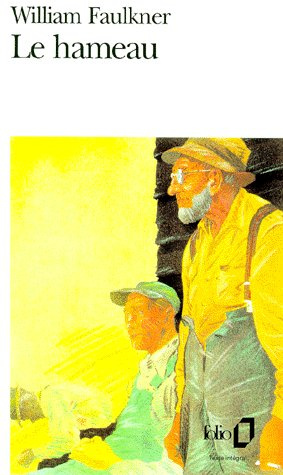
Le Hameau
Flem Snopes, métayer sans fortune, s'introduit dans la famille Warner. Secret et rusé, il parvient à épouser Eula, la fille du vieux Will Warner, supplantant son rival Labove, qui a tenté d'abuser d'elle. Sur le triomphe de Snopes, qui roule tout le monde, et qui symbolise l'avilissement du Sud, s'achève ce premier acte d'une trilogie romanesque qui se poursuivra avec Le domaine et La ville.Sur commande en 2-4 joursCOMMANDER11,20 € -

WILD PALMS
'His prose style is all his own, often sensuously alert, evocative, graceful' Daily Telegraph 'There is no writer living who can play upon a scene the rich and Rembrandtesque flame that Faulkner commands' Evening Standard In this feverishly beautiful novel, William Faulkner interweaves two narratives, each wholly absorbing in its own right, each subtly illuminating the other. In New Orleans in 1937, a man and a woman embark on a headlong flight into the wilderness of illicit passion, she fleeing her husband and the temptations of respectability. In Mississippi ten years earlier, a convict sets forth across a flooded river, risking his one chance at freedom to rescue a pregnant woman. From these separate stories Faulkner composes a symphony of deliverance and damnation, survival and self-sacrifice, a novel in which elemental danger is juxtaposed with fatal injuries of the spirit.EpuiséVOIR PRODUIT13,60 € -
ABSALOM ABSALOM
From a little after two oclock until almost sundown of the long still hot weary dead September afternoon they sat in what Miss Coldfield still called the office because her father had called it that-a dim hot airless room with the blinds all closed and fastened for forty-three summers because when she was a girl someone had believed that light and moving air carried heat and that dark was always cooler, and which (as the sun shone fuller and fuller on that side of the house) became latticed with yellow slashes full of dust motes which Quentin thought of as being flecks of the dead old dried paint itself blown inward from the scaling blinds as wind might have blown them. There was a wistaria vine blooming for the second time that summer on a wooden trellis before one window, into which sparrows came now and then in random gusts, making a dry vivid dusty sound before going away: and opposite Quentin, Miss Coldfield in the eternal black which she had worn for forty-three years now, whether for sister, father, or nothusband none knew, sitting so bolt upright in the straight hard chair that was so tall for her that her legs hung straight and rigid as if she had iron shinbones and ankles, clear of the floor with that air of impotent and static rage like children's feet, and talking in that grim haggard amazed voice until at last listening would renege and hearing-sense self-confound and the long-dead object of her impotent yet indomitable frustration would appear, as though by outraged recapitulation evoked, quiet inattentive and harmless, out of the biding and dreamy and victorious dust.Her voice would not cease, it would just vanish. There would be the dim coffin-smelling gloom sweet and oversweet with the twice-bloomed wistaria against the outer wall by the savage quiet September sun impacted distilled and hyperdistilled, into which came now and then the loud cloudy flutter of the sparrows like a flat limber stick whipped by an idle boy, and the rank smell of female old flesh long embattled in virginity while the wan haggard face watched him above the faint triangle of lace at wrists and throat from the too tall chair in which she resembled a crucified child; and the voice not ceasing but vanishing into and then out of the long intervals like a stream, a trickle running from patch to patch of dried sand, and the ghost mused with shadowy docility as if it were the voice which he haunted where a more fortunate one would have had a house. Out of quiet thunderclap he would abrupt (man-horse-demon) upon a scene peaceful and decorous as a schoolprize water color, faint sulphur-reek still in hair clothes and beard, with grouped behind him his band of wild niggers like beasts half tamed to walk upright like men, in attitudes wild and reposed, and manacled among them the French architect with his air grim, haggard, and tatterran. Immobile, bearded and hand palm-lifted the horseman sat; behind him the wild blacks and the captive architect huddled quietly, carrying in bloodless paradox the shovels and picks and axes of peaceful conquest. Then in the long unamaze Quentin seemed to watch them overrun suddenly the hundred square miles of tranquil and astonished earth and drag house and formal gardens violently out of the soundless Nothing and clap them down like cards upon a table beneath the up-palm immobile and pontific, creating the Sutpen's Hundred, the Be Sutpen's Hundred like the oldentime Be Light. Then hearing would reconcile and he would seem to listen to two separate Quentins now-the Quentin Compson preparing for Harvard in the South, the deep South dead since 1865 and peopled with garrulous outraged baffled ghosts, listening, having to listen, to one of the ghosts which had refused to lie still even longer than most had, telling him about old ghost-times; and the Quentin Compson who was still too young to deserve yet to be a ghost but nevertheless having to be one for all that, since he was born and bred in the deep South the same as she was-the two separate Quentins now talking to one another in the long silence of notpeople in notlanguage, like this: It seems that this demon-his name was Sutpen-(Colonel Sutpen)-Colonel Sutpen. Who came out of nowhere and without warning upon the land with a band of strange niggers and built a plantation -(Tore violently a plantation, Miss Rosa Coldfield says)-tore violently. And married her sister Ellen and begot a son and a daughter which-(Without gentleness begot, Miss Rosa Coldfield says)-without gentleness. Which should have been the jewels of his pride and the shield and comfort of his old age, only-(Only they destroyed him or something or he destroyed them or something. And died)-and died. Without regret, Miss Rosa Coldfield says-(Save by her) Yes, save by her. (And by Quentin Compson) Yes. And by Quentin Compson."Because you are going away to attend the college at Harvard they tell me," she said. "So I dont imagine you will ever come back here and settle down as a country lawyer in a little town like Jefferson since Northern people have already seen to it that there is little left in the South for a young man. So maybe you will enter the literary profession as so many Southern gentlemen and gentlewomen too are doing now and maybe some day you will remember this and write about it. You will be married then I expect and perhaps your wife will want a new gown or a new chair for the house and you can write this and submit it to the magazines. Perhaps you will even remember kindly then the old woman who made you spend a whole afternoon sitting indoors and listening while she talked about people and events you were fortunate enough to escape yourself when you wanted to be out among young friends of your own age.""Yessum," Quentin said. Only she dont mean that he thought. It's because she wants it told. It was still early then. He had yet in his pocket the note which he had received by the hand of a small negro boy just before noon, asking him to call and see her-the quaint, stiffly formal request which was actually a summons, out of another world almost-the queer archaic sheet of ancient good notepaper written over with the neat faded cramped script which, due to his astonishment at the request from a woman three times his age and whom he had known all his life without having exchanged a hundred words with her or perhaps to the fact that he was only twenty years old, he did not recognise as revealing a character cold, implacable, and even ruthless. He obeyed it immediately after the noon meal, walking the half mile between his home and hers through the dry dusty heat of early September and so into the house (it too somehow smaller than its actual size-it was of two storeys-unpainted and a little shabby, yet with an air, a quality of grim endurance as though like her it had been created to fit into and complement a world in all ways a little smaller than the one in which it found itself) where in the gloom of the shuttered hallway whose air was even hotter than outside, as if there were prisoned in it like in a tomb all the suspiration of slow heat-laden time which had recurred during the forty-three years, the small figure in black which did not even rustle, the wan triangle of lace at wrists and throat, the dim face looking at him with an expression speculative, urgent, and intent, waited to invite him in.It's because she wants it told he thought so that people whom she will never see and whose names she will never hear and who have never heard her name nor seen her face will read it and know at last why God let us lose the War: that only through the blood of our men and the tears of our women could He stay this demon and efface his name and lineage from the earth. Then almost immediately he decided that neither was this the reason why she had sent the note, and sending it, why to him, since if she had merely wanted it told, written and even printed, she would not have needed to call in anybody-a woman who even in his (Quentin's) father's youth had already established (even if not affirmed) herself as the town's and the county's poetess laureate by issuing to the stern and meagre subscription list of the county newspaper poems, ode eulogy and epitaph, out of some bitter and implacable reserve of undefeat; and these from a woman whose family's martial background as both town and county knew consisted of the father who, a conscientious objector on religious grounds, had starved to death in the attic of his own house, hidden (some said, walled up) there from Confederate provost marshals"men and fed secretly at night by this same daughter who at the very time was accumulating her first folio in which the lost cause's unregenerate vanquished were name by name embalmed; and the nephew who served for four years in the same company with his sister's fiance and then shot the fiance to death before the gates to the house where the sister waited in her wedding gown on the eve of the wedding and then fled, vanished, none knew where.It would be three hours yet before he would learn why she had sent for him because this part of it, this first part of it, Quentin already knew. It was a part of his twenty years" heritage of breathing the same air and hearing his father talk about the man; a part of the town's-Jefferson's-eighty years"heritage of the same air which the man himself had breathed between this September afternoon in 1909 and that Sunday morning in June in 1833 when he first rode into town out of no discernible past and acquired his land no one knew how and built his house, his mansion, apparently out of nothing and married Ellen Coldfield and begot his two children-the son who widowed the daughter who had not yet been a bride-and so accomplished his allotted course to its violent (Miss Coldfield at least would have said, just) end. Quentin had grown up with that; the mere names were interchangeable and almost myriad. His childhood was full of them; his very body was an empty hall echoing with sonorous defeated names; he was not a being, an entity, he was a commonwealth. He was a barracks filled with stubborn back-looking ghosts still recovering,..."EpuiséVOIR PRODUIT13,57 €


Du même éditeur
-

La Poésie érotique aujourd'hui
Après La Poésie érotique , anthologie de Marcel Béalu revue et enrichie de dessins par Louise Bourgoin en 2023, voici L a Poésie érotique aujourd'hui : une plongée inédite dans les plus beaux textes contemporains sur le désir, l'amour et la volupt é. L'érotisme définirait-il notre ère poétique ? C'est la conviction de Thomas Deslogis. Le premier quart du XXIe siècle semble, de fait, avoir beaucoup à dire sur l'étrange rapport que nous entretenons avec la chose sexuelle, le désir s'exprimant désormais comme une affirmation de soi, comme un pouvoir pris sur son propre corps. Avec une grande diversité de tons et de formes, cette anthologie rassemble plus de soixante-dix voix françaises et étrangères, allant de Sony Labou Tansi à Rim Battal, de Christophe Tarkos à Cécile Coulon, de Brigitte Fontaine à Hervé Le Tellier, de Roberto Bolaño à Clara Ysé... Toutes s'inscrivent avec brio et humour dans une longue tradition qu'elles renouvellent en profondeur. " Si la poésie de notre temps est avant tout érotique, c'est parce qu'elle a compris que nous n'avancerons, en tant que société, que lorsque nos corps seront réellement libres. Un besoin de décomplexion des chairs dont s'est superbement imprégnée Louise Bourgoin. Ses dessins accompagnent les poèmes avec la langueur explicite que nous propose ce voyage au pays du plaisir et du poing levé, faisant de cette anthologie un objet à la beauté sulfureuse. " Extrait de la préface de Thomas DeslogisEn stockCOMMANDER29,00 € -

L'amour entre hommes dans la poésie française
En 2024, tandis que l'Assemblée nationale travaille à la réhabilitation des milliers de personnes condamnées pour homosexualité entre 1942 et 1982, Seghers publie la première anthologie de poésie gay, présentée par Frank Delorieux et richement illustrée par l'artiste lisboète Tomás Castro Neves. Les poètes ont toujours chanté l'eros, avec pudeur ou impudeur, et un insatiable désir de liberté. Franck Delorieux rassemble ici ceux qui ont osé écrire les amours entre hommes, du Moyen Age à nos jours, qu'ils soient de grands noms de la poésie française, des auteurs anonymes ou bien des écrivains occasionnellement versificateurs. Aussi surprenant que cela puisse paraître, il comble ainsi une lacune puisqu'un tel ouvrage n'a jamais été publié. Des textes aux accents homophobes d'Eustache Deschamps à ceux, libertins, de Denis Sanguin de Saint-Pavin, de la plainte de Théophile de Viau - condamné à mort pour obscénité - aux vers crus et croisés de Verlaine et Rimbaud, cette anthologie raconte en creux une histoire de l'homosexualité en France. Avec les premières revues gays puis la libération sexuelle, le XXe siècle autorise enfin une grande variété dans l'expression des désirs, portée par Max Jacob, Jean Cocteau, René Crevel, Aragon, Jean Genet, Jacques Prévert, Guy Lévis Mano, Henry de Montherlant ou Marguerite Yourcenar. Ce livre serait inachevé sans les poètes contemporains, tels William Cliff, Olivier Barbarant ou Arthur Dreyfus, dont les voix saisissent par leur singularité et leur beauté. Dans son travail d'artiste, Tomás Castro Neves explore les thèmes de la sensualité et de la sexualité par l'émotion. Ses nus, qui ponctuent l'ensemble de cette anthologie, invitent à poser un regard nouveau sur le corps masculin, dont ils révèlent toute la poésie.Sur commande en 2-4 joursCOMMANDER29,00 € -

Poésies. Précédé de Le nom de Laure
Pour sa troisième collaboration avec la villa Noailles et les éditions 7L, Seghers publie l'?uvre poétique complète de Marie Laure de Noailles, préfacée par Chantal Thomas.Après le roman autobiographique La Chambre des écureuils et les essais Journal d'un peintre et Lettres provençales réunis en un volume, les éditions Seghers et 7L poursuivent leur collaboration avec la villa Noailles en vue de mettre au jour l'?uvre littéraire de Marie Laure de Noailles, l'une des plus importantes mécènes du XXe siècle, figure emblématique des arts et des lettres. Saluées par la presse, favorablement accueillies en librairie, ces nouvelles éditions ont fait passer les écrits de celle que l'on surnommait " la vicomtesse du bizarre " de l'oubli à la reconnaissance.Le présent ouvrage, consacré à sa poésie, complétera la collection en réunissant trois recueils, initialement publiés dans les années 1940 et 1950 : L'An quarante , La Viole d'amour et Cires perdues .Sur commande en 2-4 joursCOMMANDER24,99 € -

Sans un regret. Toutes les paroles de ses chansons
Pour relancer " poésie & chansons ", une plongée dans les chansons de Françoise Sagan, méconnues ou inédites. Figure du Paris littéraire des années 1950 et 1960, romancière adulée, Françoise Sagan a aussi, on le sait peu, signé des paroles de chansons. C'est à l'invitation de son ami, le compositeur Michel Magne, qu'elle se lance avec succès dans cette forme d'écriture. Ses textes seront portés à la scène par les plus grands interprètes, de Juliette Gréco à Marcel Mouloudji, de Régine à Yves Montand puis à Johnny Hallyday. Ce volume rassemble toutes les chansons que nous a léguées Françoise Sagan, ainsi que des inédits, des brouillons parfois griffonnés sur des feuilles volantes, présentés pour la première fois par son fils, Denis Westhoff. Sophie Delassein, spécialiste de la chanson française et déjà auteure d'une biographie remarquée de l'écrivaine, nous raconte, documents à l'appui, l'histoire méconnue de cette aventure et lève le voile sur une part demeurée secrète de son ?uvre... " Les textes de Sagan sont désormais posés là, il ne reste plus qu'à les saisir du bout du c'ur et à leur trouver la mélodie qui va. Des chansons ni graves ni légères, mais dans cet entre-deux d'un flou délicat et poétique, so Sagan . " Extrait de la préface de Sophie DelasseinSur commande en 2-4 joursCOMMANDER15,00 €


De la même catégorie
-

Voyage au centre de la Terre. Texte abrégé
Le professeur Lidenbrock est persuadé d'avoir découvert le chemin qui mène au centre de la Terre. Accompagné de son neveu Axel, l'impétueux géologue part en Islande. Là, au fond d'un volcan, les deux explorateurs et leur guide s'enfoncent dans les entrailles mystérieuses du globe. Un voyage d'une folle audace, véritable défi lancé à la science.Sur commande en 2-4 joursCOMMANDER6,60 € -

Entre chiens et loups Tome 2 : La couleur de la haine
Imaginez un monde où tout est noir ou blanc ? Où ce qui est noir est riche, puissant et dominant. Où ce qui est blanc est pauvre, opprimé et méprisé. Noirs et Blancs ne se mélangent pas. Jamais. Pourtant, Callie Rose est née. Enfant de l'amour pour Sephy et Callun, ses parents. Enfant de la honte pour le monde entier. Chacun doit alors choisir son camp et sa couleur. Mais pour certains, cette couleur prend une teinte dangereuse... celle de la haine.Notes Biographiques : Malorie Blackman est née en 1962, à Londres. Tout d'abord ingénieur en informatique, elle se consacre ensuite entièrement à l'écriture. Ses romans ont obtenu de nombreux prix. Traduite en plusieurs langues, elle est aujourd'hui devenue un auteur incontournable de la littérature de jeunesse.EpuiséVOIR PRODUIT8,85 € -

Made in Vietnam
Lan, quatorze ans, est ouvrière dans une usine de baskets, au sud du Vietnam. Sa famille a besoin de son salaire pour survivre. Malgré les conditions de travail déplorables, la jeune fille doit apprendre à se taire et à désobéir. Ses éclats de rire et son indignation, elle les réserve à Hoa, sa meilleure amie. Cependant, tout au fond d'elle, couve le feu de la révolte...EpuiséVOIR PRODUIT7,75 € -

Alex Rider Tome 6 : Arkange
Alex Rider va-t-il abandonner l'espionnage ? Après avoir échappé à la mort, il est bien décidé à reprendre sa vie d'adolescent ordinaire. Mais sa rencontre avec Paul Drevin, le fils d'un milliardaire, à qui il sauve la vie, propulse Alex au centre d'un conflit lié à la construction du premier hôtel de l'espace : l'Arkange.Sur commande en 2-4 joursCOMMANDER7,75 €


