

Aventures de Robinson Crusoé
Les ""Aventures de Robinson Crusoé"" de Daniel Defoe est un roman captivant qui raconte l'histoire extraordinaire d'un homme naufragé sur une île déserte. Publié pour la première fois en 1719, ce livre est devenu un classique de la littérature anglaise. L'histoire commence lorsque Robinson Crusoé, un jeune homme avide d'aventure, décide de quitter sa vie confortable en Angleterre pour partir en mer. Cependant, son voyage tourne rapidement au cauchemar lorsqu'il est victime d'une tempête dévastatrice et se retrouve seul survivant sur une île isolée. Le roman relate les efforts incroyables de Robinson pour survivre dans cet environnement hostile. Il apprend à chasser, à pêcher et à cultiver ses propres aliments. Il construit également un abri et fabrique des outils à partir des ressources limitées de l'île. Au fil des années, il développe des compétences et une résilience remarquables, devenant ainsi un véritable Robinson Crusoé. Pendant son séjour sur l'île, Robinson fait également la rencontre d'un indigène qu'il nomme Vendredi. Ensemble, ils forment une amitié profonde et apprennent à se comprendre malgré leurs différences culturelles. Les ""Aventures de Robinson Crusoé"" est bien plus qu'un simple récit d'aventures. C'est une réflexion sur la solitude, la survie et la capacité de l'homme à s'adapter à des situations extrêmes. Le roman explore également des thèmes tels que la religion, la morale et la nature humaine. Avec son style d'écriture captivant et son personnage principal inoubliable, ""Les Aventures de Robinson Crusoé"" est un livre qui continue de fasciner les lecteurs du monde entier depuis plus de trois siècles. C'est un récit intemporel qui nous rappelle la force de la volonté humaine et la capacité de l'homme à surmonter les obstacles les plus difficiles. Extrait : ""En peu de temps je commençai à lui parler et à lui apprendre à me parler. D'abord je lui fis savoir que son nom serait Vendredi ; c'était le jour où je lui avais sauvé la vie, et je l'appelai ainsi en mémoire de ce jour."""
| Nombre de pages | 80 |
|---|---|
| Date de parution | 03/02/2014 |
| Poids | 132g |
| Largeur | 156mm |
| EAN | 9782335006025 |
|---|---|
| Titre | Aventures de Robinson Crusoé |
| Auteur | Defoe Daniel |
| Editeur | LIGARAN |
| Largeur | 156 |
| Poids | 132 |
| Date de parution | 20140203 |
| Nombre de pages | 80,00 € |
| Disponibilité | Impression à la demande |
Pourquoi choisir Molière ?
Du même auteur
-
Les Aventures de Robinson Crusoé
RESUME : "Les Aventures de Robinson Crusoé" est un récit captivant de survie et de résilience écrit par Daniel Defoe. Publié pour la première fois en 1719, ce roman raconte l'histoire de Robinson Crusoé, un jeune homme avide d'aventures maritimes. Après un naufrage, il se retrouve échoué sur une île déserte, où il doit apprendre à survivre seul, loin de toute civilisation. Crusoé construit un abri, cultive la terre et élève des animaux pour subvenir à ses besoins. Au fil des années, il développe des compétences de survie impressionnantes et adopte une routine qui lui permet de maintenir sa santé physique et mentale. La solitude de l'île pousse Crusoé à réfléchir sur sa vie, sa foi et son existence. Sa rencontre avec Vendredi, un indigène qu'il sauve des cannibales, marque un tournant dans son isolement. Ensemble, ils forment un lien de camaraderie et d'entraide. Le roman explore des thèmes complexes tels que la colonisation, la religion, et la nature humaine, tout en offrant une critique subtile de la société européenne de l'époque. Defoe parvient à capturer l'essence de l'esprit humain face à l'adversité, rendant ce livre intemporel et universellement apprécié. A travers les péripéties de Crusoé, le lecteur est invité à réfléchir sur la capacité de l'homme à s'adapter et à triompher des défis les plus ardus. L'AUTEUR : Daniel Defoe, né en 1660 à Londres, est un écrivain et journaliste anglais, souvent considéré comme l'un des pionniers du roman moderne. Fils d'un boucher, il reçoit une éducation qui le prépare à une carrière dans le commerce, mais il choisit finalement de se consacrer à l'écriture. Defoe écrit sur une variété de sujets, allant de la politique à l'économie, en passant par la religion. Son oeuvre la plus célèbre, "Robinson Crusoé", est souvent citée comme le premier véritable roman en langue anglaise. En plus de ses contributions littéraires, Defoe est également connu pour ses pamphlets politiques, qui lui valent parfois des ennuis avec les autorités. Son style journalistique et son sens du détail réaliste confèrent à ses écrits une authenticité qui séduit les lecteurs de son temps. Au-delà de "Robinson Crusoé", Defoe a écrit de nombreux autres romans, dont "Moll Flanders" et "Journal de l'année de la peste", qui témoignent de son talent à capturer la complexité de la condition humaine. Daniel Defoe meurt en 1731, laissant derrière lui un héritage littéraire qui continue d'influencer les écrivains contemporains.Impression à la demandeCOMMANDER19,50 € -
THE FORTUNES AND MISFORTUNES OF THE FAMOUS MOLL FLANDERS - COMPLEMENTED WITH THE BIOGRAPHY OF THE AU
The Fortunes and Misfortunes of the Famous Moll Flanders tells the story of the fall and eventual redemption of a lone woman in 17th-century England. It purports to be the true account of the life of the eponymous Moll, detailing her exploits from birth until old age. The titular heroine appears as a whore, bigamist, and thief, lives in The Mint, commits adultery and incest, and yet manages to retain the reader's sympathy.Impression à la demandeCOMMANDER19,95 € -
ROBINSON CRUSOE
Extrait I was born in the Year 1632, in the City of York, of a good Family, tho not of that Country, my Father being a Foreigner of Bremen, who settled first at Hull: He got a good Estate by Merchandise, and leaving off his Trade, lived afterward at York, from whence he had married my Mother, whose Relations were named Robinson, a very good Family in that Country, and from whom I was called Robinson Kreutznaer; but by the usual Corruption of Words in England, we are now called, nay we call our selves, and write our Name Crusoe, and so my Companions always call’d me.I had two elder Brothers, one of which was Lieutenant Collonel to an English Regiment of Foot in Flanders, formerly commanded by the famous Coll. Lockhart, and was killed at the Battle near Dunkirk against the Spaniards: What became of my second Brother I never knew any more than my Father or Mother did know what was become of me.Being the third Son of the Family, and not bred to any Trade, my Head began to be fill’d very early with rambling Thoughts: My Father, who was very ancient, had given me a competent Share of Learning, as far as House-Education, and a Country Free-School generally goes, and design’d me for the Law; but I would be satisfied with nothing but going to Sea, and my Inclination to this led me so strongly against the Will, nay the Commands of my Father, and against all the Entreaties and Perswasions of my Mother and other Friends, that there seem’d to be something fatal in that Propension of Nature tending directly to the Life of Misery which was to be-fal me.My Father, a wise and grave Man, gave me serious and excellent Counsel against what he foresaw was my Design. He call’d me one Morning into his Chamber, where he was confined by the Gout, and expostulated very warmly with me upon this Subject: He ask’d me what Reasons more than a meer wandring Inclination I had for leaving my Father’s House and my native Country, where I might be well introduced, and had a Prospect of raising my Fortunes by Application and Industry, with a Life of Ease and Pleasure. He told me it was for Men of desperate Fortunes on one Hand, or of aspiring, superior Fortunes on the other, who went abroad upon Adventures, to rise by Enterprize, and make themselves famous in Undertakings of a Nature out of the common Road; that these things were all either too far above me, or too far below me; that mine was the middle State, or what might be called the upper Station of Low Life, which he had found by long Experience was the best State in the World, the most suited to human Happiness, not exposed to the Miseries and Hardships, the Labour and Sufferings of the mechanick Part of Mankind, and not embarass’d with the Pride, Luxury, Ambition and Envy of the upper Part of Mankind. He told me, I might judge of the Happiness of this State, by this one thing, viz. That this was the State of Life which all other People envied, that Kings have frequently lamented the miserable Consequences of being born to great things, and wish’d they had been placed in the Middle of the two Extremes, between the Mean and the Great; that the wise Man gave his Testimony to this as the just Standard of true Felicity, when he prayed to have neither Poverty or Riches.He bid me observe it, and I should always find, that the Calamities of Life were shared among the upper and lower Part of Mankind; but that the middle Station had the fewest Disasters, and was not expos’d to so many Vicissitudes as the higher or lower Part of Mankind; nay, they were not subjected to so many Distempers and Uneasinesses either of Body or Mind, as those were who, by vi-cious Living, Luxury and Extravagancies on one Hand, or by hard Labour, Want of Necessaries, and mean or insufficient Diet on the other Hand, bring Distempers upon themselves by the natural Consequences of their Way of Living; That the middle Station of Life was calculated for all kind of Vertues and all kinds of Enjoyments; that Peace and Plenty were the Hand-maids of a middle Fortune; that Temperance, Moderation, Quietness, Health, Society, all agreeable Diversions, and all desirable Pleasures, were the Blessings attending the middle Station of Life; that this Way Men went silently and smoothly thro’ the World, and comfortably out of it, not embarass’d with the Labours of the Hands or of the Head, not sold to the Life of Slavery for daily Bread, or harrast with perplex’d Circumstances, which rob the Soul of Peace, and the Body of Rest; not enrag’d with the Passion of Envy, or secret burning Lust of Ambition for great things; but in easy Circumstances sliding gently thro the World, and sensibly tasting the Sweets of living, without the bitter, feeling that they are happy, and learning by every Day’s Experience to know it more sensibly.After this, he press’d me earnestly, and in the most affectionate manner, not to play the young Man, not to precipitate my self into Miseries which Nature and the Station of Life I was born in, seem’d to have provided against; that I was under no Necessity of seeking my Bread; that he would do well for me, and endeavour to enter me fairly into the Station of Life which he had been just recommending to me; and that if I was not very easy and happy in the World, it must be my meer Fate or Fault that must hinder it, and that he should have nothing to answer for, having thus discharg’d his Duty in warning me against Measures which he knew would be to my Hurt: In a word, that as he would do very kind things for me if I would stay and settle at Home as he directed, so he would not have so much Hand in my Misfortunes, as to give me any Encouragement to go away: And to close all, he told me I had my elder Brother for an Example, to whom he had used the same earnest Perswasions to keep him from going into the Low Country Wars, but could not prevail, his young Desires prompting him to run into the Army where he was kill’d; and tho’ he said he would not cease to pray for me, yet he would venture to say to me, that if I did take this foolish Step, God would not bless me, and I would have Leisure hereafter to reflect upon having neglected his Counsel when there might be none to assist in my Recovery.I observed in this last Part of his Discourse, which was truly Prophetick, tho’ I suppose my Father did not know it to be so himself; I say, I observed the Tears run down his Face very plentifully, and especially when he spoke of my Brother who was kill’d; and that when he spoke of my having Leisure to repent, and none to assist me, he was so mov’d, that he broke off the Discourse, and told me, his Heart was so full he could say no more to me.I was sincerely affected with this Discourse, as indeed who could be otherwise; and I resolv’d not to think of going abroad any more, but to settle at home according to my Father’s Desire. But alas! a few Days wore it all off; and in short, to prevent any of my Father’s farther Importunities, in a few Weeks after, I resolv’d to run quite away from him. However, I did not act so hastily neither as my first Heat of Resolution prompted, but I took my Mother, at a time when I thought her a little pleasanter than ordinary, and told her, that my Thoughts were so entirely bent upon seeing the World, that I should never settle to any thing with Resolution enough to go through with it, and my Father had better give me his Consent than force me to go without it; that I was now Eighteen Years old, which was too late to go Apprentice to a Trade, or Clerk to an Attorney; that I was sure if I did, I should never serve out my time, and I should certainly run away from my Master before my Time was out, and go to Sea; and if she would speak to my Father to let me go but one Voyage abroad, if I came home again and did not like it, I would go no more, and I would promise by a double Diligence to recover that Time I had lost. --Ce texte fait référence à l'édition Poche .EpuiséVOIR PRODUIT16,80 € -

Robinson Crusoé
Roman d'aventures sur le mode d'une autobiographie, Robinson Crusoé raconte les péripéties qu'un marin échoué sur une île déserte vit à la suite d'un naufrage. Optimiste, inventif et énergique, Robinson surmonte toutes les difficultés et apprend une nouvelle forme de bonheur en étant tour à tour cultivateur, artisan et guerrier. Ce récit invite à une réflexion profonde sur la place de l'homme dans la nature et pose au lecteur la question très actuelle de la différence, avec l'arrivée de l'indigène Vendredi.Sur commande en 2-4 joursCOMMANDER3,00 €



Du même éditeur
-
Hernani ou l'honneur castillan
Extrait : "Oh ! par pitié pour toi, fuis ! - Tu me crois, peut-être, Un homme comme sont tous les autres, un être Intelligent, qui court droit au but qu'il rêva. Détrompe-toi. Je suis une force qui va ! "Impression à la demandeCOMMANDER19,99 € -
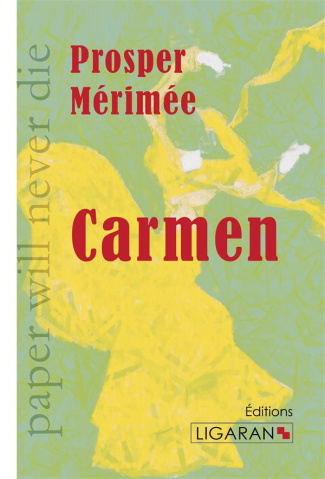
Carmen
Carmen, écrit par Prosper Mérimée, est un roman captivant qui nous plonge dans l'Espagne du XIXe siècle. Ce récit nous transporte au coeur de l'Andalousie, où se mêlent passion, amour et tragédie. L'histoire se déroule autour du personnage éponyme, Carmen, une gitane séduisante et mystérieuse. Elle captive tous ceux qui croisent son chemin, hommes comme femmes, par sa beauté envoûtante et son charme irrésistible. Carmen est une femme libre, indépendante et fière, qui refuse de se soumettre aux conventions sociales de l'époque.Le narrateur, un officier de l'armée espagnole du nom de Don José, tombe sous le charme de Carmen. Leur rencontre va bouleverser sa vie et le plonger dans une spirale de passion et de désespoir. Entre amour fou et jalousie dévorante, leur relation tumultueuse est le fil conducteur de ce roman. Prosper Mérimée nous offre une plongée fascinante dans la culture gitane, avec ses traditions, ses superstitions et ses danses envoûtantes. Il nous dépeint également une Espagne en pleine effervescence, entre corridas, contrebande et révoltes populaires. Carmen est un roman qui explore les thèmes de l'amour, de la liberté et de la fatalité. Mérimée nous offre une galerie de personnages hauts en couleur, des descriptions saisissantes et un style d'écriture précis et incisif. Adapté à de nombreuses reprises au théâtre, à l'opéra et au cinéma, Carmen est un classique de la littérature française qui continue de fasciner les lecteurs du monde entier. Plongez-vous dans cette histoire passionnante et laissez-vous emporter par le destin tragique de Carmen et Don José. Extrait : ""Elle avait un jupon rouge fort court qui laissait voir des bas de soie blancs avec plus d'un trou, et des souliers mignons de maroquin rouge attachés avec des rubans couleur de feu. Elle écartait sa mantille afin de montrer ses épaules et un gros bouquet de cassie qui sortait de sa chemise. Elle avait encore une fleur de cassie dans le coin de la bouche, et elle s'avançait en se balançant sur ses hanches comme une pouliche du haras de Cordoue."""Impression à la demandeCOMMANDER16,99 € -

Les filles du feu
Les Filles du feu, écrit par Gérard de Nerval, est un recueil de nouvelles publié en 1854. Considéré comme l'une des oeuvres majeures de la littérature romantique française, ce livre nous plonge dans un univers empreint de mystère et de poésie.À travers ces nouvelles, Gérard de Nerval explore les méandres de l'âme humaine et nous transporte dans des mondes fantastiques et oniriques. Les Filles du feu est une véritable invitation au voyage, où le lecteur est emporté dans des contrées lointaines, tantôt réelles, tantôt imaginaires.Chaque nouvelle est une véritable pépite littéraire, où l'auteur manie avec brio les mots et les images. Les personnages qui peuplent ces récits sont tour à tour envoûtants, énigmatiques et fascinants. Ils nous entraînent dans leurs histoires, entre rêve et réalité, où se mêlent amour, folie et désir.Les Filles du feu est également un livre profondément introspectif, où l'auteur se livre avec une sincérité bouleversante. Gérard de Nerval explore les méandres de sa propre psyché, nous dévoilant ses doutes, ses angoisses et ses tourments. À travers ces récits, il nous invite à une réflexion sur la condition humaine et sur la quête de sens qui anime chacun d'entre nous.Ce recueil de nouvelles est un véritable chef-d'oeuvre de la littérature romantique, où la beauté des mots se mêle à la profondeur des émotions. Les Filles du feu est un livre à lire et à relire, pour se laisser envoûter par la plume envoûtante de Gérard de Nerval et pour se perdre dans les méandres de l'âme humaine. Extrait : ""J'étais le seul garçon dans cette ronde, où j'avais amené ma compagne toute jeune encore, Sylvie, une petite fille du hameau voisin, si vive et si fraîche, avec ses yeux noirs, son profil régulier et sa peau légèrement hâlée!... Je n'aimais qu'elle, je ne voyais qu'elle, - jusque-là !"""Impression à la demandeCOMMANDER19,99 € -

Du côté de chez Swann
""Du côté de chez Swann"" est le premier volume de ""À la recherche du temps perdu"" de Marcel Proust. Ce roman emblématique de la littérature française raconte l'histoire de Charles Swann, un homme de la haute société parisienne, et de sa relation avec Odette de Crécy. À travers les yeux du narrateur, le lecteur est plongé dans un monde de souvenirs, de jalousie et de passion, où les personnages évoluent dans les salons mondains et les jardins de la Belle Époque. Avec une prose riche et envoûtante, Proust explore les méandres de la mémoire et de l'amour, offrant une vision profonde et captivante de la condition humaine. Extrait : ""Et bientôt, machinalement, accablé par la morne journée et la perspective d'un triste lendemain, je portai à mes lèvres une cuillerée du thé où j'avais laissé s'amollir un morceau de madeleine. Mais à l'instant même où la gorgée mêlée des miettes du gâteau toucha mon palais, je tressaillis, attentif à ce qui se passait d'extraordinaire en moi."""Impression à la demandeCOMMANDER29,99 €


