

Aspergirls : Empowering Females with Asperger Syndrome
*Gold Medal Winner in the Sexuality / Relationships Category of the 2011 IPPY Awards** Honorary Mention in the 2010 BOTYA Awards Women's Issues Category *Girls with Asperger's Syndrome are less frequently diagnosed than boys, and even once symptoms have been recognised, help is often not readily available. The image of coping well presented by AS females of any age can often mask difficulties, deficits, challenges, and loneliness.This is a must-have handbook written by an Aspergirl for Aspergirls, young and old. Rudy Simone guides you through every aspect of both personal and professional life, from early recollections of blame, guilt, and savant skills, to friendships, romance and marriage. Employment, career, rituals and routines are also covered, along with depression, meltdowns and being misunderstood. Including the reflections of over thirty-five women diagnosed as on the spectrum, as well as some partners and parents, Rudy identifies recurring struggles and areas where Aspergirls need validation, information and advice. As they recount their stories, anecdotes, and wisdom, she highlights how differences between males and females on the spectrum are mostly a matter of perception, rejecting negative views of Aspergirls and empowering them to lead happy and fulfilled lives.This book will be essential reading for females of any age diagnosed with AS, and those who think they might be on the spectrum. It will also be of interest to partners and loved ones of Aspergirls, and anybody interested either professionally or academically in Asperger's Syndrome.
| EAN | 9781849058261 |
|---|---|
| Auteur | Rudy Simone |
| Editeur | GARDNERS |
| Date de parution | 20100615 |
| Disponibilité | Sur commande en 6-10 jours |
Pourquoi choisir Molière ?
Du même auteur
-

Vivre avec une femme Asperger. 22 conseils pour son partenaire
Cet ouvrage s?adresse au partenaire d?une femme présentant le syndrome d?Asperger, qui souhaite une relation plus profonde et significative avec sa compagne. En abordant tous les sujets, du sexe aux questions sensorielles, de la vulnérabilité émotionnelle au fait de recevoir et adresser la critique de façon attentionnée, Rudy Simone propose des conseils pratiques qui aideront le partenaire à éviter les écueils et à forger une relation durable avec une Aspergirl. Que ce soit une surcharge sensorielle, des difficultés sociales, une confusion cognitive, chaque problème, chaque défi a une solution. Ce livre fourmille également de conseils tirés de la propre expérience de fauteur ainsi que des témoignages de partenaires. Il sera également utile à quiconque est en relation avec une Aspergirl, que ce soit un parent, un ami, ou même un partenaire professionnel.EpuiséVOIR PRODUIT20,90 € -

L'Asperger au féminin . Comment favoriser l'autonomie des femmes atteintes du syndrôme d'Asperger
Extrait de l'introduction Les femmes atteintes de troubles du spectre autistique constituent une subculture, elle-même partie intégrante d'une subculture. Nos bizarreries, nos difficultés, nos habitudes, nos caractéristiques et nos points de vue sont similaires, à peu de choses près, à ceux des hommes, avec ce petit truc en plus qui nous est propre. Non pas que le Syndrome d'Asperger (SA) se présente différemment chez les filles et les femmes, il est simplement perçu différemment, passant par conséquent la plupart du temps inaperçu. Lorsque je parcours les écrits de femmes Asperger telles que Liane Holliday Willey, Dona Williams ou encore Mary Newport, le fait que je me reconnaisse enfin chez d'autres femmes me rend particulièrement enthousiaste. C'est la première fois qu'une telle chose est possible car jamais auparavant je n'avais pu m'identifier à mes camarades de classe, à mes pairs et encore moins aux représentations médiatiques de ce qu'est et devrait être une femme. Je ne me reconnais pas non plus dans les portraits d'enfants autistes véhiculés par les médias qui sont en proie à des difficultés bien plus criantes que celles que j'ai pu rencontrer. Et c'est là le point crucial du SA, les difficultés auxquelles nous nous heurtons, bien que réelles, ne sont pas toujours manifestes aux yeux des autres, ce qui fait que nos comportements ne sont pas forcément compris. On entend parfois dire des personnes atteintes du syndrome d'Asperger qu'elles ont une forme de compétence savante. En ce qui me concerne, si tant est que j'aie une habileté particulière, il s'agirait de visualiser des structures et des liens mettant en relation des concepts disparates. Alors que certains sujets abordés dans ce livre pourront paraître un peu aléatoires aux yeux d'une personne non avertie, les femmes Asperger qui me liront comprendront. Il s'agit des problèmes qui affectent la plupart d'entre nous, si ce n'est nous toutes; ce sont les liens qui nous unissent. Dépression, problèmes sensoriels, difficultés sur le plan professionnel et relationnel sont autant de manifestations du SA. Mais il est d'autres aspects propres à mon expérience qui ont modelé ma personnalité et j'étais curieuse de savoir si d'autres femmes Asperger avaient une vision similaire des choses. J'ai donc posé des questions du type: - Est-ce que vos problèmes sensoriels ont une quelconque influence quant au choix de vos partenaires? - Aimez-vous avoir des rapports sexuels? - Quelle est votre opinion concernant la répartition des rôles en fonction du sexe? - La maternité? - Est-ce que vous ressentez une quelconque culpabilité à cause de votre SA? - À quoi vos effondrements émotionnels sont-ils dus et comment les ressentez-vous? Vous est-il possible d'y mettre un terme avant même qu'ils ne se manifestent? - Combien de diagnostics erronés avez-vous reçus avant que l'éventualité du syndrome d'Asperger ne soit soulevée?EpuiséVOIR PRODUIT22,00 € -

L'Asperger au travail
Tout savoir pour une vie professionnelle épanouie. Un ouvrage qui intéressera les employeurs, les Aspies et tout leur entourage. Chacun aspire à trouver un travail épanouissant dans lequel il pourra exprimer ses différentes compétences. Ces attentes sont identiques pour les personnes avec Asperger. Pourtant, aujourd'hui, plus de 85 % d'entre elles se retrouvent sans emploi à temps plein. La différence peut faire peur aux employeurs. Néanmoins, au-delà des difficultés réelles mais surmontables, employer un " Aspie " peut être véritablement bénéfique pour l'entreprise. Souvent dotés d'une très grande intelligence et de capacités indéniables, ils apportent, quand ils sont engagés dans leur domaine d'expertise, une vraie plus-value. Cet ouvrage aidera chaque employeur à pouvoir comprendre et développer les ressources des personnes avec Asperger au profit de son activité. Parallèlement, il permettra à chaque " Aspie " de développer ses propres compétences, de renforcer son estime et de perfectionner son intégration sociale. Il y trouvera en effet des réponses à des questions telles que " Comment s'habiller pour un entretien d'embauche ? , Comment s'adapter à son environnement de travail ? , Comment développer des relations avec des collègues ? ". S'appuyant sur de nombreux témoignages, Rudy Simone offre des conseils pratiques, gages d'une intégration réussie pour les deux parties. Cet ouvrage intéressera les employeurs, les Aspies et tout leur entourage.En stockCOMMANDER24,90 € -
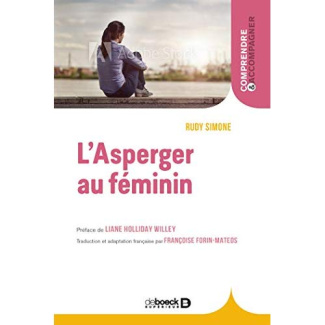
L'Asperger au féminin
La lecture idéale pour comprendre et aider les femmes Asperger ! Les « Aspergirls » sont souvent moins diagnostiquées que leurs homologues masculins. Cependant, leur souffrance n’en demeure pas moins conséquente, avec un véritable sentiment de décalage et d’incompréhension vis-à-vis de leurs comportements. L’autrice, elle-même Asperger, aborde avec précision et détail de nombreux aspects du quotidien : la vie sociale, amoureuse, professionnelle, le vieillissement, etc. LA Bible pour mieux comprendre les Aspergirls !En stockCOMMANDER22,90 €


Du même éditeur
-

The Man in the High Castle
Revue de presse The most brilliant sci-fi mind on any planet (Rolling Stone)California's own William Blake. Visionary and prophet (Daily Telegraph)Sur commande en 6-10 joursCOMMANDER11,30 € -

The water knife
From the international bestselling author of the Hugo and Nebula award-winning The Windup Girl, comes an electrifying thriller set in a world on the edge of collapse.WATER IS POWERThe American Southwest has been decimated by drought, Nevada and Arizona skirmish over dwindling shares of the Colorado River, while California watches.When rumors of a game-changing water source surface in Phoenix, Las Vegas water knife Angel Velasquez is sent to investigate.With a wallet full of identities and a tricked-out Tesla, Angel arrows south, hunting for answers that seem to evaporate as the heat index soars and the landscape becomes more and more oppressive. There, Angel encounters Lucy Monroe, a hardened journalist who knows far more about Phoenix's water secrets than she admits, and Maria Villarosa, a young Texas migrant who dreams of escaping north to those places where water still falls from the sky.As bodies begin to pile up and bullets start flying, the three find themselves pawns in a game far bigger, more corrupt, and dirtier than any of them could have imagined. With Phoenix teetering on the verge of collapse and time running out, their only hope for survival rests in one another's hands.But when water is more valuable than gold, alliances shift like sand, and the only truth in the desert is that someone will have to bleed if anyone hopes to drink.Sur commande en 6-10 joursCOMMANDER11,25 € -

-

In Pale battalions
Extrait Chapter OneChildhood memories fit their own intricate pattern. They cannot be made to conform to the version of our past we try to impose upon them. Thus I could say that Lord and Lady Powerstock and the home they gave me at Meongate more than compensated for being an orphan, that a silver spoon easily took the place of my mother's smile. I could say it--but every recollection of my early years would deny it.Meongate must once have been the crowded, bustling house of a cheerful family, as the Hallowses must once have been that family. Every favour of nature in its setting where the Hampshire downs met the pastures of the Meon valley, every effort of man in its spacious rooms and landscaped park, had been bestowed on the home of one small child.Yet it was not enough. When I was growing up at Meongate in the early 1920s, most of its grandeur had long since departed. Many of the rooms were shut up and disused, much of the park turned over to farmland. And all the laughing, happy people I imagined filling its empty rooms and treading its neglected lawns had vanished into a past beyond my reach.I grew up with the knowledge that my parents were both dead, my father killed on the Somme, my mother carried off by pneumonia a few days after my birth. It was not kept from me. Indeed, I was constantly reminded of it, constantly confronted with the implication that I must in some way bear the blame for the shadow of grief, or of something worse, that hung over their memory. That shadow, cast by the unknown, lay at the heart of the cold, dark certainty that also grew within me: I was not wanted at Meongate, not welcomed there, not loved.It might have been different had my grandfather not been the grave, withdrawn, perpetually melancholic man that he was. I, who never knew him when he was young, cannot imagine him as anything other than the wheelchair-bound occupant of his ground-floor rooms, deprived by his own morbidity, as much as by the lingering effects of a stroke, of all warmth and fondness. When Nanny Hiles took me, as she regularly did, to kiss him goodnight, all I wanted to do was escape from the cold, fleeting touch of his flesh. When, playing on the lawn, I would look up and see him watching me from his window, all I wanted to do was run away from the mournful, questing sadness in his eyes. Later, I came to sense that he was waiting, waiting for me to be old enough to understand him, waiting in the hope that he would live to see that day.Lady Powerstock, twenty years his junior, was not my real grandmother. She was buried in the village churchyard, another ghost whom I did not know and who could do nothing to help me. I imagined her as everything her successor was not--kind, loving and generous--but it did me no good. Olivia, the woman I was required to address as Grandmama in her place, had once been beautiful and, at fifty, her looks were still with her, her figure still fine, her dress sense impeccable. That we were not related by blood explained, to my satisfaction, why she did not love me. What I could not explain was why she went so far as to hate me, but hate me she undoubtedly did. She did not trouble to disguise the fact. She let it hover, menacing and unspoken, at the edge of all our exchanges, let it grow as an awareness between us, a secret confirmation that she too was only waiting, waiting for death to remove her husband and with him any lingering restraint on her conduct towards me. There was an air of practised vice about her that was to draw men all her life, an air of voluptuous pleasure at her own depravity that made her hatred of me seem merely instinctive. Yet there was always more to it than that. She had drawn some venom from whatever part she had played in the past of that house and had reserved it for me.My only friend in those days, my only guide through Meongate's hidden perils, was Fergus, the taciturn and undemonstrative major-domo, "shifty" as Olivia described him and certainly not as deferential as he should have been, but none the less my sole confidant. Sally, the sullen maid, and humourless Nanny Hiles both went in awe of Olivia, but Fergus treated her with an assurance, bordering on disrespect, that made him my immediate ally. A cautious, solitary, pessimistic man who had expected little from life and consequently been spared many disappointments, perhaps he took pity on a lonely child whose plight he understood better than she did herself. He would take me on covert expeditions through the grounds, or down to the wooded reach of the Meon where he fished of a quiet afternoon, or into Droxford in the trap, when he would buy me a twist of sherbet and leave me sitting on the wall outside Wilsmer's saddlery whilst he went in to haggle over a new bridle for the pony. For such brief moments as those, kicking my heels on Mr. Wilsmer's wall and eating my sherbet in the sunshine, I was happy. But such moments did not last.It was Fergus who first showed me my father's name, recorded with the other war dead of the village, on a plaque at the church. Their Name Liveth for Evermore, the inscription said, and his name--Captain the Honourable John Hallows--is all that did live for me. I would stare at it for what seemed like hours trying to conjure up the real living and breathing father that he had never been to me, seeing only those stiff, expressionless, uniformed figures preserved by photographs in back copies of the Illustrated London News, glimpsing no part of his true self beyond the neatly carved letters of his name.As for my mother, of her there was no record at all, no grave, no memorial of any kind. Fergus, when I questioned him, prevaricated. My mother's grave, if she had one, was far away--and he did not know where. There were, I was to understand, limits to what even he could tell me. Whether he suggested it or not I cannot remember, but, for some reason, I decided to ask Olivia. I cannot recall how old I was when it happened, but I had followed her into the library, where she often went to look at a painting that hung there."Where is my mother's grave?" I said bluntly, partly intending the question to be a challenge. All hatred is, in time, reciprocated and I had come to hate Olivia as much as she hated me; I did not then appreciate how dangerous an enemy she could be.She did not answer in words. She turned aside from that great, high, dark painting and hit me so hard across the face that I nearly fell over. I stood there, clutching the reddening bruise, too shocked by the pain of it to cry, and she stooped over me, her eyes blazing. "If you ever ask that question again," she said, "if you ever mention your mother again, I'll make you suffer."The mystery of my mother thenceforth became the grand and secret obsession of my childhood. My father's death, after all, had a comforting simplicity about it. Every November there was an Armistice Parade in the village to commemorate the sacrifice of Captain the Honourable John Hallows and the many others like him. Though not permitted to join the Brownie troop that took part in the parade, I was allowed to go and watch and could imagine myself marching with all the little girls who, like me, had lost their father. But, at the end of the parade, they went home to their mothers; I could not even remember mine.Sometimes, though, I thought I could remember her. It was impossible, of course, if what I had been told of her was true, but Olivia had succeeded in making me doubt everything I had not personally experienced, and there was one dim, early memory, seemingly at the very dawn of my recollection, to sustain what I so wanted to believe.I was standing on the platform at Droxford railway station. It was a hot summer's day: I could feel the heat of the gravel seeping up through my shoes. A train was standing at the platform, great billows of smoke rising as the engine gathered steam. The man standing beside me, who had been holding my hand, stooped and lifted me up, cradling me in his arms to watch the train pull out. He was stout and white-haired. I remember the rumble of his voice and the brim of his straw hat touching my head as he raised his free hand to wave. And I was waving too, at a woman aboard the train who had wound down the window and was leaning out, waving also and smiling and crying as she did so. She was dressed in blue and held a white handkerchief in her right hand. And the train carried her away. And then I cried too and the stout old man hugged me, the brass buttons on his coat cold against my face.I recounted the memory to Fergus one day, when we were returning from a mushrooming expedition. When I had finished, I asked him who he thought the old man was."Sounds like old Mr. Gladwin," he replied. "The first Lady Powerstock's father. He lived here . . . till she sent him away." By she Fergus always meant Olivia."Why did she do that?""She'd have had her reasons, I don't doubt.""When did he go?""The summer of 1920, when you were three. Back to Yorkshire, so they say. A proper caution, was Mr. Gladwin.""Who was the pretty lady, Fergus?""That I don't know.""Was she . . . my mother?"He pulled up and looked down at me with a frown. "That she was not," he said with deliberate slowness. "Your mother passed away a few days after she had you. You know that. No amount of wanting is going to make you remember her.""Then . . . who was the pretty lady?"His frown became less kindly. "I told you: I don't know. That Mr. Gladwin, he was a close one. Now, look to that napkin or you'll pitch your breakfast into the lane--and mine with it."If the pretty lady wasn't my mother, who was she? What was old Mr. Gladwin, my great-grandfather, to her? There were no answers within my reach, just the secret hope I went on harbouring that maybe my mother wasn't really dead at all, just ....Sur commande en 6-10 joursCOMMANDER12,50 €




De la même catégorie
-

Intelligence artificielle. La nouvelle barbarie
Géolocalisation, réponses automatiquesaux mails, propositions d'achats ciblant les goûts du consommateur... L'intelligenceartificielle est déjà à l'oeuvre dans notre quotidien. Et sa place ne cesse degrandir, de s'affirmer à chaque seconde. " Pour notre bien ", assurent les GAFA et autres géants du numérique. Pourtant, l'intelligence artificiellen'est pas une technologie comme les autres ni un simple progrès technique. Ellecontient une philosophie, une vision de la vie et de l'Homme inquiétante. Promouvant en effet une équivalence entre l'humain et la machine, elle permetd'imaginer une pensée sans sujet qui nie la subjectivité. En imitant l'homme, elle le défie (et parfoisle surpasse) dans des domaines essentiels de la vie en société : lajustice, la médecine ou l'organisation du travail...Sur commande en 2-4 joursCOMMANDER20,50 € -
Channeling. Contact avec les maîtres ascensionnés et le commandant Ashtar Sheran
Lors d'une séance de reiki faite par mon époux, je fis une sortie de corps spontanée. Je me retrouvai dans l'espace. C'est là que je vis un énorme vaisseau qui stationnait. Je m'en approchai afin de regarder à l'intérieur. L'agencement me paraissait singulier. Il n'y avait pas de joint entre les meubles et le vaisseau. À l'intérieur, je distinguai le profil d'un homme debout devant une table. Face à lui, se trouvaient trois hommes assis. Je réalisai que j'étais à la fenêtre d'un vaisseau extraterrestre et je n'arrêtais pas de me dire : " Comment ai-je pu monter si haut ? " Je fixai l'homme blond aux cheveux longs qui se trouvait de profil et, au bout de quelques secondes, il tourna la tête brusquement et me regarda fixement. Je me trouvais devant le Commandant Ashtar Sheran... "Sur commande en 2-4 joursCOMMANDER29,15 € -

Fabuleuses erreurs. De Darwin à Einstein
Charles Darwin, Lord William Kelvin, Linus Pauling, Fred Hoyle, Albert Einstein : cinq scientifiques hors du commun qui ont accompli des découvertes scientifiques considérables. Mais également cinq hommes qui se sont aussi, souvent en même temps, parfois lourdement, fourvoyés sur certains sujets. Charles Darwin n'a pas bien évalué les effets de " dilution " dans la transmission des caractères génétiques ; Lord Kelvin a largement sous-évalué l'âge de la Terre ; Linus Pauling s'est fait " coiffer au poteau " dans la découverte de la structure de l'ADN par Jim Watson et Francis Crick ; Fred Hoyle fut un partisan irréductible de la théorie de l'Univers stationnaire ; enfin, Einstein créa une constante cosmologique pour une mauvaise raison. Il ne s'agit pas d'énumérer les erreurs de ces grands hommes, mais bien plutôt de constater et d'analyser les conséquences bénéfiques de ces errements : la théorie de l'évolution de Darwin fonde la génétique moderne ; Kelvin enseigne à ses successeurs comment utiliser la thermodynamique en astronomie et en géologie ; Linus Pauling introduit superbement les considérations chimiques en biologie ; Fred Hoyle démontre les bienfaits et les limites des approches scientifiques qui se démarquent des théories " à la mode " et, curieusement, au lieu d'être une erreur, l'introduction de la constante cosmologique par Einstein s'avère extraordinairement bénéfique. C'est à une véritable enquête policière, qui dévoile de nombreux aspects jusque-là ignorés de l'histoire des sciences, que s'est consacré l'astrophysicien Mario Livio, qui expose ici de façon originale et vivante les chemins parfois tortueux empruntés par la recherche scientifique.Sur commande en 2-4 joursCOMMANDER23,00 € -

Etonnant vivant. Découvertes et promesses du XXIe siècle
Qu'est-ce que la vie ? Quelles sont ses origines ? Quelle est la frontière entre le "soi" et le "non-soi" ? Quel est le propre de l'homme ? Ce livre invite à un voyage au coeur du vivant qui plonge le lecteur depuis les toutes premières formes de vie sur terre jusqu'au sein de la complexité du vivant. Il donne à voir les applications étonnantes qui en découlent dans les domaines biotechnologiques et médicaux. Le lecteur parcourra ainsi l'immensité insoupçonnée de la biodiversité et les capacités extraordinaires des êtres vivants à s'adapter aux conditions les plus extrêmes. Il découvrira les liens de parenté entre organismes qui définissent l'arbre de la vie, les interactions entre les composants de tout être vivant, l'impact de l'environnement sur l'évolution et le fonctionnement des organismes, et les promesses d'innovations contenues dans ces révolutions scientifiques et technologiques Ce livre est le témoignage passionné d'une communauté de chercheurs en sciences de la vie qui espèrent donner le goût de la nature et susciter la curiosité vis-à-vis des terrains inconnus et immenses qu'il reste à explorer. C'est au prix d'une recherche qui requiert du temps, des prises de risque, de l'imagination, de la créativité et de la liberté que les grands tournants des sciences de la vie du XXIe siècle ont pris corps. Et c'est à ce prix que ces sciences continueront à être porteuses d'avenir et de progrès. Ce livre est le témoignage passionné d'une centaine de scientifiques qui ont contribué à sa rédaction pour partager leur émerveillement face aux découvertes et aux promesses portées par les sciences du vivant de ce début de siècle.Sur commande en 2-4 joursCOMMANDER22,00 €


