
TOKENS OF LOVE, LOSS AND DISRESPECT
Coins from the 18th and early 19th centuries are physically and visually intriguing. In addition to their monetary uses, they were repurposed to communicate private and public messages - from ad hoc scratchings and punch marks to full-scale re-engraving of surfaces. This book aims to give 21st-century readers insight into that experience and to the many unofficial purposes these objects served. Drawing on the largest extant collection of defaced coins and tokens, this publication brings together for the first time the full-range of expertise required to understand the phenomenon, with contributions from 11 scholars and collectors. It focuses on a significant period in British history, when modification expressed political commentary, commercial activity, familial and emotional commitment, personal identity and life history. It will examine the coins and tokens themselves and look at who modified them, where, why and how. The circumstances of the coins' subsequent survival is explained, and each aspect will be set in its specific historical contexts. Defaced coins and tokens are often enigmatic objects, and this book will offer a means of decoding and assessing them, while also drawing attention to their value as a distinctive source of historical evidence. The contributors will also consider what these surviving coins reveal about the society in which they were produced and the light they shed on major historical developments of the period. Tim Hitchcock, for example, discusses the new prison culture that emerged following the outbreak of the American Revolution in 1776, evidenced in a growing number of convict tokens made in Newgate. Hamish Maxwell Stewart examines love tokens illustrated with the 'Sailor's Farewell' within the context of the market for sailor's gifts and tattoos to ward against the dangers of oceanic travel. Steve Poole looks at tokens as souvenirs of public hangings, not only in terms of the influence they exerted on contemporary public opinion but as exemplars of the wider material culture of public punishment. And Sally Holloway examines the design and iconography of love tokens exchanged as romantic gifts. As well as 12 essays, there is an annotated catalogue of 100 coins, selected for their individual interest or representativeness of a distinctive type of modification or motif.
| Nombre de pages | 192 |
|---|---|
| Date de parution | 03/03/2023 |
| Poids | 1 140g |
| Largeur | 188mm |
| EAN | 9781911300946 |
|---|---|
| Titre | TOKENS OF LOVE, LOSS AND DISRESPECT |
| Auteur | MILLETT TIMOTHY |
| Editeur | HOLBERTON |
| Largeur | 188 |
| Poids | 1140 |
| Date de parution | 20230303 |
| Nombre de pages | 192,00 € |
| Disponibilité | Sur commande en 4-6 jours |
Pourquoi choisir Molière ?
Du même auteur
-

Sexual Politics. La politique du mâle
Sexual Politics, issu de la thèse soutenue par Kate Millett en 1970 à l'université de Columbia (Etats-Unis) suscite un véritable engouement dès sa parution, en plein essor du Women's Lib dont l'autrice est partie prenante. L'essai, paru en France sous le titre La politique du mâle (Stock, 1970), a été réédité en 2007 par Antoinette Fouque sous son titre original, en concertation avec l'autrice avec laquelle elle a partagé amitié et bien des combats pour la libération des femmes. Dans cet essai magistral devenu un classique et désormais disponible en édition de poche, Kate Millett critique la société occidentale en se concentrant sur la dénonciation du pouvoir patriarcal et de la négation du corps féminin à tous les niveaux : idéologique, sociologique, anthropologique, politique, ainsi que littéraire. Ce livre qui fit l'effet d'un pavé dans la mare en révélant les injustices sans nombre subies par les femmes contribua par la suite à favoriser le développement des études et recherches féminines au niveau universitaire.Sur commande en 2-4 joursCOMMANDER10,00 € -
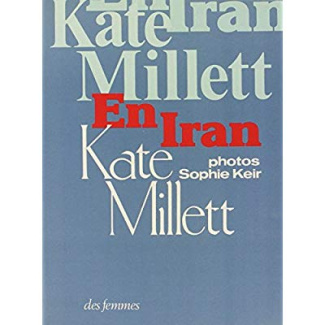
EN IRAN
Photos de Sophie Keir En mars 1979, en Iran, des milliers de femmes descendent dans la rue pour manifester leur libération du joug impérialiste et leur volonté de se libérer du joug de l'islam féodal. En Iran témoigne de ce moment décisif, que vécut Kate Millett, militante de la première heure du Women's lib américain, présente à Téhéran, à l'invitation du Comité pour la liberté des artistes et des intellectuels en Iran (CAIFI) dans lequel elle militait contre la torture et la collaboration de l'État américain avec le Shah. Quatre militantes du MLF français, Sylvina Boissonnas, Claudine Mulard, Michelle Muller et Sylviane Rey, la retrouvent à Téhéran, en solidarité avec les Iraniennes à la suite de l'ordre donné aux femmes par l'Imam Khomeiny de porter impérativement un voile. Après ces journées historiques, Kate Millett, qui se verra expulsée par le gouvernement iranien, confiera aux éditions Des femmes la traduction française du livre qu'elle a écrit une fois rentrée aux États-Unis.EpuiséVOIR PRODUIT17,25 € -

Sexual Politics. La politique du mâle
Si le mot politique est utilisé ici, dans la discussion concernant les sexes, c'est avant tout parce qu'il a l'immense avantage de souligner la véritable nature de leur situation relative, historiquement et à l'époque actuelle. Il est opportun, peut-être même obligatoire aujourd'hui, de développer une psychologie, une philosophie des relations de puissance mieux adaptées à leur objet, et qui dépassent le cadre conceptuel trop simple qu'offre notre politique traditionnelle. Peut-être même est-il impératif que nous nous préoccupions de définir une théorie de la politique traitant des relations de puissance sur des bases moins conventionnelles que celles dont nous avons l'habitude. J'ai donc jugé pertinent d'adopter, pour bases de cette définition, le contact personnel et l'interaction entre les membres de groupes bien définis et cohérents : races, castes, classes et sexes. Car c'est précisément parce que certains groupes n'ont aucune représentation dans diverses structures politiques reconnues que leur position tend à être si stable, leur soumission si continue. . . Kate Millett, née en 1934 dans le Minnesota, est une figure majeure du féminisme du XXe siècle. Elle est connue dans le monde entier pour son combat politique. Sa thèse, Sexual Politics, soutenue en 1970 à l'université de Columbia, paraît en France en 1971 sous le titre La politique du mile. Elle connaît un véritable engouement dès sa parution. Kate Millett a publié de nombreux livres (En vol, Sita, En Iran...) tout en consacrant sa vie à la libération des femmes.Sur commande en 2-4 joursCOMMANDER20,50 € -

Sita
Sita, celle que je distingue parmi toutes les autres. Celle que je trouve toujours, au premier regard, étrange, peu sympathique. Je ne suis pas fière d'elle, c'est à peine si je peux me la représenter en imagination. Et puis la voici qui me tombe dessus. Belle aussitôt, redevenue le centre de mon univers, et moi je suis un satellite ou un enfant qui la suit, accrochée à ses basques, vers le lieu où l'on récupère les bagages. Déjà noyée dans son visage, les yeux tournés vers les siens, affamée, totalement convaincue.Sur commande en 2-4 joursCOMMANDER20,50 €


Du même éditeur
-

'A Perfect Eye and Steady Hand'. Goldsmithing in Tudor & Stuart London
This handsomely illustrated book is published to mark the opening of the Goldsmiths' Gallery at the new London Museum in Smithfield. Showcasing the Cheapside Hoard alongside historic treasures from the Goldsmiths' Company's collection, it takes readers on a global journey in the wake of plate, jewels and gemstones - and the people who made, traded and treasured them. Gold and silver are precious - prized as a form of portable capital, essential for the mints and coinage, used to express power and status. Yet great skill was needed in the buying, the fashioning and the selling of either metal. As fashions changed, much early modern plate and jewellery was melted down when sentiment gave way to market value. This makes the survival of the Goldsmiths' Company's holdings exceptional - and the Cheapside Hoard, unearthed by workmen in 1912 after lying undisturbed for nearly 300 years - nothing short of extraordinary. Comprising over 500 pieces - made of emeralds, diamonds and sapphires sourced from across the world, worked into mesmerising brooches, buttons, necklaces and rings - the Cheapside Hoard is the greatest single collection of Elizabethan and Stuart jewellery in the world. The book places the Hoard in its historical and global context, celebrating it alongside highlights from the Goldsmiths' Company's collection. It offers four main chapters on Elizabethan and early Stuart London, the goldsmiths' trade, the Hoard itself, and the city's global networks. Interwoven thematic sections explore craftsmanship, personal stories, trade practices, taste and fashion - bringingtogether jewels and plate to reveal a rich tapestry of skill, style and exchange.PréventePRÉCOMMANDER35,00 € -

-
-