A portrait of the artist as a young man
A masterpiece of subjectivity, a fictionalized memoir, a coming-of-age prose-poem, this brilliant novella introduces Joyce's alter ego, Stephen Daedelus, the hero of Ulysses, and begins the narrative experimentation that would help change the concept of literary narrative forever. It describes Stephen's formative years in Dublin; as Stephen matures, so does the writing, until it sparkles with clarity. The style presents numerous, almost insurmountable, problems for the oral interpreter, particularly one with the limited vocal range of John Lynch. But Lynch pays no attention to the problems. Instead, he identifies so completely with Daedelus, throws himself so lustily into the book, that it is as if the passionate young artist himself is bursting out of your speakers. Y.R. Winner of AUDIOFILE Earphones Award © AudioFile 2001, Portland, Maine-- Copyright - AudioFile, Portland, Maine
| EAN | 9781853260063 |
|---|---|
| Titre | A portrait of the artist as a young man |
| ISBN | 1853260061 |
| Auteur | Joyce James |
| Editeur | WORDSWORTH |
| Largeur | 0 |
| Poids | 100 |
| Date de parution | 20010405 |
| Nombre de pages | 0,00 € |
Pourquoi choisir Molière ?
Du même auteur
-

Ulysse
Joyce JamesLe 16 juin 1904, à Dublin. À partir des déambulations, élucubrations, rencontres et solitudes de trois personnages, Leopold Bloom, Stephen Dedalus et Molly Bloom, Joyce récrit l'Odyssée d'Homère. L'architecture d'Ulysse est un incroyable tissage de correspondances : le roman foisonne d?échos internes, de réminiscences, de choses vues et entendues, digérées et métamorphosées. En même temps que Proust, Joyce écrit le grand roman de la mémoire et de l'identité instable. Dans ce livre qui tient de l'encyclopédie et de la comédie humaine, l'auteur convoque tous les styles, tous les tons - y compris comique -, du monologue intérieur au dialogue théâtral. La lecture d'Ulysse est de ces expériences déterminantes qui changent notre perception du roman comme notre vision du monde.EN STOCKCOMMANDER14,50 € -

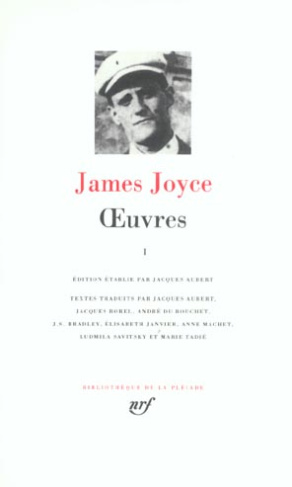
Oeuvres. Tome 1
Joyce JamesTOME I : 1901-1915. Poésies : Poèmes de jeunesse - Musique de chambre - Poèmes du cycle de « Musique de Chambre » - Le Saint-Office - De l'eau dans le gaz - Poèmes d'Api - « Ecce puer » - Poèmes de circonstance. Proses et récits : Épiphanies - Dublinois - Portrait de l'artiste [1904] - Stephen le Héros - Portrait de l'artiste en jeune homme - Giacomo Joyce - Théâtre : Les Exilés - Essais, articles, conférences - Choix de lettres (1901-1915). Appendice : Rêves - Traductions. Édition de Jacques Aubert, trad. de l'anglais par Jacques Aubert, Jacques Borel, André Du Bouchet, Jenny S. Bradley, Élisabeth Janvier, Anne Machet, Ludmilla Savitzky et Marie Tadié.Sur commande, 2 à 4 joursCOMMANDER73,50 € -

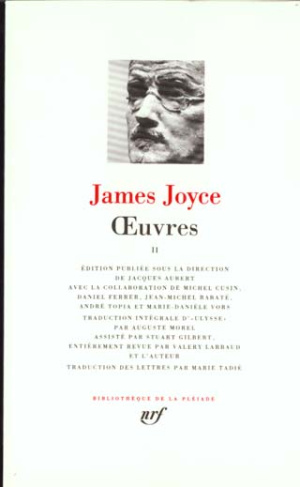
Oeuvres. Tome 2
Joyce JamesTOME II : Ulysse - Choix de lettres (1915-1932). Édition publiée sous la direction de Jacques Aubert avec la collaboration de Michel Cusin, Daniel Ferrer, Jean-Michel Rabaté, André Topia et Marie-Danièle Vors, trad. de l'anglais par Auguste Morel, Stuart Gilbert et Marie Tadié. Traduction d'Ulysse revue par Valery Larbaud et l'auteur. Contient douze cartes.Sur commande, 2 à 4 joursCOMMANDER79,00 € -

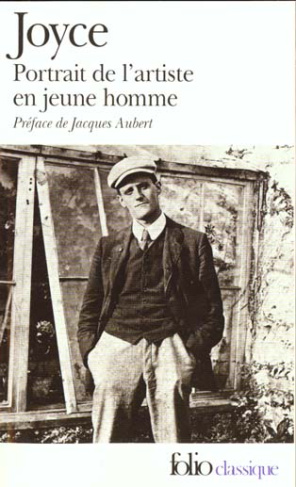
Portrait de l'artiste en jeune homme précédé de Portrait de l'artiste
Joyce JamesC'est le premier succès achevé de Joyce, terminé vers 1914. Roman autobiographique, l'auteur y raconte son enfance et sa jeunesse à Dublin, son éducation chez les jésuites, ses révoltes contre ces mondes clos, sa libération par la vocation artistique (d'où le titre). Le style va du réalisme brutal à la plus grande poésie, de l'ironie à l'émotion. Joyce y donne avec clarté - ce sont les deux ouvrages ultérieurs, Ulysse et Finnegans Wake, qui passent pour obscurs - sa vision du réel et de l'imaginaire.Ce roman de formation, document capital sur Joyce, est aussi un grand livre.Sur commande, 2 à 4 joursCOMMANDER11,20 €
Du même éditeur
-

Persuasion (VO)
Austen JaneExtrait Sir Walter Elliot, of Kellynch Hall, in Somersetshire, was a man who, for his own amusement, never took up any book but the Baronetage; there he found occupation for an idle hour, and consolation in a distressed one; there his faculties were roused into admiration and respect by contemplating the limited remnant of the earliest patents; there any unwelcome sensations arising from domestic affairs changed naturally into pity and contempt as he turned over the almost endless creations of the last century; and there, if every other leaf were powerless, he could read his own history with an interest which never failed. This was the page at which the favourite volume always opened:--'ELLIOT OF KELLYNCH HALL''Walter Elliot, born March 1, 1760, married July 15, 1784, Elizabeth, daughter of James Stevenson, Esq., of South Park, in the county of Gloucester; by which lady (who died 1800) he has issue, Elizabeth, born June 1, 1785; Anne, born August 9, 1787; a still-born son, November 5, 1789; Mary, born November 20, 1791.'Precisely such had the paragraph originally stood from the printer's hands; but Sir Walter had improved it by adding, for the information of himself and his family, these words, after the date of Mary's birth:--'Married, December 16, 1810, Charles, son and heir of Charles Musgrove, Esq., of Uppercross, in the county of Somerset,' and by inserting most accurately the day of the month on which he had lost his wife. Then followed the history and rise of the ancient and respectable family in the usual terms; how it had been first settled in Cheshire, how mentioned in Dugdale, serving the office of high sheriff, representing a borough in three successive parliaments, exertions of loyalty, and dignity of baronet, in the first year of Charles II with all the Marys and Elizabeths they had married; forming altogether two handsome quarto pages, and concluding with the arms and motto:--'Principal seat, Kellynch Hall, in the county of Somerset,' and Sir Walter's handwriting again in this finale:--'Heir presumptive, William Walter Elliot, Esq., great-grandson of the second Sir Walter.''Vanity was the beginning and end of Sir Walter Elliot's character: vanity of person and of situation. He had been remarkably handsome in his youth, and at fifty-four was still a very fine man. Few women could think more of their personal appearance than he did, nor could the valet of any new-made lord be more delighted with the place he held in society. He considered the blessing of beauty as inferior only to the blessing of a baronetcy; and the Sir Walter Elliot, who united these gifts, was the constant object of his warmest respect and devotion. His good looks and his rank had one fair claim on his attachment, since to them he must have owed a wife of very superior character to anything deserved by his own. Lady Elliot had been an excellent woman, sensible and amiable, whose judgment and conduct, if they might be pardoned the youthful infatuation which made her Lady Elliot, had never required indulgence afterwards. She had humoured, or softened, or concealed his failings, and promoted his real respectability for seventeen years; and though not the very happiest being in the world herself, had found enough in her duties, her friends, and her children, to attach her to life, and make it no matter of indifference to her when she was called on to quit them. Three girls, the two eldest sixteen and fourteen, was an awful legacy for a mother to bequeath, an awful charge rather, to confide to the authority and guidance of a conceited, silly father. She had, however, one very intimate friend, a sensible, deserving woman, who had been brought, by strong attachment to herself, to settle close by her, in the village of Kellynch; and on her kindness and advice Lady Elliot mainly relied for the best help and maintenance of the good principles and instruction which she had been anxiously giving her daughters. This friend and Sir Walter did not marry, whatever might have been anticipated on that head by their acquaintance. Thirteen years had passed away since Lady Elliot's death, and they were still near neighbours and intimate friends, and one remained a widower, the other a widow. That Lady Russell, of steady age and character, and extremely well provided for, should have no thought of a second marriage, needs no apology to the public, which is rather apt to be unreasonably discontented when a woman does marry again, than when she does not; but Sir Walter's continuing in singleness requires explanation. Be it known, then, that Sir Walter, like a good father (having met with one or two private disappointments in very unreasonable applications), prided himself on remaining single for his dear daughter's sake. For one daughter, his eldest, he would really have given up anything, which he had not been very much tempted to do. Elizabeth had succeeded at sixteen to all that was possible of her mother's rights and consequence; and being very handsome, and very like himself, her influence had always been great, and they had gone on together most happily. His two other children were of very inferior value. Mary had acquired a little artificial importance by becoming Mrs. Charles Musgrove; but Anne, with an elegance of mind and sweetness of character, which must have placed her high with any people of real understanding, was nobody with either father or sister; her word had no weight, her convenience was always to give way--she was only Anne. To Lady Russell, indeed, she was a most dear and highly valued goddaughter, favourite, and friend. Lady Russell loved them all, but it was only in Anne that she could fancy the mother to revive again. A few years before Anne Elliot had been a very pretty girl, but her bloom had vanished early; and as, even in its height, her father had found little to admire in her (so totally different were her delicate features and mild dark eyes from his own), there could be nothing in them, now that she was faded and thin, to excite his esteem. He had never indulged much hope, he had now none, of ever reading her name in any other page of his favourite work. All equality of alliance must rest with Elizabeth, for Mary had merely connected herself with an old country family of respectability and large fortune, and had, therefore, given all the honour and received none: Elizabeth would, one day or other, marry suitably. It sometimes happens that a woman is handsomer at twenty-nine than she was ten years before; and, generally speaking, if there has been neither ill-health nor anxiety, it is a time of life at which scarcely any charm is lost. It was so with Elizabeth, still the same handsome Miss Elliot that she had begun to be thirteen years ago, and Sir Walter might be excused, therefore, in forgetting her age, or, at least, be deemed only half a fool, for thinking himself and Elizabeth as blooming as ever, amidst the wreck of the good looks of everybody else; for he could plainly see how old all the rest of his family and acquaintance were growing. Anne haggard, Mary coarse, every face in the neighbourhood worsting, and the rapid increase of the crow's foot about Lady Russell's temples had long been a distress to him. Elizabeth did not quite equal her father in personal contentment. Thirteen years had seen her mistress of Kellynch Hall, presiding and directing with a self-possession and decision which could never have given the idea of her being younger than she was. For thirteen years had she been doing the honours, and laying down the domestic law at home, and leading the way to the chaise and four, and walking immediately after Lady Russell out of all the drawing-rooms and dining-rooms in the country. Thirteen winters' revolving frosts had seen her opening every ball of credit which a scanty neighbourhood afforded, and thirteen springs shown their blossoms, as she travelled up to London with her father, for a few weeks' annual enjoyment of the great world. She had the remembrance of all this, she had the consciousness of being nine-and-twenty to give her some regrets and some apprehensions; she was fully satisfied of being still quite as handsome as ever, but she felt her approach to the years of danger, and would have rejoiced to be certain of being properly solicited by baronet-blood within the next twelvemonth or two. Then might she again take up the book of books with as much enjoyment as in her early youth, but now she liked it not. Always to be presented with the date of her own birth and see no marriage follow but that of a youngest sister, made the book an evil; and more than once, when her father had left it open on the table near her, had she closed it, with averted eyes, and pushed it away. She had had a disappointment, moreover, which that book and especially the history of her own family, must ever present the remembrance of. The heir presumptive, the very William Walter Elliot, Esq., whose rights had been so generally supported by her father, had disappointed her. She had, while a very young girl, as soon as she had known him to be, in the event of her having no brother, the future baronet, meant to marry him, and her father had always meant that she should. He had not been known to them as a boy; but soon after Lady Elliot's death, Sir Walter had sought the acquaintance, and though his overtures had not been met with any warmth, he had persevered in seeking it, making allowance for the modest drawing-back of youth; and, in one of their spring excursions to London, when Elizabeth was in her first bloom, Mr. Elliot had been forced into the introduction. He was at that time a very young man, just engaged in the study of the law; and Elizabeth found him extremely agreeable, and every plan in his favour was confirmed. He was invited to Kellynch Hall; he was talked of and expected all the rest of the year; but he never came. The following spring he was seen again in town, found equally agreeable, again encouraged, invited, and expected, and again he did not come; and the next tidings were tha... --Ce texte fait référence à l'édition Broché .EN STOCKCOMMANDER5,00 € -

A study in Scarlet and the sign of the four
Conan Doyle ArthurCHAPTER IMr. Sherlock HolmesIn the year 1878 I took my degree of Doctor of Medicine of the University of London, and proceeded to Netley to go through the course prescribed for surgeons in the army. Having completed my studies there, I was duly attached to the Fifth Northumberland Fusiliers as Assistant Surgeon. The regiment was stationed in India at the time, and before I could join it, the second Afghan war had broken out. On landing at Bombay, I learned that my corps had advanced through the passes, and was already deep in the enemy?s country. I followed, however, with many other officers who were in the same situation as myself, and succeeded in reaching Candahar in safety, where I found my regiment, and at once entered upon my new duties.The campaign brought honours and promotion to many, but for me it had nothing but misfortune and disaster. I was removed from my brigade and attached to the Berkshires,with whom I served at the fatal battle of Maiwand. There I was struck on the shoulder by a Jezail bullet, which shattered the bone and grazed the subclavian artery. I should have fallen into the hands of the murderous Ghazis had it not been for the devotion and courage shown by Murray, my orderly, who threw me across a pack-horse, and succeeded in bringing me safely to the British lines.Worn with pain, and weak from the prolonged hardships which I had undergone, I was removed, with a great train of wounded sufferers, to the base hospital at Peshawur. Here I rallied, and had already improved so far as to be able to walk about the wards, and even to bask a little upon the verandah, when I was struck down by enteric fever, that curse of our Indian possessions. For months my life was despaired of, and when at last I came to myself and became convalescent, I was so weak and emaciated that a medical board determined that not a day should be lost in sending me back to England. I was despatched, accordingly, in the troopship Orontes, and landed a month later on Portsmouth jetty, with my health irretrievably ruined, but with permission from a paternal government to spend the next nine months in attempting to improve it.I had neither kith nor kin in England, and was therefore as free as air?or as free as an income of eleven shillings and sixpence a day will permit a man to be. Under such circumstances I naturally gravitated to London, that great cesspool into which all the loungers and idlers of the Empire are irresistibly drained. There I stayed for some time at a private hotel in the Strand, leading a comfortless, meaningless existence, and spending such money as I had, considerably more freely than I ought. So alarming did the state of my finances become, that I soon realized that I must either leave the metropolis and rusticate somewhere in the country, or that I must make a complete alteration in my style of living. Choosing the latter alternative, I began by making up my mind to leave the hotel, and to take up my quarters in some less pretentious and less expensive domicile.On the very day that I had come to this conclusion, I was standing at the Criterion Bar, when some one tapped me on the shoulder, and turning round I recognized young Stamford, who had been a dresser under me at Barts. The sight of a friendly face in the great wilderness of London is a pleasant thing indeed to a lonely man. In old days Stamford had never been a particular crony of mine, but now I hailed him with enthusiasm, and he, in his turn, appeared to be delighted to see me. In the exuberance of my joy, I asked him to lunch with me at the Holborn, and we started off together in a hansom.?Whatever have you been doing with yourself, Watson?? he asked in undisguised wonder, as we rattled through the crowded London streets. ?You are as thin as a lath and as brown as a nut....I gave him a short sketch of my adventures, and had hardly concluded it by the time that we reached our destination.?Poor devil!? he said, commiseratingly, after he had listened to my misfortunes. ?What are you up to now?...?Looking for lodgings,? I answered. ?Trying to solve the problem as to whether it is possible to get comfortable rooms at a reasonable price....?That?s a strange thing,? remarked my companion, ?you are the second man to-day that has used that expression to me....?And who was the first?? I asked.?A fellow who is working at the chemical laboratory up at the hospital. He was bemoaning himself this morning because he could not get some one to go halves with him in some nice rooms which he had found, and which were too much for his purse....?By Jove!? I cried; ?if he really wants some one to share the rooms and the expense, I am the very man for him. I should prefer having a partner to being alone....Young Stamford looked rather strangely at me over his wine glass. ?You don?t know Sherlock Holmes yet,? he said; ?perhaps you would not care for him as a constant companion....?Why, what is there against him?...?Oh, I didn?t say there was anything against him. He is a little queer in his ideas?an enthusiast in some branches of science. As far as I know he is a decent fellow enough....?A medical student, I suppose?? said I.?No?I have no idea what he intends to go in for. I believe he is well up in anatomy, and he is a first-class chemist; but, as far as I know, he has never taken out any systematic medical classes. His studies are very desultory and eccentric, but he has amassed a lot of out-of-the-way knowledge which would astonish his professors....?Did you never ask him what he was going in for?? I asked.?No; he is not a man that it is easy to draw out, though he can be communicative enough when the fancy seizes him....?I should like to meet him,? I said. ?If I am to lodge with any one, I should prefer a man of studious and quiet habits. I am not strong enough yet to stand much noise or excitement. I had enough of both in Afghanistan to last me for the remainder of my natural existence. How could I meet this friend of yours?...?He is sure to be at the laboratory,? returned my companion. ?He either avoids the place for weeks, or else he works there from morning till night. If you like, we will drive round together after luncheon....?Certainly,? I answered, and the conversation drifted away into other channels.As we made our way to the hospital after leaving the Holborn, Stamford gave me a few more particulars about the gentleman whom I proposed to take as a fellow-lodger.?You mustn?t blame me if you don?t get on with him,? he said; ?I know nothing more of him than I have learned from meeting him occasionally in the laboratory. You proposed this arrangement, so you must not hold me responsible....?If we don?t get on it will be easy to part company,? I answered. ?It seems to me, Stamford,? I added, looking hard at my companion, ?that you have some reason for washing your hands of the matter. Is this fellow?s temper so formidable, or what is it? Don?t be mealy-mouthed about it....?It is not easy to express the inexpressible,? he answered with a laugh. ?Holmes is a little too scientific for my tastes?it approaches to cold-bloodedness. I could imagine his giving a friend a little pinch of the latest vegetable alkaloid,15 not out of malevolence, you understand, but simply out of a spirit of inquiry in order to have an accurate idea of the effects. To do him justice, I think that he would take it himself with the same readiness. He appears to have a passion for definite and exact knowledge....?Very right too....?Yes, but it may be pushed to excess. When it comes to beating the subjects in the dissecting-rooms with a stick, it is certainly taking rather a bizarre shape....?Beating the subjects!...?Yes, to verify how far bruises may be produced after death. I saw him at it with my own eyes....?And yet you say he is not a medical student?...?No. Heaven knows what the objects of his studies are. But here we are, and you must form your own impressions about him.? As he spoke, we turned down a narrow lane and passed through a small side-door, which opened into a wing of the great hospital. It was familiar ground to me, and I needed no guiding as we ascended the bleak stone staircase and made our way down the long corridor with its vista of whitewashed wall and dun-coloured doors. Near the farther end a low arched passage branched away from it and led to the chemical laboratory.This was a lofty chamber, lined and littered with countless bottles. Broad, low tables were scattered about, which bristled with retorts, test-tubes, and little Bunsen lamps, with their blue flickering flames. There was only one student in the room, who was bending over a distant table absorbed in his work. At the sound of our steps he glanced round and sprang to his feet with a cry of pleasure. ?I?ve found it! I?ve found it,? he shouted to my companion, running towards us with a test-tube in his hand. ?I have found a re-agent which is precipitated by h?moglobin, and by nothing else.? Had he discovered a gold mine, greater delight could not have shone upon his features.?Dr. Watson, Mr. Sherlock Holmes,? said Stamford, introducing us.?How are you?? he said cordially, gripping my hand with a strength for which I should hardly have given him credit. ?You have been in Afghanistan, I perceive....?How on earth did you know that?? I asked in astonishment.RÉPUISÉVOIR PRODUIT3,50 €
De la même catégorie
-

THE SONG OF ACHILLES (VO)
MILLER MADELINERésumé : Greece in the age of heroes. Awkward young prince Patroclus has been exiled to the court of King Peleus. Despite their differences, Peleus's golden boy Achilles befriends the shamed prince. As they grow into young men, their bond blossoms into something deeper ? despite the displeasure of Achilles's mother, the sea goddess Thetis. But when word comes that Helen of Sparta has been kidnapped, Achilles must go to war in distant Troy and fulfil his destiny. Torn between love and fear for his friend, Patroclus goes with him.EN STOCKCOMMANDER13,00 € -

Of mice and men (VO)
STEINBECK JOHNGary Sinise's reading of John Steinbeck's Of Mice and Men is nothing short of magnificent. Moving effortlessly from an eloquent, understated narrative voice to each character's quite particular presence, Sinise demonstrates a true command of the medium. At times, Sinise is so convincing that one is hard-pressed to believe that a single reader could be responsible for so many varied characterizations. Thanks to such a skilled reading, this audio edition captures every nuance of Steinbeck's austere prose and the full power of the novel's tragic denouement. Top to bottom, it's a masterful retelling of an American classic. R.W.B. (c)AudioFile, Portland, MaineEN STOCKCOMMANDER13,00 € -

1984 (VO)
ORWELL GEORGEGeorge Orwell's dystopian masterpiece, Nineteen Eighty-Four is perhaps the most pervasively influential book of the twentieth century, making famous Big Brother, newspeak and Room 101.'Who controls the past controls the future: who controls the present controls the past'Hidden away in the Record Department of the sprawling Ministry of Truth, Winston Smith skilfully rewrites the past to suit the needs of the Party. Yet he inwardly rebels against the totalitarian world he lives in, which demands absolute obedience and controls him through the all-seeing telescreens and the watchful eye of Big Brother, symbolic head of the Party. In his longing for truth and liberty, Smith begins a secret love affair with a fellow-worker Julia, but soon discovers the true price of freedom is betrayal.Eric Arthur Blair (1903-1950), better known by his pen-name, George Orwell, was born in India, where his father worked for the Civil Service. An author and journalist, Orwell was one of the most prominent and influential figures in twentieth-century literature. His unique political allegory Animal Farm was published in 1945, and it was this novel, together with the dystopia of Nineteen Eighty-Four (1949), which brought him world-wide fame. All his novels and non-fiction, including Burmese Days (1934), Down and Out in Paris and London (1933), The Road to Wigan Pier (1937) and Homage to Catalonia (1938) are published in Penguin Modern Classics. If you enjoyed Nineteen Eighty-Four, you might like Orwell's Animal Farm, also available in Penguin Great Orwell.'His final masterpiece... enthralling and indispensible for understanding modern history'Timothy Garton-Ash, New York Review of Books'The book of the twentieth century... haunts us with an ever-darker relevance'IndependentEN STOCKCOMMANDER13,00 € -

ROMEO AND JULIET
SHAKESPEARE WILLIAMRésumé : Set in a city torn apart by feuds and gang warfare, Shakespeare's immortal drama tells the story of star-crossed lovers, rival dynasties and bloody revenge. Romeo and Juliet is a hymn to youth and the thrill of forbidden love, charged with sexual passion and violence, but also a warning of death : a dazzling combination of bawdy comedy and high tragedy.EN STOCKCOMMANDER13,00 €