

THE GEOPOLITICAL AND GEOSECURITY IMPLICATIONS OF GLOBALISATION
The authors believe that national security is no longer simply national but also transnational and transcultural in its scope, and globalization has a significant role to play in the development of security and strategic agendas at all levels. The pursuit of global security is a transnational phenomenon which is heightened and potentially hindered by the globalization process. This publication proposes an alternative new security principle, which the editor believes is central to the understanding and attainment of lasting security and peace in today's globalized world. The principle, termed "justice-based penta-security," states that "in a globalized world, security is a pentagon of human, environmental, national, transnational and transcultural security, and global security and the security of any one state or culture cannot, therefore, be achieved without good domestic and global governance that guarantees security through justice for all individuals, states, and cultures." Through an examination of the economic, political, environmental, societal, and military links between globalization and securiy, this book provides insight into a complicated and diverse problem while proposing solutions to some of the more pressing issues that states are currently facing. This book contributes an innovative new theory and a unique perspective to the vast literature on globalization and security in a way never before achieved, making it a vital reference to any comprehensive study of these issues.
| Date de parution | 08/12/2006 |
|---|---|
| Poids | 685g |
| Largeur | 150mm |
| EAN | 9782051020121 |
|---|---|
| Titre | THE GEOPOLITICAL AND GEOSECURITY IMPLICATIONS OF GLOBALISATION |
| Auteur | AL-RODHAN NAYEF |
| Editeur | SLATKINE |
| Largeur | 150 |
| Poids | 685 |
| Date de parution | 20061208 |
| Nombre de pages | 0,00 € |
| Disponibilité | Sur commande en 4-6 jours |
Pourquoi choisir Molière ?
Du même auteur
-
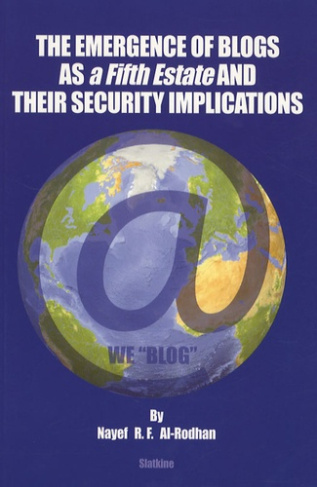
THE EMERGENCE OF BLOGS AS A FITH ESTATE AND THEIR SECURITY IMPLICATIONS
In the past ten years, the spread of the Internet and other advanced technologies has had a dramatic effect on the way people access and perceive information. One of the most revolutionary technological novelties that characterizes the modern "digital revolution" has been the explosion of weblogs. Blogs have impacted numerous facets of international politics including elections, media reporting from zones of conflict, and corporate and congressional policies. They also have potentially significant implications for policy making of the future and for national and global security. This has led to the claim that blogs deserve the title of the "fifth estate," following an analogy with the other four estates that influence modern policy shaping: executive, legislative, and judicial branches of the state and the media. This book methodically analyses the various facets of the modern blogosphere that led the author to support this claim and offers a number of recommendations to further the empowerment of blogs in the global policy arena.Sur commande en 4-6 joursCOMMANDER18,00 € -
THE ROLE OF EDUCATION IN GLOBAL SECURITY
Sustainable global security can only be achieved when education is made a priority by states and their institutions. When properly realized, education can be a global asset to fight poverty, inequality, insecurity, and disease. This book offers an innovative new philosophy in which cultural, religious, and ideological diversity in education throughout the world is encouraged and respected. The author advocates that whenever "the other" is discussed, maximum sensitivity, respect, and tolerance must be exercised by all to prevent any possible exclusion or alienation. The author also argues that there are all kinds of moral truths that see the world from different perspectives and none of them have to necessarily be more right than the other. This book provides an alternative approach to education and outlines the ingredients that any educational system must include in order to ensure a well-educated, tolerant, and peaceful world.Sur commande en 4-6 joursCOMMANDER18,00 € -

MULTILATERALISM AND TRANSNATIONAL SECURITY. A SYNTHESIS OF WIN-WIN SOLUTIONS
Sur commande en 4-6 joursCOMMANDER23,50 € -
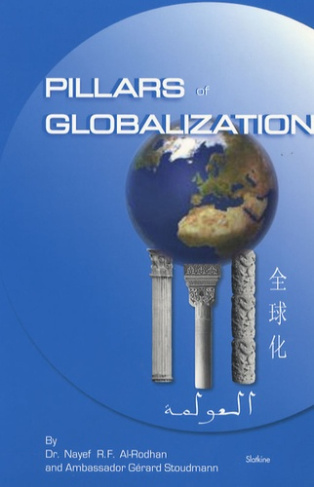
PILLARS OF GLOBALIZATION
Globalization as a process has been effecting human civilizations since the beginning of documented history. Where ibis process has brought us and where it is leading our policies, our security, and our future largely depends on the decisions that states take today. This publication also emphasizes chat for globalization to benefit humanity, the three major cultures of the world (Eastern cultures, Arab-Islamic cultures, and Western cultures), along with others, have to unite and uphold the world together (represented diagrammatically on the front caver) and not separately from one another. Three diagnostic tools provide the means for measuring the impact of globalization from a number of perspectives and outline what we can expect for the future of the international system. The proposed timeline of globalization is very comprehensive and provides unique historical insights that are not focused only on events in Western civilizations. The reader will be surprised at their relevance to today's world events and their depth. In defining globalization, the authors provide an innovative and inclusive yet simple new definition of globalization which states chat : "Globalization is a process that encompasses the causes, course, and consequences of transnational and transculturel integration of human and non-human activities". The authors also provide the basis for careful analysis and conceptualization through the use of an innovative globalization matrix designed to predict patterns and policy as States handle the effects of ibis process as well as matrices for security and stability. This book provides an evolutionary and encyclopaedic reference to this vital concept and should provide a cornerstone for any further study when assessing the impact of globalization on our historical, modem, and future world.Sur commande en 4-6 joursCOMMANDER19,00 €




Du même éditeur
-
-
-
BIBLE ET INFORMATIQUE : METHODES, OUTILS, RESULTATS. ACTES DU SECOND COLLOQUE INTERNATIONAL DE L'ASS
Sur commande en 4-6 joursCOMMANDER67,00 € -